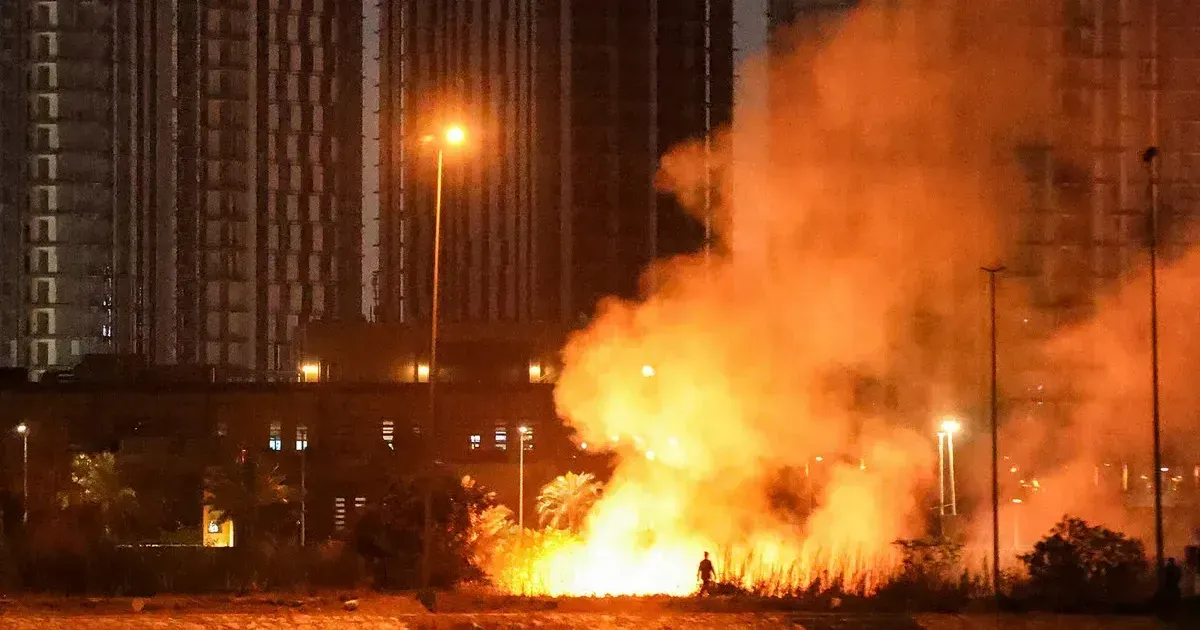
Tehran launched cluster munitions at civilian targets in Tel Aviv late Tuesday, marking a sharp departure from traditional missile exchanges. Iranian military officials confirmed the strike as a direct response to the death of Ali Larijani, a prominent security figure killed by Israeli forces earlier this month. The attack began shortly after 10:00 p.m. local time when air raid sirens sounded across central Israel.
Witnesses in the Israeli coastal city reported seeing multiple submunitions detonate over an apartment complex and a central train station. Emergency services are currently working to extract survivors from the rubble of a collapsed residential block. Richard Engel of NBC News reported that the use of cluster bombs suggests a more lethal intent than previous Iranian barrages. These weapons scatter dozens of smaller explosives over a wide area, often causing severe civilian casualties.
Cluster Bombs Strike Tel Aviv Residential Zones
Iranian commanders chose weapons specifically designed for maximum area saturation during the Tuesday night assault. Cluster munitions release a swarm of smaller bomblets that fall indiscriminately, a tactic that has drawn international criticism for its impact on non-combatants. One specific strike hit a crowded apartment building in the Herzliya district, causing a partial structural collapse that trapped dozens of families under concrete and steel.
But the damage extended beyond residential zones to critical infrastructure. Submunitions also rained down on a major train station, disrupting the transport network used by thousands of daily commuters. Local police cordoned off the area to manage unexploded ordnance, which creates a secondary threat to residents who may inadvertently handle the small, brightly colored bomblets. Separately, the Israeli Air Force scrambled jets to intercept the remaining salvos, though the sheer volume of submunitions overwhelmed localized defense systems. Military analysts note that while Iron Dome is effective against single-warhead rockets, the fragmented nature of cluster bombs presents a unique challenge for radar and interception strategy.
Iran unleashed deadly cluster bombs over Tel Aviv, hitting at least one apartment building as well as a train station.
And the psychological impact on the population has been immediate. Families spent the night in reinforced shelters, listening to the rhythmic sequence of multiple small explosions rather than the single thud of a standard rocket impact. Israeli officials stated that this escalation will receive a forceful response, though they have not detailed the nature of the upcoming counter-strike.
Security Crisis Spreads to U.S. Embassies in Middle East
Violence migrated beyond the borders of Israel as Iranian-aligned forces targeted American diplomatic missions across the region. The U.S. Embassy in Baghdad faced a direct assault on Tuesday, with mortars and drones targeting the highly fortified Green Zone. Staff members were ordered to move to secure bunkers while security teams engaged the incoming threats with land-based defense systems. Yet the threat was not isolated to Iraq. Intelligence reports confirmed that Iranian strikes previously targeted American embassies in Kuwait and Saudi Arabia, creating a coordinated pressure campaign against Western interests. This multi-front aggression forced the State Department to order an immediate security review for all diplomatic facilities in the Middle East.
Kuwait City and Riyadh both reported increased drone activity near American compounds throughout the evening. Local security forces in these nations have coordinated with U.S. Marines to strengthen perimeter defenses. In fact, the breadth of these attacks suggests that Tehran is no longer distinguishing between Israeli military targets and American diplomatic ones. Washington ordered embassy staff to limit movement and prepare for potential evacuation scenarios. Even so, the White House has maintained a cautious stance on direct military intervention against Iranian soil. Diplomatic channels remain frayed, as the coordinated nature of the embassy strikes indicates a high level of central planning within the Iranian Revolutionary Guard Corps. To that end, the Pentagon has moved additional naval assets into the Persian Gulf to deter further strikes on U.S. personnel.
Ali Larijani and the Origins of Iranian Retaliation
Larijani was the primary architect of the domestic crackdown on anti-government protesters in January, a role that earned him both local infamy and a high-ranking position within the security apparatus. His death earlier this month during an Israeli operation removed one of Tehran's most influential hardliners. Iranian leadership viewed his killing not just as a loss of personnel but as an affront to the state itself. For one, Larijani helped oversee the internal security forces that used lethal force to quell the winter uprisings. His strategic influence extended into Lebanon and Syria, where he managed proxy networks that have long pressured Israel's northern border. Iranian media outlets have spent the last week broadcasting eulogies and calls for vengeance, setting the stage for the cluster bomb attack on Tel Aviv.
Meanwhile, the internal politics of Iran pushed the regime toward a visible display of force. Hardline factions within the government demanded a retaliation that would match the severity of the loss of Larijani. By choosing cluster munitions, the regime communicated a willingness to inflict civilian pain in direct proportion to the perceived violation of their sovereign security. Larijani's career was defined by a ruthless adherence to the survival of the clerical establishment.
Still, the elimination of such a high-profile figure often creates a power vacuum that leads to erratic military decision-making. Analysts suggest the use of cluster bombs may be a result of this internal instability as various factions vie for control over the retaliation strategy. This environment makes future movements by the Iranian military difficult to predict with traditional intelligence models.
Why Cluster Munitions Change the War
The cluster-munition strike narrows the space for de-escalation because civilian harm changes the diplomatic math. Allies that might tolerate military retaliation face a harder choice when residential areas become part of the battlefield. Iran has chosen a weapon that punishes neighborhoods after the first explosion, leaving unexploded bomblets as a continuing threat to civilians.
This is not strategic deterrence; it is terror dressed up as retaliation. Tehran wanted a spectacle after Larijani’s death, and it found one by scattering risk across apartment blocks and transit routes. Any government that answers an assassination with cluster bombs over a city is admitting that it no longer distinguishes between military pressure and civilian punishment. That choice will harden Israel’s response and make every diplomatic off-ramp narrower.