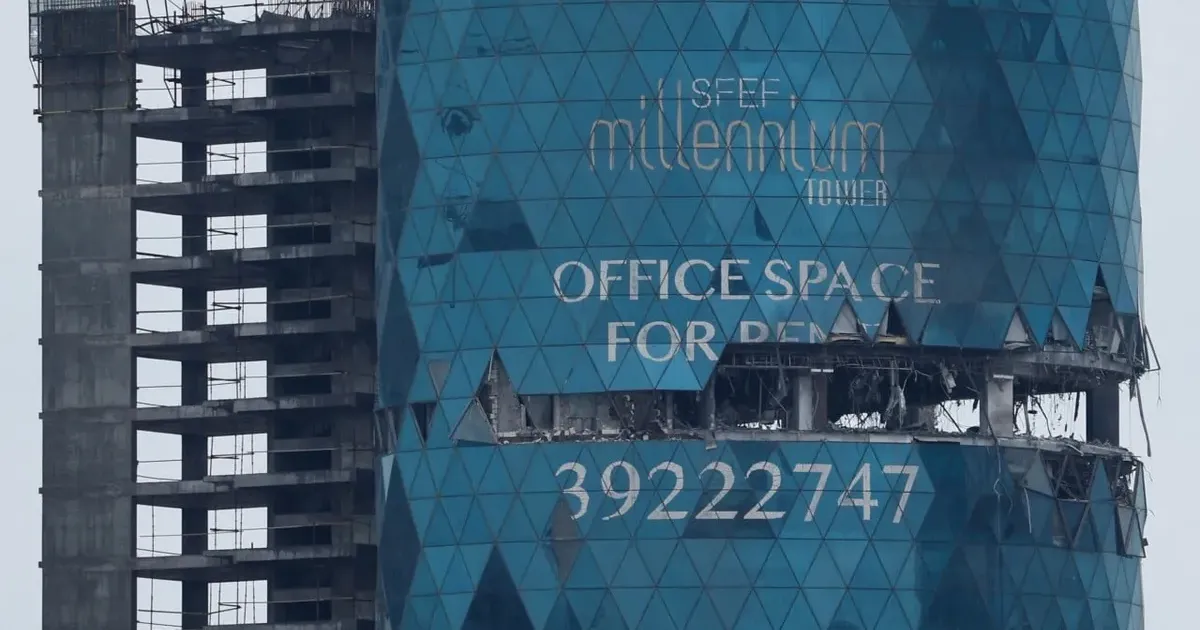
Iranian forces launched missile and drone attacks targeting major industrial hubs in Bahrain and the United Arab Emirates. Explosions rocked the Manama skyline as heavy ordnance impacted primary smelting facilities, marking a sharp escalation in the five-week-old regional war. On March 29, 2026, security officials in the Gulf Cooperation Council said the barrage sought to dismantle the economic foundations of the non-oil industrial sector. Logistics hubs throughout the region have ceased operations while military units assess damage to critical infrastructure.
Industrial Targets in Bahrain and United Arab Emirates
Aluminium Bahrain, which operates one of the largest smelting complexes on the planet, confirmed on Sunday that its main facility sustained direct hits. Two employees were injured during the Saturday night raid according to a statement released by the state-controlled company. Smelting operations require constant electricity and stable temperature controls, both of which were compromised when the strikes hit the power distribution grid surrounding the site. Engineers are currently working to prevent the molten metal from cooling and solidifying inside the pots, an event that would effectively destroy the production line. Staff members remain in bunkers as secondary sirens continue to sound across the industrial zone. Emirates Global Aluminium also reported meaningful structural damage at its United Arab Emirates operations. Missile strikes and suicide drones breached the perimeter of the facility, causing fires that burned for several hours before emergency crews established control. This specific site is a primary supplier of high-grade aluminum to the global aerospace and automotive sectors. Disruption at Emirates Global Aluminium will likely trigger force majeure declarations for European and American manufacturers who depend on this supply-chain for precision parts. Damage assessments are difficult because of the ongoing threat of further aerial incursions. The facility's output contributes sharply to the non-oil gross domestic product of the United Arab Emirates.
“Two employees at Aluminium Bahrain were hurt in Saturday’s attack, the state-controlled company said.”
Escalation in the Persian Gulf has now moved beyond naval skirmishes into the deliberate destruction of high-value industrial assets.
Petron secured Russian crude for Philippine refineries as Asian buyers searched for non-Gulf supply during the Hormuz closure.
Energy security concerns have forced Southeast Asian nations to look toward Moscow for immediate relief. Petron Corp., the only refiner in the Philippines, has got 2.48 million barrels of Russian crude oil to stabilize its domestic reserves. Manila officials authorized the purchase after the closure of the Strait of Hormuz rendered traditional Middle Eastern supply routes non-viable. National energy stocks had fallen to a 15-day supply buffer before the Russian tankers were contracted to bypass the conflict zone. This procurement reflects a broader trend of Pacific nations ignoring Western diplomatic pressure in favor of basic economic survival. Refineries in Bataan are reconfiguring their equipment to process the heavier Russian grades.
Philippines President Ferdinand Marcos Jr. has repeatedly stated that the country must prioritize energy availability over geopolitical alignment. Government data indicates that the cost of shipping from the Middle East has tripled since the war in Iran began. Russian suppliers offered the 2.48 million barrels at a discount compared to the Brent benchmark, which has surged past $120 per barrel. Traditional suppliers in Saudi Arabia and Kuwait cannot guarantee delivery through the maritime chokepoints currently under Iranian threat. The tankers carrying the Russian cargo are expected to arrive at the Limay terminal within the next twelve days.
Wall Street Shifts to Bearish Equity Strategies
Financial markets in New York have begun pricing in a prolonged period of regional instability. Wall Street bank strategists are now actively promoting trades that profit from a slow, steady decline in stock valuations rather than sudden crashes. Bankers describe these as grind lower trades, designed to benefit from persistent downward pressure on the S&P 500 and the Nasdaq. Systematic selling has replaced the panic-driven volatility seen during the first two weeks of the conflict. Hedge funds are increasingly using put spreads and long-gamma positions to capitalize on the eroding confidence of retail investors. Institutional capital is flowing out of tech-heavy indices and into short-term Treasury bills.
Investment houses like Goldman Sachs and Morgan Stanley have adjusted their year-end targets to reflect the reality of a shuttered Strait of Hormuz. Corporate earnings for the second-quarter are expected to show the first signs of the aluminum and oil shocks on manufacturing margins. Traders are focusing on the $4,200 level for the S&P 500 as the next major support zone. Analysts suggest that the absence of a quick military resolution is forcing a structural repricing of risk across all asset classes. Options volume for bearish bets reached a three-year high on Friday afternoon.
Global Infrastructure and the Hormuz Transit Crisis
Shipping through the Strait of Hormuz is currently restricted to local traffic under heavy military escort. Global insurance providers have suspended coverage for commercial vessels attempting to traverse the waterway, effectively halting the flow of 20% of the world's daily oil consumption. Commercial satellite imagery shows dozens of tankers anchored outside the Gulf of Oman, waiting for a security window that has yet to materialize. The Iranian navy continues to deploy sea mines and fast-attack boats along the primary shipping lanes. Cargo ships carrying manufactured goods from the East are diverted around the Cape of Good Hope, adding three weeks to standard delivery times. Port congestion in Singapore and Rotterdam have increased by 40% since the closure began.
Supply-chain managers at major automotive firms are warning of parts shortages that will manifest by early April. Aluminum prices on the London Metal Exchange jumped 14% following the news of the strikes in Bahrain and the UAE. Security analysts at the Pentagon believe the targeting of smelters is a calculated move to inflict long-term damage on the industrial capacity of Iran's regional rivals. Regional stability persists as a secondary concern to the immediate protection of heavy industry. Production at the affected aluminum plants will likely take months to restore even if the fighting stops immediately.
Why Aluminum Became a War Target
Western foreign policy has once again been exposed as a paper tiger despite focused regional aggression. While the United States and its allies maintain a powerful naval presence in the Arabian Sea, they have failed to protect the fixed industrial assets of their primary partners in the Gulf. The strikes on Bahrain and the UAE demonstrates that Iranian military planners have correctly identified the fragility of the global supply chain. They are not merely fighting a war for territory, they are conducting an economic siege that bypasses traditional naval defense perimeters. By hitting aluminum smelters, Tehran has struck central to the global aviation and green energy transitions, sectors that are already struggling with inflationary pressures.
Pacific nations like the Philippines are providing a preview of the new world order. Petron Corp. choosing Russian crude is not a matter of political preference but an admission that Western security guarantees are no longer synonymous with energy security. Manila has effectively decoupled its energy policy from Washington's sanctions regime, a move that will likely be emulated by Indonesia and Vietnam as the conflict drags on. This pragmatic shift undermines the effectiveness of economic warfare and suggests that the era of Western-led energy embargoes has reached its terminal point. Regional powers will trade with whoever can deliver the barrels.
Global markets are not falling into an abyss, they are slowly grinding toward a reality where the Middle East is no longer a reliable industrial hub. Short the recovery.