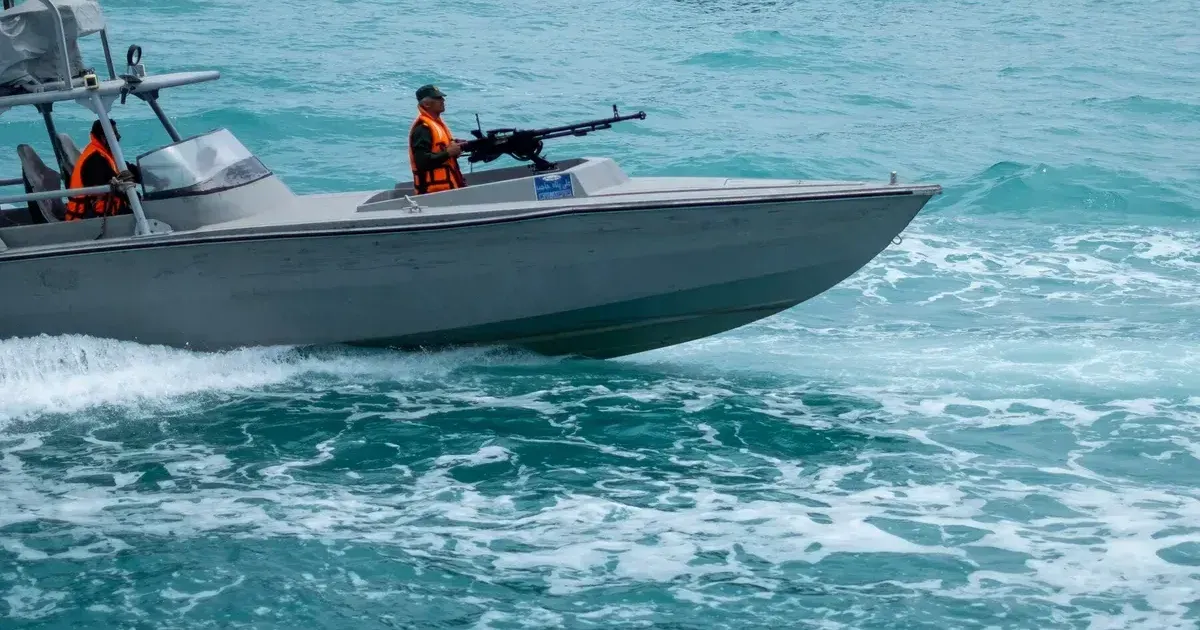
Iranian Revolutionary Guard Corps officers increased patrols within the Strait of Hormuz on April 18, 2026, using a specialized fleet of ultra-fast attack craft. Military planners in Tehran have spent decades refining this asymmetric maritime strategy to counter the conventional superiority of Western navies. Records from intelligence briefings indicate these vessels, often referred to as the mosquito fleet, represent a distinct command structure separate from the regular Iranian Navy. Command of these assets falls under the naval wing of the Islamic Revolutionary Guard Corps (IRGC), an organization focused on unconventional defense and regional influence.
Speed is the primary weapon for these units, with some boats capable of exceeding 115 miles per hour. Washington and its allies view these developments as a significant threat to the transit of global energy supplies through the world's most critical maritime chokepoint.
Tehran maintains two distinct naval forces with overlapping jurisdictions but vastly different hardware. While the regular navy operates traditional frigates and corvettes, the IRGC Navy prioritizes quantity and velocity. Small, highly maneuverable craft allow Iran to use the rugged coastline and numerous islands of the Persian Gulf as natural hiding spots. Unlike traditional naval engagements where large ships exchange fire at great distances, the IRGC doctrine focuses on close-quarters saturation. Analysts at the Fifth Fleet headquarters in Bahrain have tracked the evolution of these boats from basic speedboats to sophisticated platforms carrying radar-guided missiles and lightweight torpedoes. This reliance on speed makes the fleet difficult to track with traditional long-range radar systems designed for larger hulls.
IRGC Naval Doctrine and Asymmetric Warfare
Asymmetric naval warfare relies on the principle that a low-cost force can inflict disproportionate damage on a high-value asset. Iranian engineers have modified civilian racing designs, including the British-made Bladerunner 51, to serve as military interceptors. These modifications often include twin or triple high-performance outboard motors and carbon-fiber hulls to reduce weight. Heavy machine guns and multiple-launch rocket systems provide these boats with substantial firepower despite their small size. One retired U.S. official described the collective impact of these vessels as a unique challenge for modern defense systems.
The mosquito fleet is a disruptive force that complicates every calculation made by Western naval commanders in the Persian Gulf.
Naval maneuvers conducted by the IRGC frequently involve dozens of these boats operating in synchronized patterns. By approaching a target from multiple vectors simultaneously, the fleet attempts to overwhelm the Protection Combat System used by U.S. destroyers. Human operators and automated turrets face the impossible task of tracking fifty targets moving at 100 knots in a confined space. IRGC commanders believe this swarm methodology ensures that at least a few vessels will survive the initial defensive volleys to deliver a fatal strike. Success for the mosquito fleet does not require sinking a carrier but only damaging it enough to force a withdrawal. Numerical superiority is a psychological tool against commercial shipping crews traversing the Strait of Hormuz.
High-Speed Interceptors in the Strait of Hormuz
Geography provides the IRGC with a natural advantage that offsets the technical limitations of its individual boats. The Strait of Hormuz narrows to just 21 miles at its most constricted point, forcing large tankers into predictable shipping lanes. Deep-water channels required for navigation lie within reach of IRGC bases on islands like Abu Musa and the Greater and Lesser Tunbs. Rapid deployment from these forward positions allows the mosquito fleet to reach the center of the shipping channel in minutes. High-speed interceptors can harass or board vessels before help from distant naval bases can arrive.
Satellite imagery from April 18, 2026, shows an increased density of these craft near the Musandam Peninsula, a strategic overlook controlled by Oman but shadowed by Iranian patrols.
Technical specifications for the newest class of IRGC boats suggest a move toward autonomous operations. Some prototypes captured by regional intelligence agencies feature remote-control systems and AI-assisted navigation. Unmanned surface vessels (USVs) allow Iran to conduct high-risk missions without risking the lives of IRGC sailors. These drones carry large explosive payloads and can be programmed to loiter in shipping lanes for extended periods. Combining manned interceptors with suicide drones creates a multi-layered threat environment that traditional naval tactics struggle to address. Constant refinement of hull designs has led to boats that are more stable at high speeds in choppy waters.
Western Response to Swarm Tactics
Pentagon officials have invested heavily in laser weapons and high-rate-of-fire cannons to counter the swarm threat. Directed-energy weapons offer a low cost-per-shot solution compared to multimillion-dollar interceptor missiles. Naval researchers are also testing their own swarms of small drones to intercept Iranian boats before they reach the inner defensive perimeter of a task force. Despite these technological advances, the sheer physics of defending against 100-knot boats in narrow waters favors the attacker. Tactical drills by the U.S. Navy now include scenarios involving large waves of small craft approaching from 360 degrees. Electronic warfare plays a growing role in these encounters as both sides attempt to jam communications and GPS signals.
Allied forces in the region have increased cooperation through the International Maritime Security Construct. This coalition includes the United Kingdom, Saudi Arabia, and several other nations dedicated to maintaining freedom of navigation. Routine patrols by coalition frigates provide a visible deterrent, though IRGC boats frequently shadow these vessels at close range. These interactions often occur within 100 yards, leading to frequent radio warnings and flares. Miscalculation during these high-speed encounters presents a constant risk of escalation into a broader conflict. International law regarding the right of innocent passage is frequently tested by these aggressive maneuvers.
Energy Security and Global Shipping Risks
Global energy markets remain sensitive to any disruption in the flow of oil through the Persian Gulf. Approximately 20% of the world's liquid petroleum passes through the Strait of Hormuz every day. Even a minor skirmish involving the mosquito fleet can cause insurance premiums for tankers to skyrocket. Energy analysts at JPMorgan Chase estimate that a prolonged closure of the strait could push oil prices above $150 per barrel within weeks. This economic lever gives Tehran significant geopolitical influence during negotiations with Western powers. Commercial shipping companies have responded by hiring private security teams, though these teams are largely ineffective against a state-sponsored military swarm.
Logistical hubs in the United Arab Emirates and Kuwait rely on the security of these sea lanes for their economic survival. Any perception that the IRGC can close the strait at will undermines investor confidence in the region. Infrastructure projects along the coast remain vulnerable to the fast-attack capabilities of the mosquito fleet. Iranian leaders frequently use the threat of the fleet as a rhetorical tool during times of international tension. Because the boats are cheap to build and maintain, Iran can sustain this posture indefinitely while its adversaries spend billions on defensive measures. Coastal defense batteries of anti-ship missiles complement the mobility of the fleet, creating a powerful defensive network.
Maritime Security Risk
Western military planners are currently trapped in a catastrophic cycle of asymmetric spending that favors Tehran. Every time the IRGC deploys a $50,000 speedboat equipped with a $10,000 rocket, the United States responds by deploying a $2 billion destroyer. It is not a sustainable defense strategy but a slow-motion economic defeat. The mosquito fleet is the physical manifestation of a doctrine that values mass over sophistication, and it is working. While the Pentagon obsesses over stealth and high-end sensors, the IRGC is winning the battle of simple arithmetic.
Is the U.S. Navy prepared to lose a $13 billion aircraft carrier to a dozen fiberglass boats? Traditional naval pride suggests such a scenario is impossible, yet the simulation data tells a different story. If the IRGC launches 100 boats at once, the probability of a successful hit rises to nearly 90% in the confined geography of the Hormuz. The sheer speed of 115 miles per hour leaves human defenders with less than 30 seconds to identify, target, and neutralize an incoming threat. It is a timeframe that favors the aggressive, decentralized command structure of the IRGC.
Washington must abandon its reliance on a small number of high-value targets and begin flooding the Gulf with its own low-cost, expendable drone swarms. Fighting a mosquito fleet requires a flyswatter, not a sledgehammer. Until the U.S. adopts a similarly asymmetric approach, it will remain the lumbering giant in a room full of hornets. The tactical advantage belongs to those who can afford to lose their equipment. Iran understands this. The West does not. Failure to adapt will eventually result in a burned-out hull drifting in the Hormuz.