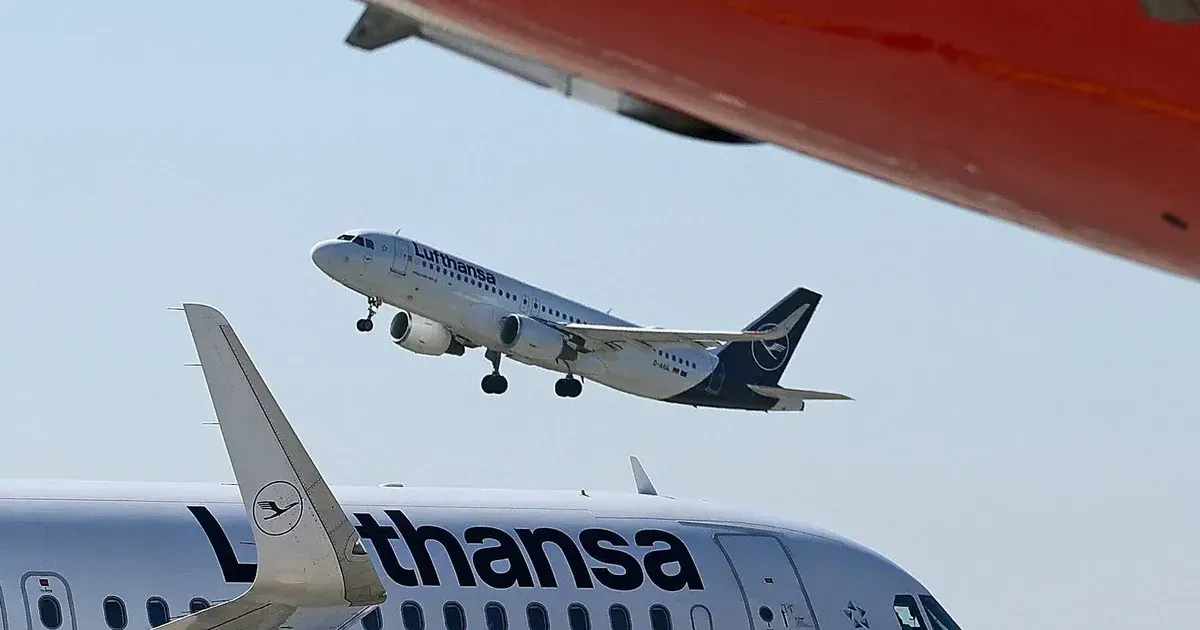
Lufthansa’s plan to cancel roughly 20,000 flights shows how the Iran war’s energy shock is spreading through aviation and the wider global economy. Lufthansa announced on April 22, 2026, that it will cancel approximately 20,000 flights across its global network to reduce the financial impact of soaring energy costs. Global jet fuel prices jumped more than 70 percent since the initiation of the regional conflict, creating an unsustainable overhead for carriers operating in Europe. These airlines consume the largest volume of jet fuel transported through the Strait of Hormuz, a critical maritime artery now facing serious disruption. Executives confirmed that reducing flight frequencies is a necessary measure to preserve liquidity while oil markets remain volatile.
Fuel shortages and logistical bottlenecks have turned once-profitable routes into liabilities for major European carriers. Carriers are now forced to bypass traditional flight paths to avoid the escalating combat zone, adding hours to transit times and increasing crew expenditures. This logistical pivot drains fuel reserves faster than supply chains can replenish them. Logistics managers at major hubs like Frankfurt and Paris report that cargo shipments are also facing delays as priority shifts to essential military and government transport. Profitability in the aviation sector has evaporated as the cost of Brent Crude fluctuates wildly with every new report from the front lines.
Lufthansa Grounded by Soaring Jet Fuel Costs
Surging operational costs have effectively paralyzed long-haul aviation strategies developed during the post-pandemic recovery. Lufthansa representatives stated that the 70 percent spike in fuel costs represents the single largest expense increase in the company's modern history. Managing such a rapid escalation requires sharp reductions in capacity to prevent a total collapse of the balance sheet. European carriers are particularly vulnerable because they lack the domestic fuel production capabilities found in the United States or the subsidized energy sectors of the Middle East. Analysts at several brokerage firms have downgraded the entire aviation sector to underweight.
Internal documents from the airline industry suggest that more cancellations may be necessary if the blockade of the Strait of Hormuz persists through the summer. Regional security experts warn that the maritime corridor is likely to stay contested for the foreseeable future, preventing the return of stabilized oil pricing. Refineries in the Mediterranean are already operating at reduced capacity due to a lack of feedstock. Aviation experts believe the current crisis will lead to a permanent restructuring of global air travel, with higher ticket prices becoming the new standard. Every canceled flight represents lost revenue that may never be recovered through future bookings.
Direct costs are only one part of the problem facing the transport industry. Insurance premiums for aircraft flying near the Middle East have tripled in the last six weeks, adding millions to the cost of maintaining standard schedules. Reinsurers are increasingly hesitant to cover hull losses or liability in what is now classified as an active war zone. Airlines that do not have extensive fuel hedging contracts in place are finding themselves unable to compete on price. Financial experts anticipate a wave of consolidation as smaller, less-capitalized regional carriers run out of cash reserves.
Turkish Central Bank Maintains Interest Rates
Turkey’s central bank held its benchmark interest rate steady on April 22, 2026, despite growing inflationary pressure caused by the regional conflict. Monetary policy officials signaled that they are monitoring the impact of the war on energy prices before committing to further tightening. Inflation expectations among Turkish consumers have risen sharply as the cost of imported goods climbs. Government data indicates that the current account deficit is widening as energy import costs balloon. Local businesses are struggling to manage price stability while the Lira remains under significant pressure in international currency markets.
Policy makers in Ankara are caught between the need to curb inflation and the desire to support domestic manufacturing. Higher interest rates could stifle growth in a country already dealing with the economic spillover of a nearby war. Most economists had predicted a rate hike, but the central bank opted for a more cautious approach to avoid triggering a recession. Rising costs for staples like food and fuel are hitting low-income households the hardest. Trade between Turkey and its neighbors has plummeted since the start of hostilities, further complicating the fiscal outlook.
External shocks are preventing the central bank from reaching its long-term stability goals. Energy dependency makes Turkey uniquely sensitive to the fluctuations in the Persian Gulf. Local manufacturers who rely on Iranian natural gas are reporting production slowdowns and increased overhead. Small business owners are delaying new investments until they see a clear path toward regional stabilization. The central bank has limited tools to fight cost-push inflation when the primary drivers are geopolitical rather than domestic. Investors are watching for any sign that the government might resort to unconventional monetary measures again.
Luxury Retail and Advertising Suffer Declines
Lower footfall in Middle East malls has begun to drag down the earnings of global luxury brands like LVMH. High-end shopping centers in Dubai and Doha, which usually attract affluent international tourists, are seeing a marked decline in traffic. Consumers in the region are pulling back on discretionary spending as uncertainty about the conflict grows. LVMH executives noted in recent filings that the Middle East retail sector has traditionally been a resilient foundation of their growth strategy. War has changed the psychological landscape for luxury buyers who now prioritize security over prestige purchases.
Advertising giants are also feeling the chill from the ongoing conflict. Publicis Groupe reported that several major clients have delayed large transformation projects and capital expenditure plans. CEO Arthur Sadoun noted that while brands are not cutting marketing budgets entirely, they are becoming much more selective about where they allocate funds. Uncertainty is the primary enemy of large-scale corporate investment. Many firms are choosing to wait for a clearer geopolitical signal before committing to multi-year contracts. Advertising spending in the Middle East has hit its lowest point in several years.
Economic activity in the retail sector is often a leading indicator for broader market health. When luxury brands report a slowdown, it frequently precedes a wider contraction in consumer spending. Middle Eastern consumers are shifting their focus toward essential goods and local alternatives. This shift has forced international brands to reconsider their expansion plans in the region. Real estate developers who focused on luxury retail space are seeing a spike in vacancy rates. Investors are now questioning whether the Middle East can maintain its status as a premier global shopping destination during prolonged instability.
Goldman Sachs Reports Strong Merger Activity
Wall Street remains largely decoupled from the immediate retail and transport woes affecting the real economy. Goldman Sachs reported a solid environment for investment banking activity during its first-quarter earnings call. CEO David Solomon highlighted that merger and acquisition activity continues to grow despite the geopolitical risks in the Middle East. He noted that corporate leaders are increasingly focused on the opportunities presented by artificial intelligence instead of the immediate fallout of the war. This divergence between financial services and physical commerce highlights a growing gap in how different sectors perceive risk.
While the picture emerging is what is going on geopolitically, leaders are focused on opportunities that artificial intelligence could bring, and that candidly outweigh some of the geopolitical risk, according to David Solomon, CEO of Goldman Sachs.
Institutional investors are continuing to pour capital into technology-driven deals while avoiding sectors sensitive to energy prices. M&A activity is particularly strong in the software and healthcare sectors, which are relatively insulated from fuel price volatility. Goldman Sachs maintains that the appetite for large-scale deals has not been dampened by the rising cost of capital in other parts of the world. Private equity firms are also active, looking for distressed assets in industries hit hardest by the war. Financial markets appear to be betting on a localized conflict that will not lead to a global depression.
Capital flows suggest that the tech sector is viewed as a safe haven during periods of regional war. Investors are betting that AI and automation will provide the productivity gains needed to offset higher energy costs. The optimism has kept equity markets afloat even as the aviation and retail sectors struggle. However, some analysts warn that a prolonged energy crisis will eventually drag down even the most resilient tech companies. If consumer spending continues to fall, the demand for tech services will inevitably follow. For now, the investment banking world is operating under the assumption that growth will continue unabated.
Flight Cuts Expose the Limits of Market Optimism
Wall Street’s persistent attempt to decouple geopolitical carnage from corporate spreadsheets is not a sign of resilience, but of deep cognitive dissonance. David Solomon’s assertion that AI prospects can simply outweigh the destabilization of the world’s most critical energy artery is a fantasy designed to keep shareholders from fleeing. While M&A bankers may find profit in the churning of assets, the physical reality of a 70 percent jump in jet fuel costs cannot be solved by a large language model. The aviation industry is the circulatory system of global commerce, and Lufthansa’s huge flight cuts are the first symptoms of a coming systemic stroke.
History suggests that energy shocks always win against financial sentiment. If the Strait of Hormuz remains a kinetic battleground, the resulting inflation will eventually crush the discretionary spending that fuels the very tech giants the market currently worships. Turkey’s decision to hold rates is a desperate gamble that the war will be short-lived, a hope that lacks any grounding in current military intelligence. We are moving toward a bifurcated global economy where the wealthy trade virtual assets while the real world stalls for lack of affordable fuel. Is a steady M&A market relevant when the planes aren’t flying? The answer is a decisive no.