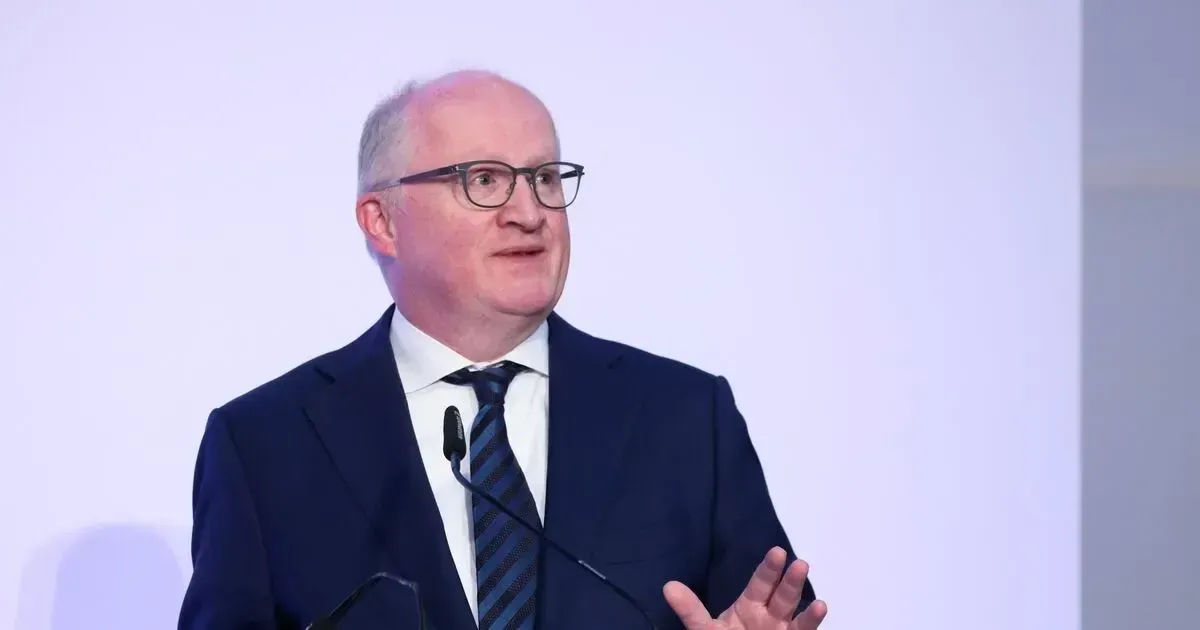
The Iran war’s energy and shipping shock has already cut Germany’s growth forecast in half while leaving the European Central Bank unable to measure the full damage. Philip Lane told observers on April 22, 2026, that the European Central Bank cannot yet quantify the economic devastation resulting from the war in Iran. Lane, who is the ECB’s chief economist, noted that the shockwaves from the conflict are still rippling through the 20-nation currency bloc. Central bankers in Frankfurt are struggling to reconcile traditional inflation models with the chaotic reality of shuttered shipping lanes and soaring fuel costs. Regional instability has already forced the German government to slash its 2026 economic growth projections in half.
“It’s still unclear how big a blow the Iran war will inflict on the euro-area economy,” Philip Lane said.
Lane spoke during a briefing where he emphasized the high level of uncertainty surrounding industrial output and consumer spending. Markets responded with volatility as the realization set in that European monetary policy might be paralyzed by these geopolitical events. Evidence suggests that the initial projections of a short-lived conflict were overly optimistic. Policymakers now face the prospect of a prolonged downturn that defies conventional central bank interventions.
German Industrial Engine Stalls on High Costs
Germany lowered its growth forecasts for the current year by 50 percent after energy prices surged for both industrial giants and private households. Berlin officials admitted that the US military engagement in Iran has effectively upended the nation's energy security strategy. Manufacturers across the Rhine Valley report that electricity and gas costs have reached levels that make global competition nearly impossible. Energy-intensive sectors like chemical production and steel manufacturing are bearing the brunt of this sudden price escalation.
Robert Habeck, the German economy minister, indicated that the government is preparing emergency subsidies to prevent a wave of industrial bankruptcies. These measures aim to stabilize a workforce that is increasingly anxious about job security and rising heating bills. Small and medium-sized enterprises, often called the Mittelstand, have reported a sharp decline in new orders as domestic demand withers. Industrialists warn that if energy prices do not stabilize, the core of German manufacturing could permanently migrate to regions with cheaper power.
Business confidence in Munich and Hamburg has plummeted to levels not seen since the global financial crisis. Economists at leading research institutes are now debating whether Germany will enter a formal recession before the end of the second quarter. Higher costs for raw materials, combined with the energy spike, have created a double squeeze on profit margins. Factory output has already contracted for three consecutive months.
Aviation Industry Struggles With Fuel Shortages
Lufthansa announced the cancellation of 20,000 flights as a direct consequence of the deepening jet fuel crisis in Europe. Shortages became acute shortly after the Iranian military restricted access to key refining regions and shipping hubs. Aviation experts warn that this large reduction in flight capacity is only the beginning of a broader contraction in the travel sector. Passengers are facing record-high ticket prices as airlines pass on the increased cost of kerosene to travelers. Similar volatility is impacting other euro-area nations, as evidenced by the Bank of Italy’s downward revision of its growth targets.
Fuel inventories at major hubs like London Heathrow and Paris Charles de Gaulle have reached critically low levels. Logistics companies are prioritizing military and essential medical transport, leaving commercial airlines to fight for the remaining supplies. Industry analysts predict that other major carriers will follow the example of the German flagship airline in the coming weeks. The impact on the summer tourism season across the Mediterranean could be catastrophic for economies like Spain and Greece.
Lufthansa executives described the current situation as an operational nightmare that requires a radical scaling back of their global network. Maintenance crews and ground staff are being placed on reduced hours as terminals sit empty. Beyond the immediate loss of revenue, the aviation industry faces long-term structural damage to its recovery plans. Frequent flyers are already shifting their habits toward rail travel or video conferencing.
Strait of Hormuz Blockade Chokes Energy Supplies
The closure of the Strait of Hormuz has effectively cut off a primary artery for global oil and gas shipments. Tankers carrying millions of barrels of crude are currently anchored in the Arabian Sea, unable to navigate the minefields and missile zones. Insurance premiums for maritime freight have skyrocketed, making even the redirected routes around the Cape of Good Hope prohibitively expensive. This maritime choke point remains the most critical vulnerability in the global energy supply chain.
Refineries in Rotterdam and Genoa are operating at reduced capacity because they cannot secure enough feedstock to maintain full production. Crude oil prices have stayed stubbornly high, reflecting the market's fear that the blockade could last for months. Strategic petroleum reserves are being tapped by several European nations, yet these stocks provide only a temporary buffer. Every day that the strait remains closed adds millions of dollars in costs to the global economy.
Logistics experts note that the redirection of shipping traffic has caused a major bottleneck at alternative ports. Supply chains for automotive parts and electronics are fracturing as containers are delayed by weeks. Port authorities in the United States and Europe are attempting to coordinate a response, but the sheer volume of disrupted trade is overwhelming. Global trade growth is expected to stall if the naval standoff continues through the summer.
Central Bankers Weigh Uncertainty in Euro Area
Philip Lane cautioned that the ECB cannot determine the full extent of the war shock while the conflict is active. Monetary policy committees are caught between the need to curb energy-driven inflation and the desire to support a flagging economy. Raising interest rates now could worsen the industrial slowdown, while lowering them might let inflation run out of control. This dilemma is complicated by the fact that the source of the inflation is geopolitical rather than domestic.
Investors are closely watching the bond markets for signs of sovereign stress in the more indebted members of the euro area. Yields on Italian and Spanish debt have begun to climb as traders demand a higher risk premium. Lane suggested that the central bank is prepared to use all available tools to maintain stability, but the efficacy of those tools is in question. Historical data provides little guidance for a scenario involving a major regional war in the Middle East.
Market participants expect the ECB to maintain its current stance until more concrete data on second-quarter GDP becomes available. Inflationary pressures are spreading from energy to food and services, creating a broad-based cost of living crisis. The euro has weakened against the dollar, further increasing the cost of imported energy and goods. Financial stability depends on a swift resolution to the hostilities, a prospect that seems increasingly unlikely.
Iran Shock Exposes Europe’s Economic Vulnerability
Europe stands naked before the consequences of its own geopolitical impotence. For decades, the continent offshored its security to Washington and its energy needs to volatile regimes. This systemic failure has finally reached a breaking point. While bureaucrats in Frankfurt debate the extent of the shock, the actual industrial base of Germany is evaporating in real time. Can a continent survive without affordable fuel? Berlin remains paralyzed, offering half-hearted growth revisions that still feel optimistic. They ignore the reality that the Strait of Hormuz is not just a shipping lane but the jugular of the global economy. By allowing a conflict of this magnitude to erupt, the West has effectively sanctioned its own demise. The era of cheap logistics and stable manufacturing has ended. European leaders must now decide if they will remain vassals of American foreign policy or prioritize the survival of their own middle class. The German growth forecast is just a number until it becomes a social reality of unemployment and civil unrest. The Lufthansa cancellations are not a temporary glitch; they are the first signs of a retreating civilization. Strategic autonomy is no longer a luxury. It is a matter of survival.