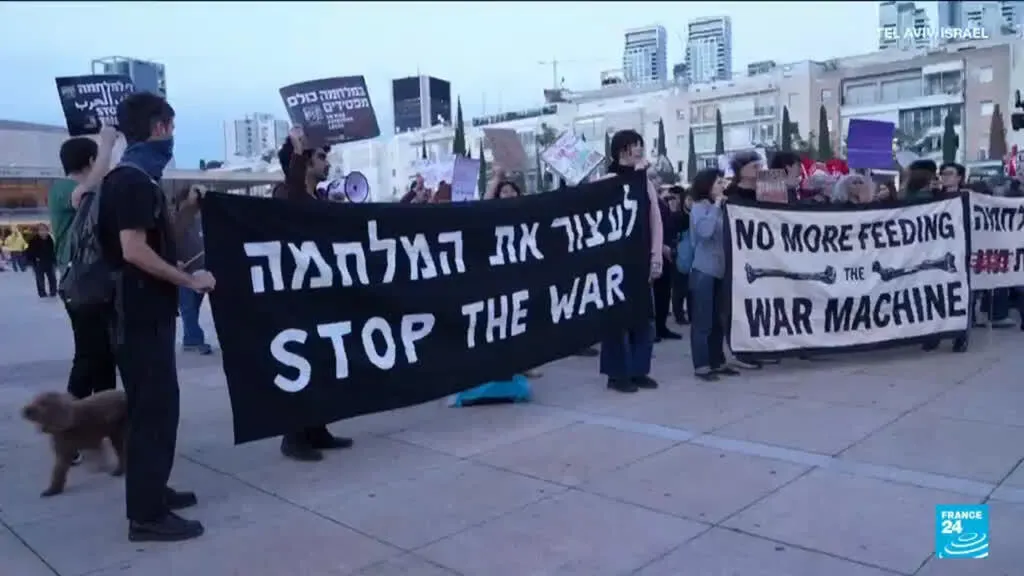
Israeli police arrested at least 18 people during anti-war protests on March 28, 2026, as opposition to the U.S.-Israeli war on Iran became more visible inside Israel. The clearest flashpoint was Habima Square in central Tel Aviv, where officers dispersed protesters and said some participants disrupted public order.
The count itself reflected the confusion of a tense night. Police and several reports put the number at at least 18, including 13 in Tel Aviv and arrests in Haifa. Other Israeli reporting later counted 21 arrests across Tel Aviv and Haifa. The precise figure is important, but the larger point is that anti-war protest had moved from the margins into a policing and civil-liberties problem for the government.
Habima Square Became The Test Site
Habima Square carried symbolic weight because it is a familiar civic stage in Tel Aviv. Hundreds gathered there against the Iran war, while protests also took place in Haifa, Jerusalem and Beersheba. The demonstrations were not yet comparable in size to Israel's largest domestic protest waves, but they were no longer invisible.
Police described parts of the Tel Aviv rally as a public-order problem. Protesters saw the same confrontation as wartime dissent being pushed off the street. That gap between the state view and the protest view is where the story sits. One side saw unauthorized disruption under security strain. The other saw a government narrowing speech while fighting abroad.
War Makes Assembly Easier To Restrict
The legal and security context made the confrontation more acute. Missile threats, Home Front Command limits, reservist mobilization and emergency policing all give authorities more language for restricting gatherings. A blocked square can be framed as more than traffic disruption when the country is under wartime alert.
But emergency conditions also create the risk of overreach. If police treat anti-war speech as a security nuisance by default, they can turn a relatively small protest into a broader democratic issue. The question is not whether wartime rules exist. The question is whether those rules remain narrow, reviewable and applied without making dissent itself suspect.
The Protest Coalition Was Starting To Widen
Reports from the night noted that anti-government protest groups were beginning to participate more openly in anti-war demonstrations. The widening coalition was important because the early protests against the Iran campaign had started small. Once more established protest networks enter the frame, the government faces a different kind of pressure.
Not every Israeli opposing the government opposes the war in the same way. Some object to the strategy, some to the duration, some to domestic legislation continuing during the conflict and some to police limits on protest. That mix can be messy, but it also makes the movement more difficult to dismiss as one narrow faction.
War Fatigue Became A Domestic Cost
The arrests showed that the campaign against Iran was not only an external security project. Reservist call-ups, business uncertainty, closed streets, missile alerts and fear of escalation all make war visible in civilian life. The longer those pressures continue, the more the government has to justify the war at home as well as abroad.
Supporters of the campaign argue that Iranian capabilities and regional proxies leave Israel with little room to soften pressure. Protesters answer that the government has not shown a credible path to de-escalation. Between those positions sits the political difficulty of a long war: security necessity and strategic drift can begin to look uncomfortably similar.
The Arrests Were A Warning, Not A Collapse
The arrests did not prove the government was losing control, and they did not prove a healthy protest system either. They showed that the war had entered Israel's domestic nervous system. A government can survive demonstrations while still being weakened by the questions those demonstrations keep alive.
If the Iran campaign produces no clear end state, every Saturday rally becomes less about one square in Tel Aviv and more about whether the public still believes the war has a finish line. Police can clear a plaza. They cannot clear the strategic question underneath it.