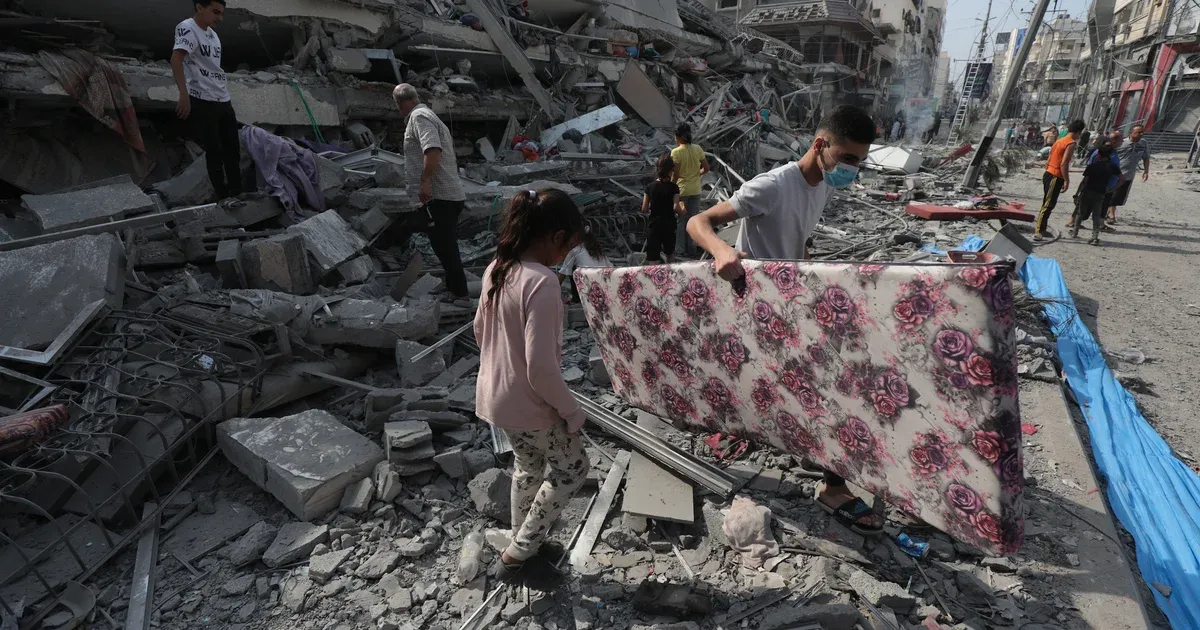
Israeli strikes hit crowds in Gaza City as the regional offensive widened across several fronts. Witnesses described chaos in northern districts while hospitals struggled to absorb new trauma cases. The Gaza City attack unfolded on April 5, 2026, as Israeli operations also intersected with violence involving Lebanon and Iran-linked activity. The civilian toll placed renewed pressure on military officials to explain the objectives and limits of the campaign.
Military operations in the Gaza Strip continued throughout the day despite simultaneous Israeli strikes occurring in Iran and Lebanon. Reports from the ground confirmed that at least four people died in separate Sunday attacks. Israel has maintained its bombardment of Palestinian territories while widening its scope to include regional rivals. This tactical choice forces medical workers in Gaza to operate under the shadow of a much larger geopolitical struggle involving the United States. Civilian casualties continue to mount in the shadow of these broader military objectives. Records from local health officials indicate that the death toll in Gaza City has reached its highest daily level in three weeks.
Israeli Air Strikes Hit Gaza City Crowds
Blood stained the pavement near the strike site where a crowd had gathered to seek dwindling food supplies. Medical personnel at the scene described the injuries as catastrophic, involving multiple limb losses and shrapnel wounds. One ambulance driver noted that the intensity of the fire made it impossible to reach the victims for nearly twenty minutes. Conflict in the urban core has rendered entire blocks inaccessible to humanitarian aid. Families have been forced to shelter in the ruins of former government buildings. These structures provide little protection from the precision munitions used in the current campaign.
The humanitarian situation in Gaza has reached a point of total collapse as the regional war expands to include multiple nations and territories.
Casualty counts from the Sunday strikes reflect a pattern of persistent engagement in densely populated areas. Israeli officials stated that the targets were operative command centers embedded within civilian infrastructure. Evidence of this claim is often difficult to verify given the restricted movement of international observers. Gaza City remains the focal point of the northern offensive. Military planners in Tel Aviv appear committed to a strategy of total denial of resources to insurgent groups. This approach has left the civilian population caught between active combat zones and the inability to evacuate safely.
Regional Expansion Into Iran and Lebanon
Across the northern border, Israeli jets targeted Hezbollah positions in southern Lebanon while long-range missiles struck facilities inside Iran. Simultaneous operations on such a scale require immense logistical coordination and sustained munitions supplies. Washington has provided meaningful support, though the domestic political cost in the United States continues to rise. Iranian state media claimed that their air defense systems intercepted several incoming projectiles over Isfahan. Israel did not provide specific details regarding the success of the long-range strikes. Military analysts suggest that the strikes were intended to degrade Iranian drone production capabilities. The attacks in Lebanon extended the same regional escalation to Beirut.
Intelligence officials in the region believe these strikes are part of a pre-emptive doctrine designed to reset the balance of power. Lebanon has seen a huge displacement of its southern population as the violence intensifies. Villages along the Blue Line are now largely deserted. Israeli artillery batteries have established a continuous presence along the border. These units provide cover for ground incursions that have become more frequent in recent days. Success on the northern front is viewed by the Israeli high command as essential for the security of their northern settlements.
Gaza Humanitarian Crisis Intensifies
Hunger has become as lethal as the air strikes for many residents of the southern and northern districts. United Nations agencies reported that aid deliveries have dropped by forty percent since the start of the April offensive. Fuel shortages have shut down the last remaining water desalination plants. Palestinians must now rely on contaminated wells for drinking water. Disease is spreading through the overcrowded tent cities in Rafah and Deir al-Balah. Medical teams have identified hundreds of cases of hepatitis A among children. Supplies of essential medications are virtually exhausted in most field hospitals.
International aid organizations have called for an immediate ceasefire to allow for an enormous influx of food and medicine. Israeli authorities maintain that they are enabling aid, yet the bureaucracy of inspections creates serious delays. Trucks often wait for days at the Kerem Shalom crossing. Once inside, they face the risk of being caught in the crossfire of active combat. Logistics experts point out that the destruction of the road network has made traditional delivery methods nearly impossible. Drones have been tested for small-scale medical drops, but they cannot meet the caloric needs of two million people.
The central question is whether stated military objectives can be separated from civilian casualties when strikes hit crowded urban spaces already under humanitarian pressure.
Sunday's strikes resulted in at least four deaths and dozens of injuries across the enclave. Israeli defense sources emphasized that every strike undergoes a rigorous vetting process to minimize collateral damage. The reality on the ground often contradicts these internal assessments. Gaza City residents describe a life defined by the constant hum of surveillance aircraft. No location in the strip is considered safe by the people living there. Military operations are expected to continue until specific high-value targets are neutralized. This timeline remains uncertain as the conflict enters its newest and most volatile phase.
Violence in the Middle East has entered a cycle that shows no sign of abating. Each strike in Gaza is now closely linked to the exchange of fire between Israel and its regional adversaries. The interconnected nature of these conflicts means that a resolution in one area is unlikely without a broader regional settlement. For the families in Gaza City, the geopolitical implications are secondary to the immediate need for survival. They continue to search for missing relatives in the rubble of the Sunday strike. Rescue efforts are ongoing despite the risk of follow-up attacks.
Civilian Casualty Pressure
National security doctrine in Tel Aviv has shifted toward a permanent state of high-intensity regional friction. Israel is currently wagering its long-term stability on the assumption that total air superiority can compensate for the absence of a political endgame. History suggests that such ambitions often lead to exhaustion. Washington provides the necessary munitions, yet the American public shows increasing fatigue with a conflict that now includes direct strikes on Iranian soil. Strategic overreach has destroyed empires in the past. By choosing to strike Iran, Lebanon, and Gaza simultaneously, the Israeli government has abandoned containment. They have embraced a zero-sum regional restructuring instead.
Such a move guarantees that even a tactical success will result in decades of insurgent blowback. Security is not found at the end of a missile. It is a house built on stable borders. Victory is an illusion.