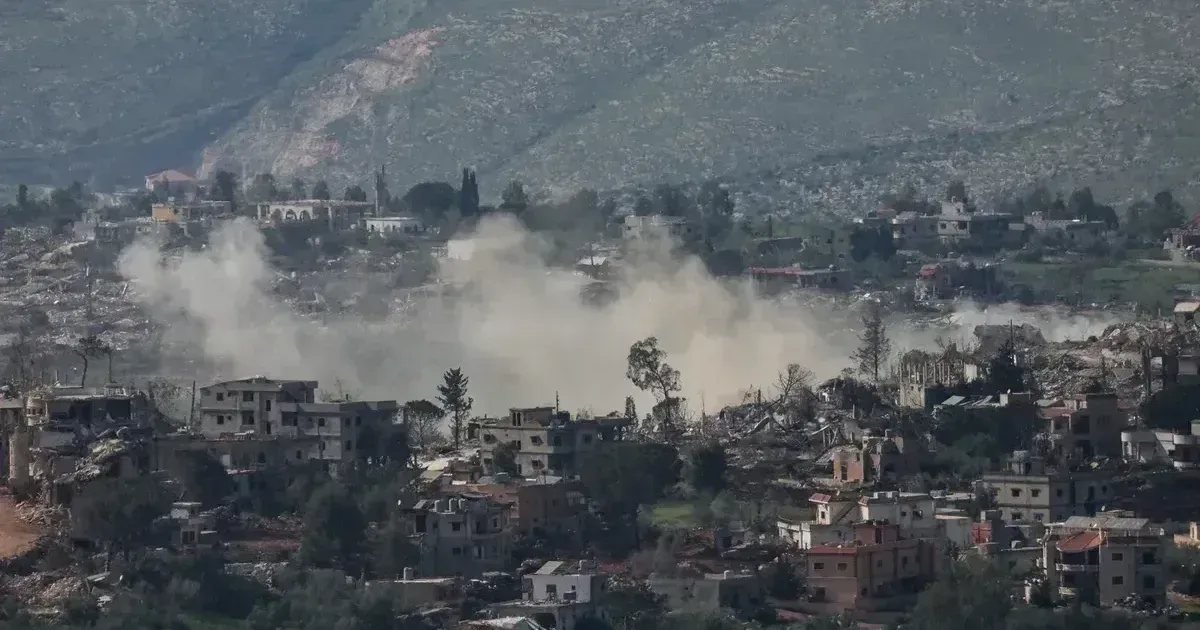
Israeli military operations intensified across Lebanon on Sunday as new waves of airstrikes targeted multiple regions. Authorities in Beirut reported a sharp surge in casualties following the latest round of aerial bombardment. This escalation comes exactly one month after a fragile ceasefire agreement was meant to end the hostilities between Israel and Hezbollah. Documentation from May 10, 2026, indicates that 39 fatalities were recorded across the country within a 24-hour period. The ceasefire language now has to compete with casualty counts, air defense claims and the political pressure on Hezbollah to respond.
Security officials in Lebanon confirmed that the strikes hit both rural outposts and urban centers. The violence persisted throughout the morning, resulting in a death toll that surpassed the average daily count since the truce began in April. Rescue teams struggled to reach certain areas where infrastructure damage hampered emergency vehicles. Many survivors were transported to hospitals in Sidon and Tyre, which are already operating at capacity.
Death Toll in Lebanon Rises
Fatalities mounted quickly as the Israeli Air Force expanded its list of targets. Reports from BBC World indicate that 39 people died in various strikes, marking one of the deadliest days for the region in recent weeks. Another cluster of 13 deaths was reported in separate incidents by local medical personnel. These numbers include civilians caught in the crossfire as projectiles struck residential buildings and agricultural zones.
Military leaders in Tel Aviv maintained that the strikes were a response to repeated violations by opposing forces. They claimed that Hezbollah had continued to move hardware into restricted zones, violating the terms of the April agreement. This defensive posture remains the primary justification for the ongoing sorties. Lebanese officials, however, described the attacks as unprovoked aggression that threatens to dissolve the little progress made by international mediators.
Reporting from the region indicates that Israel and Hezbollah have continued to exchange fire despite the ceasefire announced last month, underscoring how little practical restraint the agreement has produced on the ground.
Efforts to stabilize the border have largely failed to prevent the exchange of projectiles. Both sides continue to report incoming fire, creating a cycle of retaliation that diplomats have been unable to break. The volume of munitions used on Sunday suggests a departure from the lower-intensity exchanges that defined the previous three weeks.
Drone Strikes Near Beirut
Tensions spiked sharply when three drone strikes hit targets south of Beirut. These specific attacks resulted in four fatalities and caused widespread panic in the capital. The proximity of the strikes to the metropolitan area is a change from recent weeks, when most activity was confined to the southern border. Residents in the southern suburbs reported hearing the distinct sound of unmanned aerial vehicles hovering for hours before the detonations occurred.
Targeting the outskirts of the capital is often seen as a message to the Lebanese political leadership. Analysts note that striking near Beirut forces the central government to take a firmer stance on the presence of militant groups. Hezbollah personnel were reportedly active in the area, though the identities of all those killed in the drone strikes have not been fully confirmed. Local media outlets showed footage of scorched vehicles and damaged storefronts after the blasts.
One drone allegedly targeted a vehicle on a major highway, leading to a large fire and a temporary closure of the route. The maneuver effectively cut off a primary artery for civilian transit and logistics. The precision of the strike suggested a high degree of intelligence regarding the cargo or passengers within the vehicle.
Hezbollah Fire and Ceasefire Stability
Militant groups in Lebanon have not remained passive during the bombardment. Hezbollah militants launched their own series of rockets into northern Israel, triggering air raid sirens in several border towns. These launches provided the immediate pretext for the subsequent waves of Israeli airstrikes. Israel has stated that it will not tolerate continued rocket fire from its northern neighbor, regardless of the status of the ceasefire.
Diplomatic channels remain open but appear increasingly ineffective. Representatives from the United States and France have attempted to mediate between the parties to restore the truce. Those efforts are hampered by the lack of a neutral monitoring mechanism on the ground to verify who fires first. Without clear oversight, both belligerents blame the other for initiating the day’s violence.
The ceasefire is now a document without enforcement. Neither side has officially withdrawn from the agreement, yet the daily reality on the ground bears no resemblance to a cessation of hostilities. Military analysts suggest that both groups are testing the limits of the international community's patience. Hezbollah continues to fortify its positions while the Israeli military conducts what it calls preemptive operations.
The Ceasefire Is Losing Both Enforcement and Credibility
The collapse of the April 2026 ceasefire would mean more than a return to localized skirmishes. The breakdown risks pulling neighboring powers deeper into a confrontation that could destabilize a wider stretch of the eastern Mediterranean. When a truce fails to survive its first month, the credibility of international mediators suffers a blow that makes future agreements far more difficult to achieve. Parties involved are no longer looking for an exit strategy but are instead preparing for a protracted war of attrition.
Military logic has overtaken diplomatic reasoning in the decision-making centers of both Beirut and Tel Aviv. Every rocket launch and drone strike serves to harden public opinion, leaving little room for political compromise. If the current trend of targeting near the capital continues, the Lebanese government may find itself unable to contain the domestic pressure for a full-scale mobilization. The window for a peaceful resolution is closing as the tactical successes of each side embolden those who believe a military solution is the only viable path forward. The risk of a broader conflict is rising.