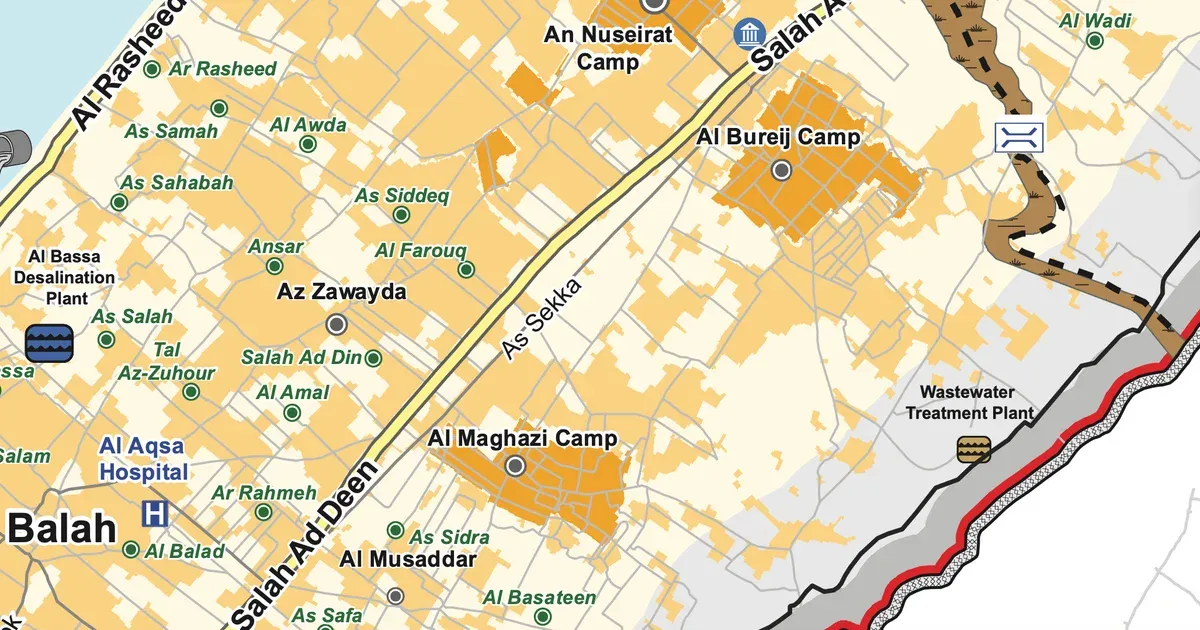
A reported drone strike near Maghazi refugee camp added another civilian toll to the Gaza war. Local medical officials said 10 Palestinians were killed while moving near an area linked to aid distribution and militia activity.
The account emerged as humanitarian groups warned that hunger, displacement and insecurity were converging around the same routes. On April 7, 2026, Israel had not publicly accepted every detail of the local claims, and independent verification remained difficult inside Gaza.
Security Clashes Precede Maghazi Aerial Bombardment
Dynamics within the central Gaza Strip have fractured as various factions compete for control over distribution routes and neighborhood security. The Israel Defense Forces (IDF) has increasingly used precision drone strikes to intervene during internal disputes when their allied local militias face immediate pressure from Hamas militants. On the morning of the attack, the militia group engaged in a firefight to maintain control over a logistical hub near the refugee camp. Hamas mobilized additional forces to the area, leading to the deployment of Israeli surveillance and strike aircraft. The escalation is a broadening of the kinetic engagement zones within densely populated civilian areas.
Reports from Maghazi suggest that the school mentioned in the strike was not the primary target, yet its proximity to the fighting ensured a high casualty rate. Aerial footage and social media accounts showed plumes of black smoke rising above the central district shortly after the missiles hit. Medics from the Palestinian Red Crescent Society navigated through narrow alleyways to reach the wounded, as the threat of secondary strikes delayed some evacuation efforts. Casualties include several individuals who were not involved in the preceding ground combat, emphasizing the high risk of collateral damage in urban drone warfare.
Militia Rivalries Erupt Near Gaza School
Internal friction between established security forces and newly formed local militias has become a defining feature of the conflict in early 2026. These militias often receive logistical support or tacit approval from Israeli authorities to challenge the administrative grip of Hamas on the local population. When these groups face tactical setbacks, the Israel Air Force frequently provides close air support to prevent their total collapse. This specific incident near the school appears to be a direct result of such a dynamic. Local residents told investigative journalists that the militia had been establishing checkpoints in the weeks leading up to the violence. Hamas perceived these checkpoints as a direct threat to its remaining urban influence.
Reports said Israeli strikes targeted Hamas security personnel after they clashed with an Israeli-backed militia near Maghazi camp.
Death Toll Mounts in Central Gaza Strike
Reporting by Al Jazeera and BBC World provided differing perspectives on the exact nature of the targets, with some outlets emphasizing the civilian proximity while others focused on the military objective. While Bloomberg suggests the strikes were part of a broader push to degrade Hamas infrastructure, Reuters' sources claim the intervention was purely reactive to protect the proxy militia. The lack of a clear frontline in central Gaza means that schools and hospitals often sit at the center of active combat zones. At the Maghazi school, classrooms had been repurposed into living quarters for thousands of families. The blast blew out windows and collapsed a portion of the outer wall, sending debris into the courtyard where children were playing.
Surrounding the strike zone, the infrastructure of the refugee camp showed signs of severe decay from previous months of sustained conflict. Water lines and electrical conduits were severed during the April 7, 2026, operation, further complicating the humanitarian response. The Palestinian Ministry of Health released a statement confirming that the majority of the deceased were men in their twenties and thirties, though several elderly residents were also among the victims. This demographic split reflects both the combatant presence and the incidental presence of civilians in the market areas near the school. No official confirmation has been provided regarding the survival of the specific militia leaders involved in the initial skirmish.
Evidence from the site shows the use of small-diameter munitions designed for surgical strikes, though the dense population of Maghazi often nullifies the precision of these weapons. Metal fragments recovered from the debris are consistent with the hardware used by Israeli drone platforms operating in the region. Witnesses described hearing the distinct buzz of unmanned aerial vehicles for hours before the missiles were fired. The intensity of the localized ground fighting had drawn an extensive crowd of curious onlookers and concerned relatives, many of whom were caught in the blast radius of the subsequent airstrike. Medical data confirms that at least 10 people were pronounced dead on arrival at the hospital.
Regional powers have monitored the rise of these local militias with mounting concern over the long-term stability of the Gaza Strip. Egyptian officials previously warned that the proliferation of armed proxies would lead to a state of perpetual civil unrest. The incident at Maghazi confirms these fears, as the vacuum left by crumbling central authority is filled by competing armed bands. Israel maintains that its operations are necessary to prevent Hamas from regrouping, yet the resulting violence often fuels further radicalization. Neighboring states see the April 7 strikes as a sign that the conflict is entering a more chaotic phase of fragmented, localized warfare.
Geopolitical analysts suggest that the strategy of supporting local militias is intended to create a buffer zone within Gaza, but the execution often results in high-profile tragedies. The 10 Palestinians killed today add to a growing list of casualties resulting from this shift in tactical focus. International observers have called for an independent investigation into the proximity of the strike to the school facility, citing potential violations of international humanitarian law. Israel has not yet released the specific intelligence used to justify the timing of the drone deployment. The security situation in central Gaza persists as a volatile mix of ideological insurgency and localized power struggles.
Civilian Risk Grows Around Aid Routes
The danger is that aid corridors can become contested spaces when armed groups, desperate civilians and military surveillance overlap. That makes every distribution route a potential flashpoint.
A durable response requires more than confirming one strike. It requires protected access, clearer accountability and a way to separate civilian movement from the armed networks operating around it.