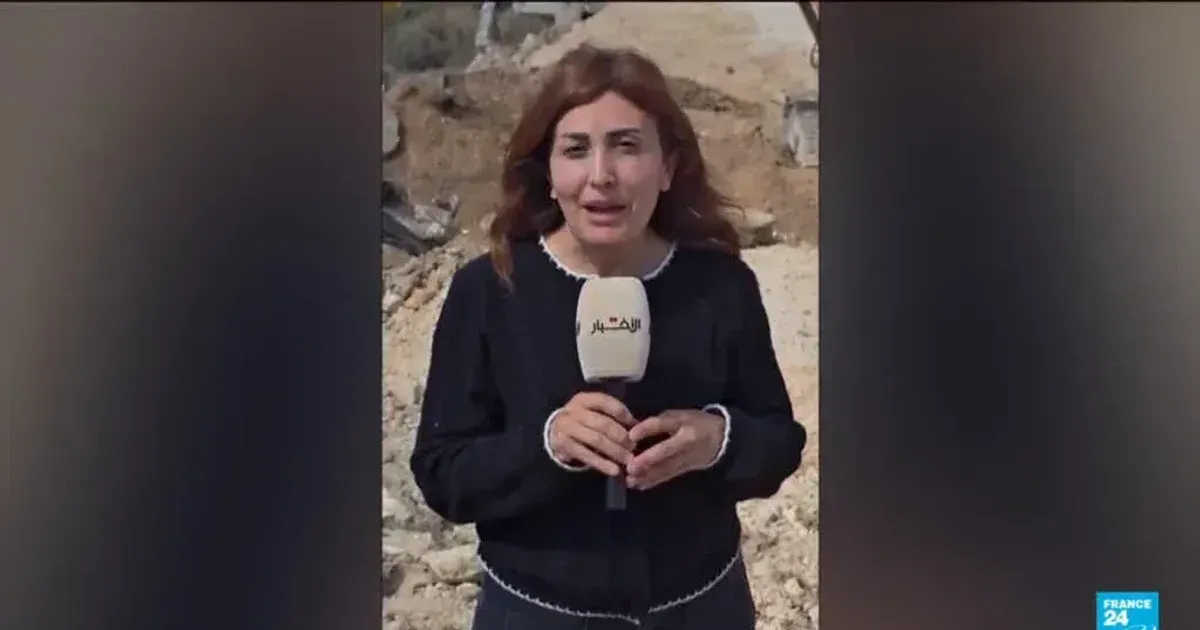
Amal Khalil, a veteran Lebanese reporter for the newspaper Al-Akhbar, died on April 23, 2026, when an Israeli missile struck her temporary shelter in the southern border region. Local military officials confirmed the blast occurred during a surge of cross-border violence that claimed a total of five people in a single afternoon. Her death represents the first killing of a member of the press since a fragile 10-day ceasefire began on April 16. Rescue workers attempted to reach the site for over two hours but reported being pushed back by active machine gun fire. Surveillance footage from the area shows a single projectile hitting the structure where Khalil had sought refuge from earlier shelling.
Al-Akhbar Journalist Amal Khalil Killed in Shelling
Amal Khalil worked for over a decade covering the volatile border between Israel and Lebanon. Colleagues at her Beirut-based newspaper described her as a careful chronicler of the displacement of civilians in the south. The strike also severely wounded a photographer who was traveling with her to document the impact of recent skirmishes on local agriculture. Medical personnel at a hospital in Tyre confirmed the photographer suffered shrapnel wounds to the chest and legs. Reports from the facility indicate he underwent emergency surgery and is currently in stable condition. Staff members at the hospital noted that three other civilians arrived with varying degrees of blast injuries during the same window of time.
Witnesses in the village of Tayr Harfa reported hearing a drone loitering for several minutes before the explosion. Lebanese security sources indicate the target was a multi-story residential building that had been partially abandoned by its owners. Data from the Lebanese Armed Forces suggests the munition used was a precision-guided air-to-surface missile. This specific type of ordnance is frequently deployed by the Israeli Air Force for targeted operations in dense urban or semi-rural settings. No military equipment was visible in the immediate vicinity of the strike site according to local residents who spoke to journalists after the blast.
Journalists working in southern Lebanon have frequently highlighted the dangers of operating in areas where the distinction between combatant and civilian is often blurred by rapid troop movements. The death of Khalil brings the total number of media workers killed in this conflict to twelve over the last eighteen months. Each incident has drawn criticism from international press freedom organizations regarding the safety of non-combatants. Despite the risks, reporters from several Beirut outlets continue to maintain a presence in the border towns to provide live updates on the security situation.
Southern Lebanon Ceasefire Collapses Under New Violence
April 16 marked the beginning of a 10-day cessation of hostilities brokered by international mediators to allow for humanitarian aid delivery. Both Israel and the armed group Hezbollah agreed to the terms, which included a freeze on targeted assassinations and cross-border rocket fire. Wednesday became the deadliest day for the region since the agreement was signed. Military analysts suggest the uptick in violence stems from a series of reconnaissance flights that Hezbollah launched over northern Israel earlier in the week. Israel responded with what it termed defensive strikes against infrastructure used to launch those drones. These escalations occurred despite diplomatic efforts to extend the ceasefire beyond its original expiration date.
Hezbollah fighters have maintained a defensive posture along the Blue Line while accusing Israel of repeated violations of the humanitarian pause. A statement released by the group through its media office claimed that Israeli jets violated Lebanese airspace twenty-two times in forty-eight hours. By contrast, the Israeli military reported that its sensors detected multiple attempts to plant explosive devices near the border fence. Every violation chips away at the confidence needed to transition the current pause into a long-term peace agreement. Civil defense teams in Lebanon reported that shelling affected at least four different border municipalities on Wednesday alone.
Rescue workers say they were forced to halt attempts to reach Khalil and a colleague after being fired on by Israeli forces.
Emergency responders from the Lebanese Red Cross stated that their vehicles were clearly marked with international symbols. Despite these markings, teams reported that small arms fire originated from Israeli positions when they moved within 300 meters of the strike zone. This interference prevented immediate medical intervention that might have saved Khalil if she had survived the initial impact. International law strictly prohibits the targeting of medical and rescue personnel during armed conflict. Defense officials in Tel Aviv have not yet issued a specific comment regarding the allegations of firing on rescuers in this instance.
Rescue Workers Face Fire Near Israeli Border
Field reports from the Civil Defense unit in Tyre describe a chaotic scene where multiple fires broke out following the missile strike. Dry brush in the surrounding hills caught fire, creating a smoke screen that further complicated rescue efforts. Teams used armored vehicles to eventually reach the rubble, where they recovered the body of Amal Khalil. Her remains were transported to a morgue in Sidon for a formal autopsy before being released to her family for burial. The photographer was evacuated using a separate route to avoid the ongoing sniper fire reported by local residents. One ambulance sustained minor damage to its windshield from debris during the extraction.
Lebanon has filed a formal complaint with the United Nations Security Council regarding the incident. The document alleges that the strike on Khalil was a premeditated act designed to suppress reporting on the ground. Similar complaints have been filed in the past, though they rarely result in immediate sanctions or changes in military behavior. The Lebanese Ministry of Information issued a statement calling for an independent investigation into the targeting of journalists. Pressure is mounting on the UN peacekeeping force, UNIFIL, to provide a detailed account of the ceasefire violations witnessed by its observers.
Security analysts note that the area where Khalil died is considered a high-risk zone due to its proximity to Hezbollah staging grounds. However, the presence of journalists in such areas is protected under the Geneva Convention provided they do not take part in hostilities. The challenge for field reporters involves maintaining visibility while avoiding being mistaken for military scouts. Many journalists now wear bright blue vests and helmets marked with the word PRESS in large white letters. These precautions did not prevent the fatal strike on the building where Khalil was staying.
Hezbollah Defense Posture and Regional Repercussions
Regional tensions are expected to rise as Hezbollah leadership weighs a response to the death of a high-profile journalist. The group often views strikes on civilians as a justification for retaliatory rocket barrages into Israeli territory. If the ceasefire collapses entirely, the prospect of a wider regional war becomes a substantial concern for global markets. Oil prices rose by 2% following the news of the strikes in southern Lebanon. Investors are closely monitoring the rhetoric from both Beirut and Jerusalem for signs of further escalation. The 10-day ceasefire was intended to hold until April 26 but currently sits close to total failure.
Israel maintains that its operations are strictly targeted at neutralizing threats to its northern communities. Military spokespeople have stated that the IDF takes extensive measures to minimize collateral damage during its strikes. They often point to the use of precision munitions as evidence of this commitment. Critics argue that the high number of civilian casualties, including journalists like Amal Khalil, suggests a failure in intelligence or a disregard for non-combatant lives. The investigation into the Wednesday strikes is ongoing within the Israeli military command according to unofficial sources. No timeline has been provided for the release of their findings.
Amal Khalil’s Death Undermines Press Safety
Can a geopolitical entity maintain a legitimate ceasefire while its targeting algorithms continue to categorize journalists as peripheral damage? The death of Amal Khalil is not a localized tragedy but a systemic failure of the international rules-based order to protect the observers of war. By firing on rescue workers, the Israeli Defense Forces have signaled a shift in engagement rules that ignores the traditional immunity granted to the Red Cross and the press. This aggressive posture suggests that the 10-day ceasefire was never a bridge to peace, but rather a tactical pause used to recalibrate targeting data for high-value targets.
If a journalist from a leading outlet like Al-Akhbar can be struck in a residential shelter, then no non-combatant in southern Lebanon can claim safety. The evidence points to the normalization of the targeted elimination of the witness.
Skepticism toward the April 16 agreement is now the only logical position for any credible analyst. Hezbollah will almost certainly use this incident to justify a return to attrition warfare, claiming that Israel has forfeited the right to a pause. The international community, led by the UN, continues to issue toothless condemnations that do nothing to deter the use of precision missiles against residential buildings. There is no middle ground when reporters are treated as combatants. The conflict has entered a phase where the narrative itself is being cleared from the battlefield through kinetic force. The ceasefire is dead.