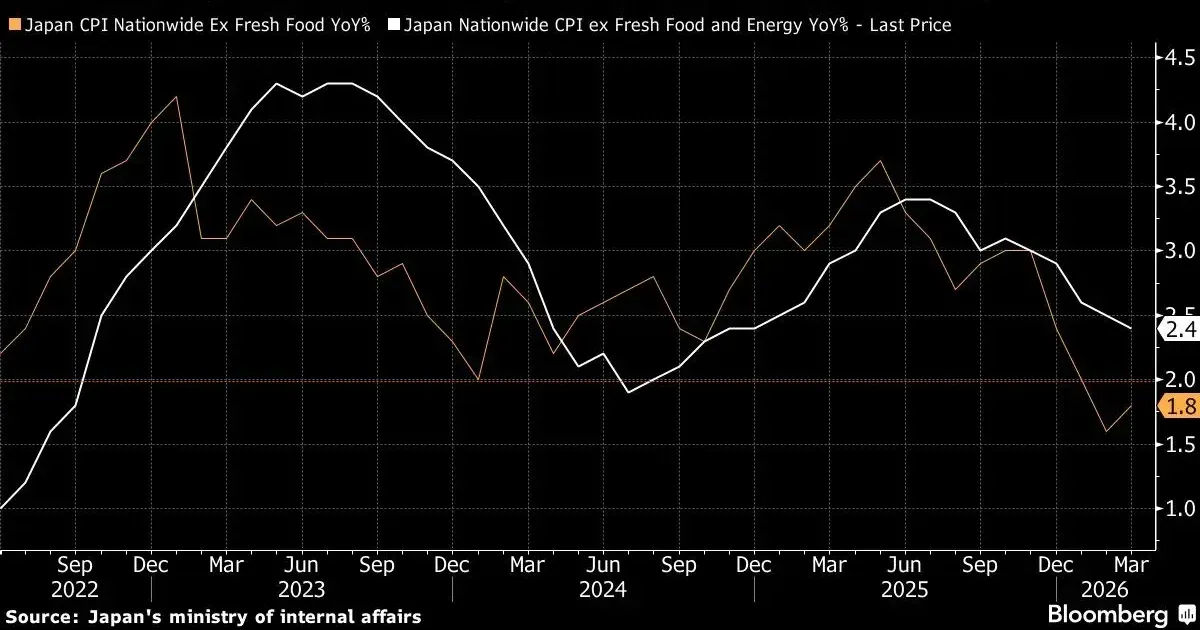
Tokyo's Ministry of Internal Affairs and Communications announced on April 24, 2026, that core consumer prices in Japan rose for the first time in five months. Market participants noted that the acceleration occurred even before the full weight of recent spikes in crude oil reached retail energy markets. Core inflation, which excludes fresh food prices but includes fuel costs, climbed at a pace that complicates the delicate policy normalization path for the Bank of Japan. This data arrival comes just days before Governor Kazuo Ueda and his colleagues gather to discuss the future of the nation's benchmark interest rates.
Economic observers had anticipated a moderate uptick, but the strength of the underlying price pressures surprised some analysts in the capital. Imported energy costs acted as a primary driver, reflecting the persistent weakness of the national currency and volatility in global commodity markets. Domestic firms continue to pass these higher input costs on to consumers, ending a nearly half-year period of decelerating price growth. Bloomberg Economics had previously indicated that price pressures were mounting across several industrial sectors before the latest oil surge began.
"Japan’s key inflation indicator accelerated for the first time in five months, suggesting price pressures were building even before the full impact of elevated oil prices ripples through the economy," Bloomberg Economics reported.
Rebounding fuel costs are only one part of the complex inflationary picture facing Kazuo Ueda. Service sector prices also showed signs of resilience, suggesting that wage increases may finally be influencing consumer behavior. Years of stagnant pay had previously prevented a sustainable rise in the cost of living, but recent labor negotiations appear to be shifting the dynamic. Major corporations have agreed to some of the largest pay hikes in decades during the spring labor offensive.
Japan Consumer Price Index Reverses Cooling Trend
Data from the statistical bureau show that the national consumer price index excluding fresh food rose 2.8 percent compared to the previous year. Household electronics and clothing also contributed to the upward movement, proving that inflation is no longer confined to the energy and food categories. Retailers across Tokyo have reported that consumers are increasingly accepting price hikes for daily necessities. Such acceptance was rare during the previous two decades of deflationary pressure.
Economists at Bloomberg pointed out that the five-month streak of slowing inflation has officially ended. Energy prices, which had been a drag on the headline number due to government subsidies, are becoming a tailwind for price growth again. Government officials in Tokyo have begun tapering these utility supports, further exposing households to global market fluctuations. Wholesale prices had already signaled this shift earlier in the month.
Imported inflation remains a primary concern for the Ministry of Finance. A weak exchange rate makes every barrel of oil more expensive when priced in local currency. Shipping costs for bulk commodities have also climbed, adding another layer of expense for Japanese manufacturers. These firms now face a choice between absorbing the costs or risking a drop in sales by raising prices. Small and medium enterprises are particularly vulnerable to these rising input expenses.
Energy Costs and Global Commodity Market Exposure
Japan depends on overseas suppliers for nearly 90 percent of its energy needs. Any disruption in global oil supply chains has a disproportionate effect on the domestic economy. Crude oil prices have remained high for consecutive weeks, and the lag in price transmission means the heaviest impact will likely arrive in May or June. Kazuo Ueda must decide if this external pressure is temporary or if it will spark a second round of price hikes across the economy.
Petroleum products at the pump reached levels not seen in several months. Transportation companies have responded by adding fuel surcharges to deliveries, which eventually reach the final price of groceries and consumer goods. Refiners have warned that their margins are thinning despite the higher prices at the station. International tensions have kept the risk premium on oil elevated.
Energy stability is the foundation of the Tokyo industrial base. Manufacturers of chemicals and steel are reporting that their energy bills have climbed by double digits over the last quarter. These industrial giants often have long-term contracts, yet even those agreements are being renegotiated at higher rates. Power utilities have also requested further rate adjustments to keep up with the cost of liquefied natural gas.
Monetary Policy Trajectory Under Governor Kazuo Ueda
Pressure is mounting on the Bank of Japan to consider a more aggressive stance on interest rates. Most analysts believe the central bank will maintain its current policy in the immediate term, but the core inflation surprise adds weight to the case for a summer rate hike. Kazuo Ueda has repeatedly stated that the bank needs to see a virtuous cycle between wages and prices before making a move. Current data suggest that this cycle may be forming more quickly than previously estimated. Institutional investors have already started pricing in a shift in the central bank's timeline. Bond yields in the sovereign market have moved higher in anticipation of a less accommodative stance. Kazuo Ueda must balance the need to curb inflation with the risk of stifling a fragile economic recovery. Private consumption has been weak in recent quarters as price hikes outpace wage growth for many families. The Bank of Japan has spent the last decade trying to generate the very inflation it now seeks to contain. Officials are cautious about overreacting to cost-push inflation driven by energy rather than demand-pull inflation driven by consumption. Raising rates too early could plunge the economy back into the stagnation that defined the 1990s and 2000s. Kazuo Ueda faces the challenge of threading the needle between these two extremes.
Corporate Pricing Power and Wage Negotiation Dynamics
Management teams at top-tier Japanese firms are showing a new willingness to adjust prices. This change in corporate culture is a shift from the traditional model of prioritizing market share through price stability. Bloomberg analysts have observed that the Shunto wage negotiations resulted in an average pay increase of over 5 percent for unionized workers. These higher labor costs must be covered by increased revenue, which often comes from price hikes. Service inflation is traditionally more sticky than commodity inflation. Prices for hotel stays, dining out, and entertainment have all trended higher as the tourism sector experiences a post-pandemic boom. Tokyo has seen a record number of international visitors, which has allowed hospitality businesses to raise rates without losing customers. This sector is now a substantial contributor to the core inflation figure. Workers are demanding higher pay to offset the loss of purchasing power caused by the rising cost of living. Real wages have struggled to keep up with inflation for 24 consecutive months, though the gap is finally narrowing. If pay increases continue to lag behind price growth, the Bank of Japan may find it difficult to justify higher interest rates. Consumption remains the weakest link in the national economic chain.
Inflation Acceleration Complicates Central Bank Timing
Ignoring the sirens of inflation has become a specialty of the Bank of Japan, but the latest data from Tokyo suggest that the luxury of denial is rapidly evaporating. For decades, the central bank lived in a world where prices were anchored to the floor by a collective psychological fear of spending. Now, that anchor has been severed by the dual blades of global energy volatility and a collapsing currency. Kazuo Ueda is not simply managing an economy; he is attempting to manage a psychological transition that the bank itself spent thirty years trying to induce. Is the current inflation truly the sustainable demand-pull variety that the BOJ has long desired? Skeptics would say no. The acceleration is largely a product of external shocks and currency devaluation, a form of taxation on the Japanese consumer that does nothing to build long-term prosperity. If the Bank of Japan raises rates to defend the yen or combat oil prices, it risks crushing the very wage growth that it claims to celebrate. The reality is that Japan is trapped. Policy makers cannot afford to ignore 2.8 percent inflation, yet the mountain of national debt makes any meaningful rise in interest rates a fiscal suicide mission. Kazuo Ueda is likely to continue his dance of ambiguity, hoping that oil prices stabilize before the public's patience with rising costs runs out. In the end, the market will force the bank's hand. The era of free money in Japan is dead, even if the central bank refuses to sign the death certificate.