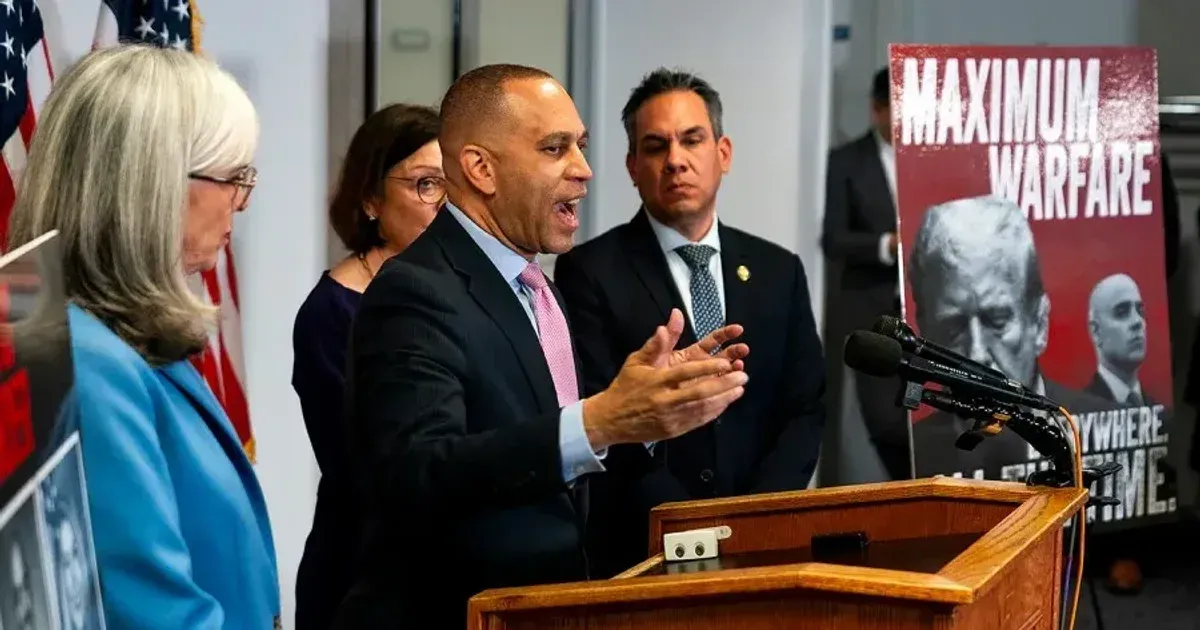
Kash Patel faced a coordinated challenge to his authority on April 23, 2026, when House Democratic leaders leveraged federal surveillance legislation to demand his resignation. Minority Leader Hakeem Jeffries escalated an enduring feud by signaling that his caucus would withhold support for the reauthorization of key spying powers. Democrats currently hold the balance of power on national security votes that require a broad consensus to clear procedural hurdles. Patel, who has led the FBI with a focus on internal restructuring, now finds his tenure linked to the survival of Section 702 of the Foreign Intelligence Surveillance Act.
Jeffries characterized the current Director as a partisan operative rather than a career professional capable of leading the nation’s premier law enforcement agency. Opposition to Patel from the Democratic side of the aisle centers on his past involvement in high-profile political investigations and his public critiques of the intelligence community. Tying the extension of warrantless spy powers to a leadership change creates a high-stakes standoff for the current administration. Section 702 allows the government to collect communications of non-U.S. citizens located outside the country, a tool officials claim is essential for counterterrorism.
Intelligence officials warned that letting these powers lapse would create substantial blind spots in global threat monitoring. Lawmakers remain divided on the scope of privacy protections required for American citizens whose data is swept up in these foreign collections. Democrats insist that trust in the agency’s leadership is a requirement for granting such broad authority. Jeffries has remained firm that Patel lacks the necessary objectivity to oversee a system with such high potential for abuse. Congressional staff members reported that several moderate Republicans are also weighing the implications of Patel’s leadership on long-term agency stability.
Jeffries Targets Patel During FISA Negotiations
Hakeem Jeffries issued a formal warning on April 23, 2026, stating that the path to reauthorizing federal surveillance powers runs through the Director’s office. This ultimatum marks a shift from previous debates where FISA was discussed primarily on its technical and legal merits. Democratic leadership views Patel as a figure who has weaponized the bureau against political rivals. By making his removal a condition for legislative cooperation, the Minority Leader is forcing a confrontation between the White House and its hand-picked FBI chief.
Critics of this tactic argue that national security should not be used as a bargaining chip for personnel disputes. Republican supporters of Patel maintain that he was appointed to reform an agency that they believe became overly politicized during previous administrations. These defenders see the Democratic threat as an attempt to protect the status quo within the federal bureaucracy. Nevertheless, the reality of the legislative calendar puts Patel in an unstable position. Without a sufficient number of Democratic votes, the Section 702 program faces a mandatory sunset at the end of the fiscal quarter.
Jeffries has long portrayed Patel as a partisan conspiracy theorist who is unfit to be the nation’s top cop. The efforts of Kash Patel to declassify materials have drawn sharp criticism from lawmakers involved in oversight.
Security experts at the New York Times and other major outlets have tracked the deteriorating relationship between the FBI and Capitol Hill for months. Patel has largely ignored the calls for his resignation, focusing instead on internal audits of previous FISA warrant applications. These audits frequently highlight errors made by previous administrations, which Patel uses to justify his continued presence at the helm. Agency morale has become a secondary concern to the public fight over statutory authority and constitutional oversight.
Investigative Scrutiny of New York Times Reporting
FBI officials confirmed on April 23, 2026, that an investigation is underway regarding a recent article published by a reporter for the New York Times. The story in question focused on the personal life and associations of Patel’s girlfriend, prompting allegations of harassment and privacy violations from the Director’s allies. Federal investigators are looking into whether the reporter used non-public data or improperly accessed government records to compile the report. Journalists across Washington expressed concern that this move represents an attempt to intimidate the press.
Patel maintains that the investigation is a standard response to potential data breaches instead of a retaliatory strike against a critic. Legal experts pointed out that the FBI has broad latitude to investigate leaks of sensitive information, even when the subjects are associated with high-ranking officials. The New York Times editorial board responded by defending the reporting as a matter of public interest given Patel’s role in the government. Transparency advocates argued that the investigation blurs the line between legitimate national security concerns and personal sensitivity.
Records show that the bureau has issued several subpoenas related to the case. This specific probe coincides with the broader political fight over Patel’s leadership, adding another layer of complexity to the FISA debate. Democrats cited the investigation as further evidence that Patel uses agency resources for personal grievances. Lawmakers have requested a briefing from the Department of Justice to clarify the legal basis for the probe into the journalist. The outcome of this investigation will likely influence the floor debate regarding the FBI’s budget and oversight mandates.
National Security Powers and Leadership Demands
Surveillance programs authorized under FISA have survived numerous challenges over the last two decades by maintaining a thin veneer of bipartisanship. That consensus broke down on April 23, 2026, as the personal reputation of the Director became the focal point of the reauthorization process. Previous debates focused on warrant requirements and data retention limits. On April 23, 2026, the focus shifted to the character of the individual who signs off on the collection orders. Republicans in the House Judiciary Committee accused Jeffries of obstructionism. They argued that the expiration of Section 702 would leave the country vulnerable to foreign interference and cyberattacks. Patel himself has released statements emphasizing the danger of a lapse in collection capabilities. He noted that the bureau’s ability to track foreign intelligence officers depends entirely on the legal authorities currently under threat. Intelligence professionals within the agency are reportedly preparing contingency plans in case the legislation fails to pass. Legislative analysts suggest that a short-term extension might be the only way to avoid a total shutdown of the program. Such a move would only delay the inevitable showdown between the Minority Leader and the Director. Patel has shown no indication that he is willing to step down to save the program. The White House has so far stood by its appointee, calling the Democratic demands unreasonable. Pressure continues to build as the deadline for reauthorization approaches without a clear path forward in the House.
Patel Standoff Turns FISA Into Political Leverage
Is the collapse of federal surveillance a price worth paying for a change in leadership? The current stalemate over Kash Patel and the FISA reauthorization exposes a dangerous evolution in how Washington manages its most sensitive tools. By linking the life of an essential intelligence program to a personnel grievance, Hakeem Jeffries has effectively declared that the integrity of the apparatus is secondary to the identity of its operator. This move is a logical, if cynical, conclusion to a decade of institutional erosion where the FBI has been treated more like a partisan prize than a neutral arbiter of the law. Patel represents the inevitable counter-reaction to a bureaucracy that spent years insulating itself from executive oversight. His presence at the top of the FBI is a deliberate provocation, and the Democratic response, threatening to blind the nation's intelligence eyes, is a gamble of stunning proportions. If the surveillance powers expire, the responsibility for the next intelligence failure will be traded back and forth in a loop of political finger-pointing that provides zero security to the public. The investigation into the New York Times reporter is a convenient distraction for both sides. It allows Patel to play the victim of a biased media while giving Democrats a fresh set of talking points about the abuse of power. Neither side appears interested in the fundamental question of whether the FBI should possess such intrusive powers in the first place. Instead, they are fighting for the steering wheel of a machine that they both know is too powerful to be left in the hands of the other. Institutional stability is dead.