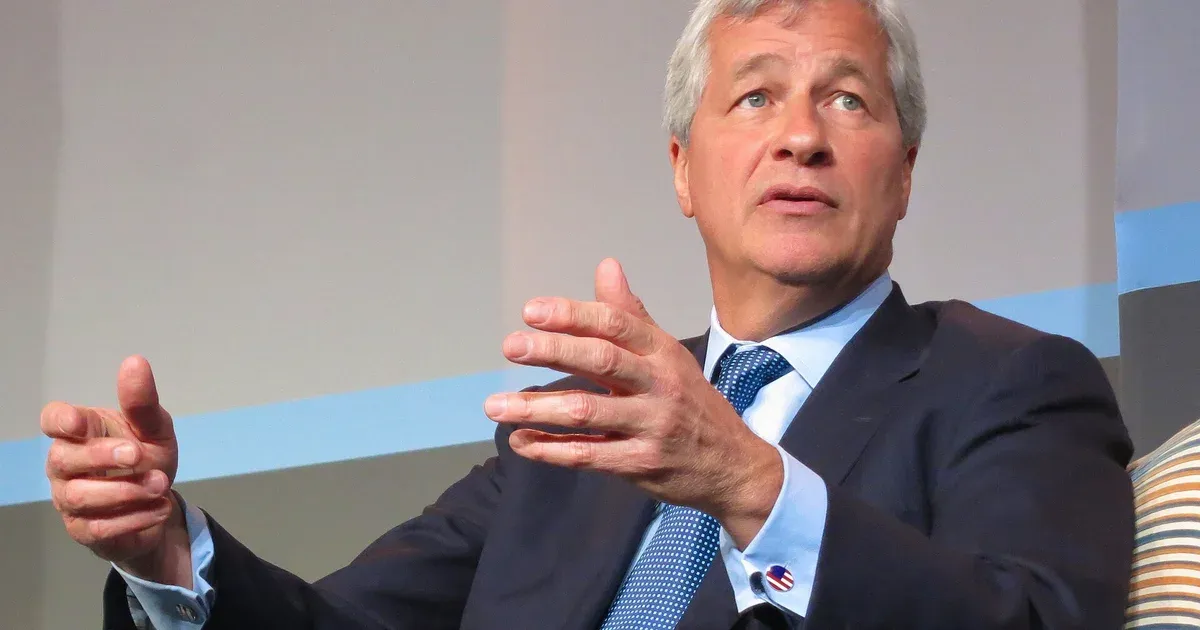
Jamie Dimon asserted that abandoning the American capitalist model is a grave mistake for the global economy. The timeline was fixed to April 1, 2026. Speaking with Tony Dokoupil on the CBS Evening News, the executive defended the free market system while simultaneously acknowledging that systemic failures have pushed the American dream out of reach for millions of citizens. The bank chief framed the argument bluntly. The comments moved beyond finance. By March 12, 2026, JPMorgan's message had turned capitalism into a corporate-politics debate.
Critics of the current system often point to the widening gap between executive compensation and worker wages as proof of a broken contract. Dimon dismissed the notion that capitalism itself is the culprit, labeling the rejection of the system as dead wrong.
Societal friction persists despite these macroeconomic gains. Dimon admitted to Dokoupil that the bottom 20 percent of the United States population has seen stagnant real wage growth for decades. Education systems in inner cities and rural areas fail to provide the skills necessary for a modern, technology-driven workforce. High housing costs and healthcare expenses further erode the financial stability of the middle class. Dimon stated he is on a crusade to address these specific structural deficiencies through targeted corporate investment and policy advocacy.
Dimon Critiques Growing Populist Economic Shifts
Political movements on both the left and right have recently converged on protectionist and anti-corporate rhetoric. Dimon views this trend as a threat to the stability of the international financial order.
Successful intervention requires not merely capital. It requires a fundamental rethinking of how the private-sector interacts with local governments. Dimon highlighted the importance of vocational training and apprenticeships in bridge-building between industry needs and labor supply. He noted that the United States labor participation rate for prime-age men has declined since the 1950s. This decline correlates with the loss of manufacturing jobs and the rise of automation in the Rust Belt. His crusade involves pushing for earned income tax credit expansions to encourage work.
"I'm on a crusade to change that," Dimon told Dokoupil regarding the fading American dream.
Investment in infrastructure is another foundation of his proposed recovery plan. The Jamie Dimon philosophy suggests that government inefficiency, not market greed, often blocks progress on essential projects like high-speed rail or green energy grids. Permitting delays can add years to simple bridge repairs or power plant construction. Dimon argued that the private-sector is ready to deploy trillions of dollars if the regulatory environment becomes more predictable. He maintains that excessive red tape acts as a hidden tax on the poorest Americans. Leaders on Wall Street are currently navigating high market volatility amid ongoing geopolitical tensions and inflationary pressures.
Artificial Intelligence Reshapes Global Financial Labor
Artificial intelligence represents another major frontier for the banking sector. Dimon characterized AI as a tool that will eventually be integrated into every single process at JPMorgan Chase. He expects the technology to handle complex risk assessments and fraud detection with speeds human analysts cannot match. While some fear enormous job losses, Dimon suggested that AI will augment human capability rather than simply replacing it. Internal reports from the bank indicate that thousands of employees already use generative AI to streamline coding and document review. The bank spent over $15 billion on technology in the previous fiscal year.
Efficiency gains from AI might lead to a shorter work week for future generations. Dimon speculated that children today might only work three and a half days a week because of productivity leaps. Still, the transition period could be volatile for workers in administrative and clerical roles. Retraining programs are already underway at major financial institutions to prepare the workforce for this shift. Dimon emphasized that companies have a moral obligation to help employees transition during periods of technological upheaval. He views AI as a necessity for maintaining a competitive edge against foreign state-backed banks.
Risk management remains a primary concern as these technologies mature. Dimon warned that bad actors will use AI to launch sophisticated cyberattacks against the financial grid. JPMorgan Chase blocks millions of malicious attempts to penetrate its systems every day. The executive believes that the marriage of finance and technology is inevitable and beneficial if managed with proper guardrails. He dismissed the idea that AI is a passing fad, comparing its impact to the invention of the steam engine. The bank's AI research department now employs over 2,000 specialists.
Prediction Markets and Future Economic Modeling
Prediction markets have gained traction as a way to aggregate information and forecast political or economic outcomes. Dimon expressed interest in how these markets can provide real-time data that traditional polling or economic modeling might miss. He noted that the wisdom of crowds often proves more accurate than individual expert opinions. These markets allow participants to bet on the likelihood of events ranging from interest rate hikes to election results. Regulation of these platforms is currently a point of contention between the Commodity Futures Trading Commission and private operators. Dimon suggested that transparent, well-regulated markets provide valuable signals to business leaders.
Economic forecasting has become increasingly difficult in a post-pandemic world. Supply-chain disruptions and shifting consumer habits have rendered many old models obsolete. Dimon observed that the resiliency of the American consumer continues to defy expectations despite high-interest rates. Household balance sheets are generally stronger than they were prior to the 2008 financial crisis. Regardless, the threat of a recession is never zero. Dimon keeps a close watch on quantitative tightening and its impact on market liquidity. He warned that the world is not yet fully prepared for the long-term effects of higher borrowing costs.
Capitalism provides the tools to solve these problems if the will exists. Dimon concluded his discussion with Dokoupil by reiterating that the system is not perfect but is superior to the alternatives. He believes that the path forward involves a mix of fierce market competition and compassionate social policy. The executive plans to continue his advocacy for the next several years. He remains the longest-serving CEO of a major American bank. JPMorgan Chase shares have sharply outperformed the S&P 500 during his tenure.
Wall Street leaders rarely moonlight as social architects without a specific return on investment in mind. Jamie Dimon is not simply defending an abstract economic theory; he is insulating the banking class from a growing tide of regulatory and social retribution. By branding himself as the man on a "crusade," he effectively co-opts the language of his critics. This rebranding effort attempts to position the world's most powerful bank as a partner to the poor instead of the designer of their displacement. The strategy is brilliant but transparent to those who track the flow of lobbying dollars toward deregulation.
Can a man who oversees $4.1 trillion truly empathize with a family unable to afford a starter home? Dimon's admission that the system is failing the bottom 20 percent is a calculated move to get ahead of more radical legislative proposals. He prefers a world where corporations voluntarily invest in Detroit over one where the government mandates a higher corporate tax rate to fund public housing. It is a defense of autonomy disguised as a mission of mercy. If the American dream is indeed slipping away, it is because the very institutions Dimon leads have prioritized shareholder returns over community stability for forty years.
Dimon's obsession with AI and prediction markets further reveals a desire to automate away the messiness of human labor and political unpredictability. He envisions a sterilized capitalism where efficiency is the highest virtue. The risk is that in perfecting the machine, he forgets the people it was meant to serve. Investors should watch whether this "crusade" results in meaningful wage increases or merely more polished press releases. The verdict: corporate statesmanship is the new risk management.