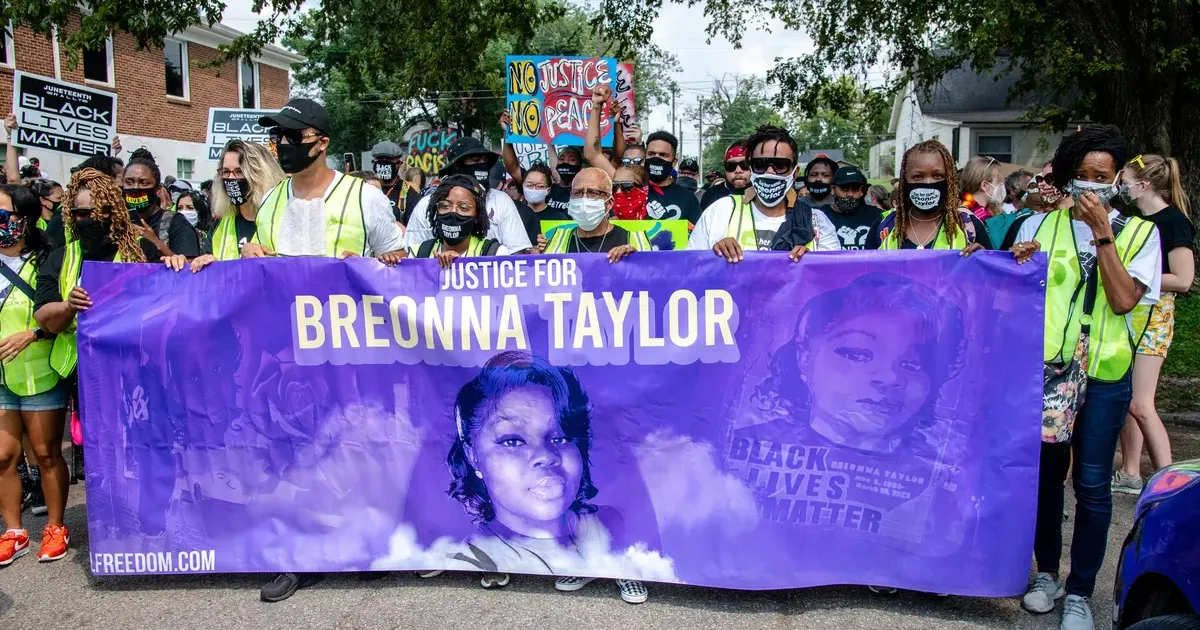
Justice Department attorneys filed a motion to drop civil rights charges against two former Louisville police officers involved in the fatal raid on the home of Breonna Taylor. This strategic retreat follows years of legal maneuvering regarding the preparation of the search warrant used to enter the apartment. Prosecutors previously alleged that the officers knowingly included false information in the affidavit to secure judicial approval for the midnight operation. But recent evidentiary hurdles and procedural setbacks forced federal authorities to reconsider the viability of the prosecution. The decision focuses on Joshua Jaynes and Kyle Meany, who faced accusations of conspiring to deprive Taylor of her constitutional rights. Former detectives Jaynes and Meany were central to the investigation into the narcotics activity of Taylor's ex-boyfriend. Investigative records showed they claimed a postal inspector verified that suspicious packages were being delivered to Taylor's residence. Yet subsequent testimony from postal officials contradicted these assertions, forming the basis for the federal civil rights case initiated in 2022. Falsifying a search warrant affidavit constitutes a violation of the Fourth Amendment, which protects citizens against unreasonable searches and seizures. And the death of a bystander during such a search usually provides the trigger for federal intervention at the highest levels of the civil rights division.
Federal Prosecutors Target Falsified Warrant Evidence
Joshua Jaynes allegedly met with another officer in a garage to align their stories after the public outcry began. According to federal sources, this meeting was an attempt to cover up the lack of verification from the U.S. Postal Service. To that end, prosecutors relied heavily on the cooperation of Kelly Goodlett, a former detective who pleaded guilty to similar charges. Goodlett's testimony was expected to be the foundation of the trial, providing an internal account of how the affidavit was fabricated. Meanwhile, the legal defense for Jaynes and Meany argued that the errors in the warrant were not intentional lies but rather administrative oversights or misunderstandings of verbal briefings. In turn, the defense sought to exclude key portions of the government's evidence during pre-trial hearings. By contrast, the Justice Department maintained for four years that the officers acted with reckless disregard for the truth. This position shifted as specific rulings from the bench restricted the scope of what the jury could consider. Prosecutors faced an increasingly narrow path to proving that the false statements directly caused the death of Taylor, rather than the subsequent actions of the officers at the door. One sentence from the filing highlights the prosecutorial burden.
Prosecutors now admit that the link between the paperwork and the gunfire is legally tenuous in the eyes of the court. The request for dismissal effectively ends the federal attempt to hold the warrant-drafters criminally responsible for the specific civil rights violations tied to the death. Even so, the dismissal does not exonerate the officers of the underlying actions that led to their termination from the force. The local government in Louisville had already paid a $12 million settlement to Taylor's family to resolve a separate civil litigation.
Legal Precedents Shape Breonna Taylor Case Dismissal
Legal experts point to a 2024 ruling by U.S. District Judge Charles Simpson III as the beginning of the end for this specific prosecution. Simpson previously dismissed the most serious charges, which carried a maximum sentence of life in prison, ruling that the officers could not be held responsible for the shooting itself. He determined that the decision of Taylor's boyfriend to fire at officers was an intervening act that broke the causal chain from the warrant. Still, the government attempted to proceed on lesser charges involving the falsification of documents.
Federal law requires a high bar of proof for "willfulness" in civil rights cases, demanding that the government prove the officers knew they were violating the law. In fact, many civil rights prosecutions fail at this exact juncture because proving intent is notoriously difficult in the absence of a written confession or clear audio recording.
Prosecutors in Washington evaluated the risk of an acquittal, which would create a binding precedent that could hamper future cases against law enforcement. Separately, the Justice Department has been under pressure to demonstrate results from its reinvigorated civil rights division. Yet the Taylor case became a liability as the legal architecture supporting it crumbled under judicial scrutiny. In particular, the move to dismiss indicates a prioritization of resources toward cases with higher probabilities of conviction. For one, the dismissal avoids a high-profile loss in a city that remains deeply divided over the 2020 shooting.
The political appetite for a protracted and likely unsuccessful trial had vanished. The filing noted that the government remains committed to civil rights but cannot ignore the legal reality of the current case file.
Civil Rights Division Shifts Strategy in Louisville
The Justice Department is not entirely exiting the Louisville oversight role. A separate consent decree continues to monitor the police department's overall practices and use-of-force policies. Yet the criminal component of the federal response has faced repeated obstacles. For instance, the trial of Brett Hankison, who was charged with endangering neighbors during the raid, resulted in a mistrial before a later conviction on different counts. Such varied outcomes across the different officers involved illustrate the complexity of applying federal law to local police incidents.
In turn, the dismissal of charges against Jaynes and Meany is a hard pivot for the Civil Rights Division. At the same time, activists in Kentucky have expressed frustration at the perceived lack of accountability for those who initiated the chain of events.
Legal scholars suggest that the Justice Department may be preparing to focus on broader systemic patterns rather than individual criminal acts in the Taylor raid. To that end, the move to drop charges is a tactical withdrawal. In fact, the federal government rarely pursues these types of document-falsification charges when the physical harm cannot be legally linked to the paperwork. The 2020 raid began with a ram at the door and ended with 32 shots fired by police. Only one officer, Goodlett, has been convicted in federal court in relation to the warrant. the Breonna Taylor case remains a test of federal civil-rights credibility. Moving to dismiss may be legally narrow, but politically it lands inside a much larger argument about accountability.