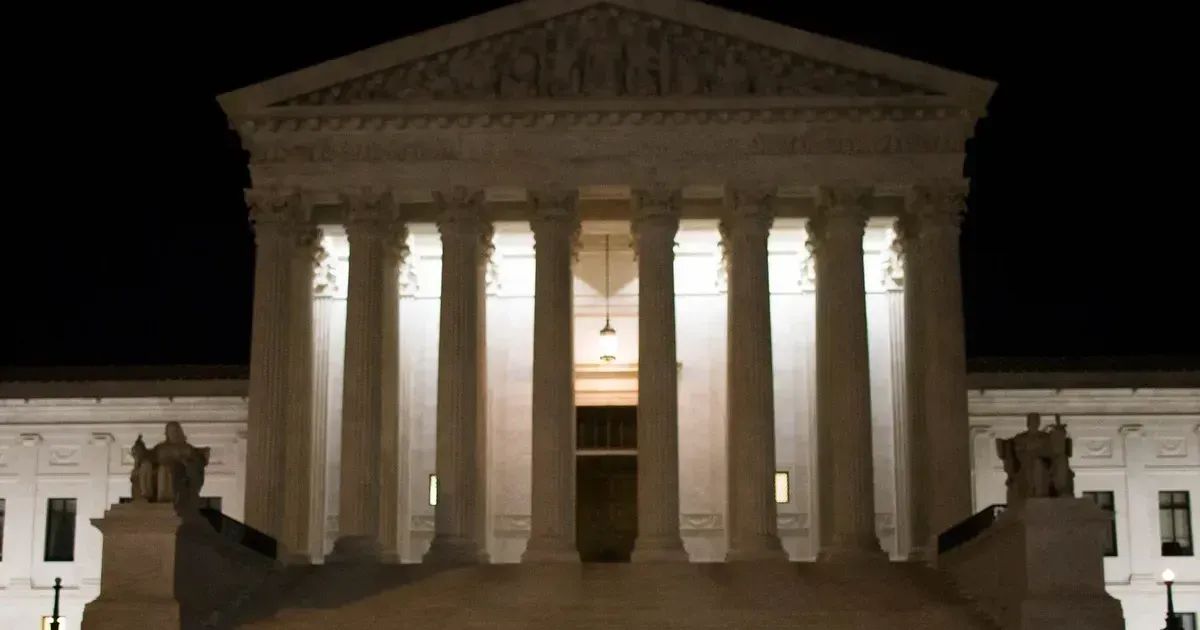
The shadow docket controversy moved from academic criticism into the documentary record. Internal communications within the Supreme Court disclosed on April 18, 2026, provide the first clear evidence of a deliberate move to bypass traditional oral arguments. These private exchanges among justices illustrate a coordinated effort to reshape the legal landscape using the emergency orders list. Records obtained by the New York Times suggest that the highest court in the nation is increasingly relying on this abbreviated process for cases with vast national implications. This documented shift indicates a departure from decades of established judicial norms requiring public hearings and lengthy written opinions.
The cache of 1,200 pages of internal documentation highlights a systemic preference for speed over transparency. Records confirm that the most consequential decisions on federal policy now originate in the dark.
Internal Records Detail Supreme Court Emergency Orders
Confidential memos reveal that the move toward the shadow docket began as a pragmatic response to a surge in emergency applications. Justices argued in private that the slow pace of the merits docket could not keep up with the demands of the modern executive branch. Written communications show a tension between the need for immediate relief and the risk of creating binding law without a full record. Several justices expressed concern that these orders might be perceived as politically motivated due to their lack of explanation.
Instead of issuing signed opinions, the court frequently releases unsigned orders that provide little guidance to lower courts. The result is a fragmented legal system where precedent is set through brief, late-night entries on an electronic docket.
Judicial scholars have long tracked the rising frequency of these emergency interventions. Before 2017, the court rarely used its emergency powers to stay lower court rulings or allow laws to take effect before a full trial. Recent data indicates a fourfold increase in such interventions over the last decade. Private memos suggest this was not an accident but a specific strategy to handle controversial cases. Within these documents, justices discuss how to frame orders to avoid public scrutiny while still achieving specific legal outcomes. The lack of oral argument prevents the public from hearing the reasoning behind these high-stakes decisions.
Confidential Documents Trace Shadow Docket Expansion
Secret papers obtained through investigative efforts show that the court’s internal deliberations have become more insulated. Justices use internal memos to lobby their colleagues on emergency stays, often bypassing the collaborative drafting process used for merits cases. This procedural deviation allows for faster results but eliminates the opportunity for dissenting voices to be heard effectively. One specific memo highlights a justice arguing that certain cases are too urgent to wait for a full term. Legislative battles over voting rights and environmental regulations are now frequently decided in this manner. Papers show that the court used its emergency powers to intervene in cases where the legal questions were still being debated in the appeals courts.
The New York Times reported that these memos illuminate the origins of the court’s now-routine shadow docket rulings on presidential power.
Public accountability hinges on the visibility of the judicial process. When the court moves major disputes to the emergency list, it limits the ability of the press and the public to monitor its work. Internal memos indicate that some members of the court are aware of the optics of this secretive track. They discussed the potential for a public backlash if the shadow docket became the primary method for handling constitutional challenges. Despite these internal warnings, the volume of emergency orders continues to climb each year. Documents show how the court slowly acclimated to this new way of doing business.
Justice Memos Reveal Presidential Power Ruling Shifts
Presidential authority is a central theme in the leaked internal memos. The Supreme Court has frequently used the shadow docket to either strengthen or restrain executive power depending on the specific legal context. In several instances, the court issued emergency stays that allowed executive actions to proceed despite lower court injunctions. These decisions were made without the traditional months of briefing and public debate. Private memos show justices debating the scope of Article II powers in these emergency applications. The influence of the Solicitor General's office is also evident in the communications. Government lawyers have become skilled at framing their requests as emergencies to get a faster hearing at the top court.
Executive orders that would have previously undergone years of litigation are now settled in weeks. This acceleration fundamentally changes the relationship between the three branches of government. Memos show that the court’s majority viewed the emergency track as a tool for administrative efficiency. Critics within the legal community argue that this efficiency comes at the cost of legal clarity. One memo reveals a justice questioning whether the court was effectively acting as a first-instance court rather than a court of last resort. The emergency orders often leave lower court judges confused about which precedents to follow. The Supreme Court currently issues more emergency orders than signed opinions in a typical month.
Administrative Shifts in Supreme Court Procedures
Administrative changes within the building have enabled this shift toward secrecy. Clerks are now trained to handle emergency petitions on a 24-hour cycle to ensure rapid responses. The internal memos detail the logistical hurdles of managing a docket that never sleeps. Justices communicated via secure digital channels to sign off on orders late at night or during holiday recesses. This 24/7 operation has reduced the formal deliberative nature of the institution. Memos indicate that the physical distance between justices during recesses has not slowed the pace of decision-making. Instead, digital communication has enabled a more frequent and less formal exchange of views. The procedural shift has made it harder for the public to know who is authoring which orders.
Transparency in the judiciary is more than a preference but a requirement for democratic legitimacy. Memos show that the internal debate over transparency is ongoing but often loses out to the perceived need for speed. Several justices argued that the court must be able to act quickly to prevent irreparable harm. However, the definition of irreparable harm has expanded sharply in recent years. The expansion allows almost any major policy dispute to be framed as an emergency. The internal papers confirm that the court is now comfortable deciding cases with millions of affected citizens through a process that leaves no paper trail. The clandestine approach to the law has become the new standard in Washington.
Shadow Docket Records Test Court Power
The Supreme Court is no longer an arbiter of law; it has become a rapid-response unit for ideological solidification. By migrating the nation’s most volatile disputes to the shadow docket, the justices have successfully insulated themselves from the very scrutiny that gives their rulings weight. It is not a matter of administrative efficiency or an overburdened calendar. It is a calculated retreat from the public square. The court is trading its long-term institutional capital for short-term tactical victories. When the highest legal body in the land decides that the public does not deserve to hear the 'why' behind a life-altering ruling, the social contract is effectively nullified.
History teaches that institutions which hide their inner workings eventually lose the consent of the governed. The leaked memos reveal a group of individuals more concerned with the mechanics of power than the principles of open justice. They have built a bypass around the constitutional requirement for a transparent judiciary. It is a dangerous precedent. If the law is whatever five people say it is behind closed doors at midnight, then the law is no longer a set of rules; it is a set of commands. The shadow docket is a failure of judicial courage.
It is an admission that the court’s current direction cannot survive the sunlight of a full public hearing. The marble facade of the court now hides a bureaucracy of secrecy. Justice is not blind; it is being blinded by design.