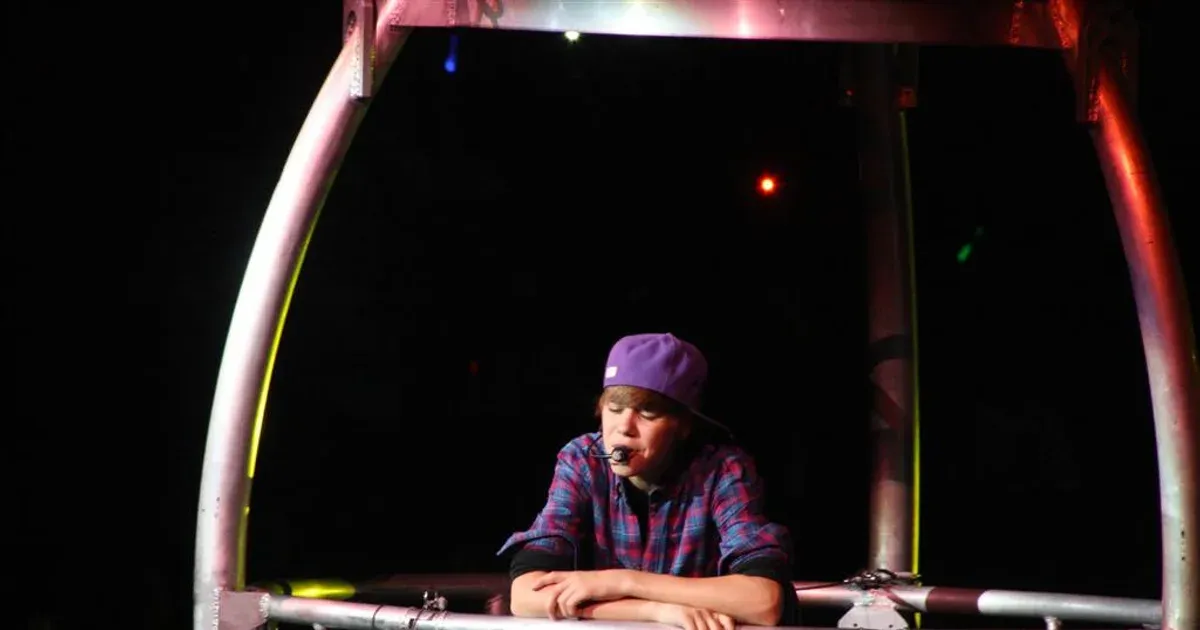
Justin Bieber returned to the main stage at Coachella using a digital backdrop of his own history to anchor a headlining performance. Standing before thousands in the California desert, the Canadian singer opted for a presentation that relied heavily on his teenage years. This stylistic choice saw the 32-year-old artist performing alongside projected versions of his younger self. High-definition screens displayed footage from the late 2000s and early 2010s, creating a visual dialogue between his present form and his origins as a global phenomenon.
Crowds gathered in Indio witnessed a set list that prioritized legacy over contemporary experimentation. Producers integrated YouTube clips from 2010, showing a fifteen-year-old Bieber performing in his signature purple hoodie. Rather than re-imagining these tracks with new arrangements, the singer often stood still, singing along with the original vocal tracks. Critics present at the festival noted the stark contrast between the high-energy choreography of his previous world tours and the static, reflective nature of this appearance.
Bieber Returns to Indio Valley Stage
He stood mostly stationary against a flood of pixels. Technical execution of the show prioritized the digital over the physical. While Bieber moved through hits like "Baby" and "Never Say Never," he frequently allowed the pre-recorded video audio to carry the melody. Some fans expressed confusion on social media regarding the lack of a live band for several segments. Earlier reports from rehearsal sources indicated that the singer wanted to lean into the viral roots of his career. By using the very videos that made him a star, he attempted to close a twenty-year loop of celebrity.
Technical Framework of the Performance
Audio-visual technicians spent weeks syncing the archival footage with the live lighting rig. The production costs for such a display were estimated to exceed $5 million, excluding the artist’s own appearance fee. Each video clip was upscaled using artificial intelligence to ensure the 2009 resolution did not look dated on the large Coachella stage screens. Engineers mapped the stage to allow Bieber to interact with his younger hologram-like projections, though he rarely engaged with them physically. He preferred to watch the screens along with the audience.
I remember when these videos were just something we uploaded from a basement in Ontario, and now they are the show.
Vocal consistency throughout the night varied. During the acoustic sections, Bieber showed flashes of the soulful range that defined his mid-career work. However, the reliance on lip-syncing during the nostalgia-heavy portions drew mixed reactions from the press pit. Industry analysts suggest this approach may be a safeguard for his physical stamina. His previous struggles with Ramsay Hunt syndrome, which caused partial facial paralysis, have made his team cautious about the rigors of live performance. A lower-intensity set allows him to fulfill headlining duties without the strain of a full-scale pop spectacle.
Commercial Impact of Nostalgia Acts
Financial analysts suggest that the nostalgia market is currently the most reliable revenue stream for major festivals. Coachella ticket prices have climbed steadily, and the demographic of attendees has shifted toward older millennials with disposable income. These fans are willing to pay a premium for the specific emotional resonance of their adolescence. Bieber’s decision to perform his oldest hits verbatim satisfies this market demand. It avoids the risk associated with testing new, unproven material on a platform that demands instant recognition.
Records show that Justin Bieber remains one of the most-streamed artists globally, with his early catalog still generating millions of dollars in quarterly royalties. By centering his Coachella set on these assets, he reinforces the value of his masters. This strategy is increasingly common among pop veterans who see their early work as a stable commodity. Other headliners in recent years have used similar tactics, but few have done so with the literal use of their original discovery videos. The performance functioned as both a concert and a live-action documentary.
Production Staging and Media Integration
Media observers focused on the heavy involvement of creative directors who specialized in digital archives. Every frame of the YouTube footage was selected to trigger specific memory markers for the audience. The sight of a young Bieber with his famous hair-flip mirrored across five-story screens evoked a visceral reaction from the crowd. Within the VIP sections, the atmosphere was less about the music and more about the spectacle of surviving child stardom. His presence felt more like a victory lap than a creative rebirth.
The desert wind did little to cool the intensity of the stage lights. Indio has seen many iterations of Bieber over the years, from the teenage guest to the troubled pop star and finally the elder statesman of the genre. His 2026 set stripped away the various personas he adopted in the interim. It focused entirely on the version of the artist that the world first met. By the time the final notes of "Sorry" faded, the audience had been taken on a carefully curated tour of a career that has been public for two decades. The lights dimmed on a performer who seemed content to let his past do the heavy lifting.
Nostalgia as Festival Currency
Marketing nostalgia to a generation that has not yet finished its first decade of adulthood reveals a deep stagnation in the contemporary pop machine. Justin Bieber’s choice to turn the Coachella main stage into a glorified YouTube reaction video is a surrender of artistic ambition. When a headliner stops trying to innovate and starts singing along to their own teenage clips, the industry has reached a point of diminishing creative returns. It is no longer about the music; it is about the safe, predictable monetization of the childhoods of twenty-somethings. It is the ultimate commodification of memory.
Goldenvoice and other promoters are increasingly allergic to risk. They prefer a static, pre-recorded nostalgia trip over the unpredictable energy of a live, evolving artist. Bieber’s performance was technically skilled and commercially savvy, but it was spiritually hollow. If the pinnacle of live music in 2026 is watching a grown man singing karaoke to his own 2010 uploads, we have lost the essence of the festival experience. We are paying five-figure VIP prices for a digital ghost. It is a brilliant business move and a dismal artistic failure.
Pop music has entered its archive era.