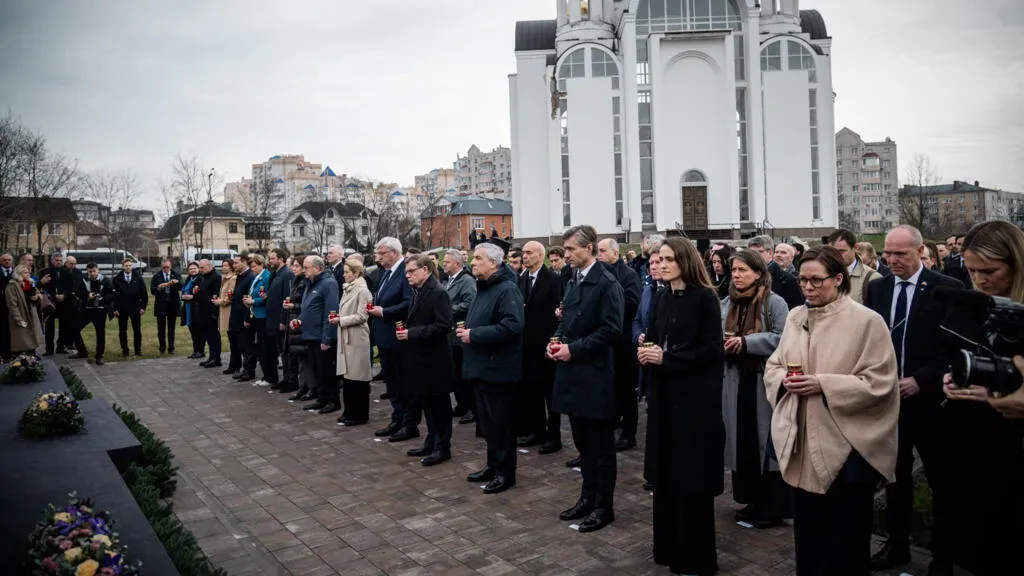
Kaja Kallas's visit to Bucha turned remembrance into a test of European follow-through. The European Union's foreign policy chief arrived with other European ministers on the fourth anniversary of the town's liberation, paying tribute in a place that has become one of the clearest symbols of Russian atrocities in Ukraine.
Bucha is not just an anniversary stop. It is evidence, accusation and political memory in one place. After Russian forces withdrew in 2022, journalists, Ukrainian officials and investigators documented civilians killed in streets, bodies found in mass graves and accounts of execution, torture and sexual violence. Ukrainian authorities have put the number of civilians found dead in the Bucha area in the hundreds.
The documented record gives the visit its force. Europe can debate ammunition, sanctions, loans and defense production in institutional language. Bucha pulls those debates back to the human reason they exist.
Bucha Keeps the War From Becoming Abstract
Four years into Russia's full-scale invasion, fatigue is one of Ukraine's enemies. The front line keeps moving through artillery shortages, drone attacks, air-defense gaps and long budget meetings. Foreign publics hear the same words until they lose weight: aid package, ceasefire, sanctions, reconstruction, accountability.
Bucha interrupts that drift. The town gives the war streets, graves, families and names. It also gives prosecutors a record that cannot be treated as a ceremonial backdrop. The International Criminal Court, Ukrainian investigators and European legal bodies have all made accountability a central part of the war response.
For Kyiv, Bucha therefore remains a diplomatic reference point. A partner who stands there is not only honoring the dead. The partner is being asked to connect memory to policy.
Kallas Made Accountability the Message
Kallas's role matters because she is not a visiting national leader making a bilateral gesture. As the EU's top diplomat, she carries the question of whether Europe can organize common action across governments that often disagree about cost, pace and risk.
Those who gave the orders must be held to account.
The accountability line is more than legal rhetoric. It rejects the idea that war-crimes cases should stop with soldiers visible in photographs or local commanders captured by investigators. It points upward, toward the political and military chain that made the occupation possible.
The harder issue is endurance. War-crimes accountability takes years. Evidence has to be preserved, witnesses protected, suspects identified and jurisdiction defended against denial, intimidation and diplomatic fatigue.
European Unity Is Still the Weak Link
The visit projected solidarity, but the European Union's Ukraine policy still depends on unanimity, national stockpiles, domestic politics and money. Hungary has repeatedly complicated sanctions and aid decisions. Other member states argue over weapons production, frozen Russian assets, budget burdens and the level of risk Europe should carry if U.S. attention shifts.
Remembrance becomes a delivery test at that point. A candle ceremony can focus attention for one day. It cannot supply shells, interceptors, armored vehicles, power-grid equipment or long-term budget support.
Ukraine needs the moral clarity of Bucha to survive the administrative grind of Brussels. Without that link, the anniversary becomes a speech. With it, the visit can help justify the unglamorous work of procurement and financing.
Aid and Justice Are Not Separate Tracks
Military support and accountability are often discussed as different files. Bucha shows why they overlap. If Russia can continue the war cheaply, the risk of new occupied towns grows. If evidence of atrocities is not pursued, the political cost of future violence falls.
Sanctions also belong in the same frame. Restrictions on Russian banks, oil revenue, military suppliers, cyber actors and sanctions-evasion networks are not symbolic extras. They are part of the attempt to raise the cost of the war while Ukraine tries to hold territory.
The challenge is that sanctions discipline weakens over time. Businesses look for exemptions, governments fear economic blowback and Russia searches for indirect routes. Bucha remains useful to Ukraine because it reminds partners what is being normalized when pressure fades.
The Visit Tests Europe's Memory
Kallas's Bucha appearance was valuable only if it strengthens the chain between outrage and action. Europe does not have to agree on every tactic to understand the basic obligation: civilians were killed under occupation, the evidence has not vanished and Ukraine is still fighting the army responsible for the invasion.
The hard part is that responsibility now has boring forms. It looks like production contracts, air-defense deliveries, court files, sanctions enforcement and budget votes that do not make dramatic images.
Bucha still matters because it makes delay visible. A memorial without deliveries becomes performance. Deliveries without memory become routine policy. Ukraine needs both: a Europe that remembers why the town changed the war, and a Europe that can still move the equipment, money and legal pressure needed to stop more towns from being added to the same record.