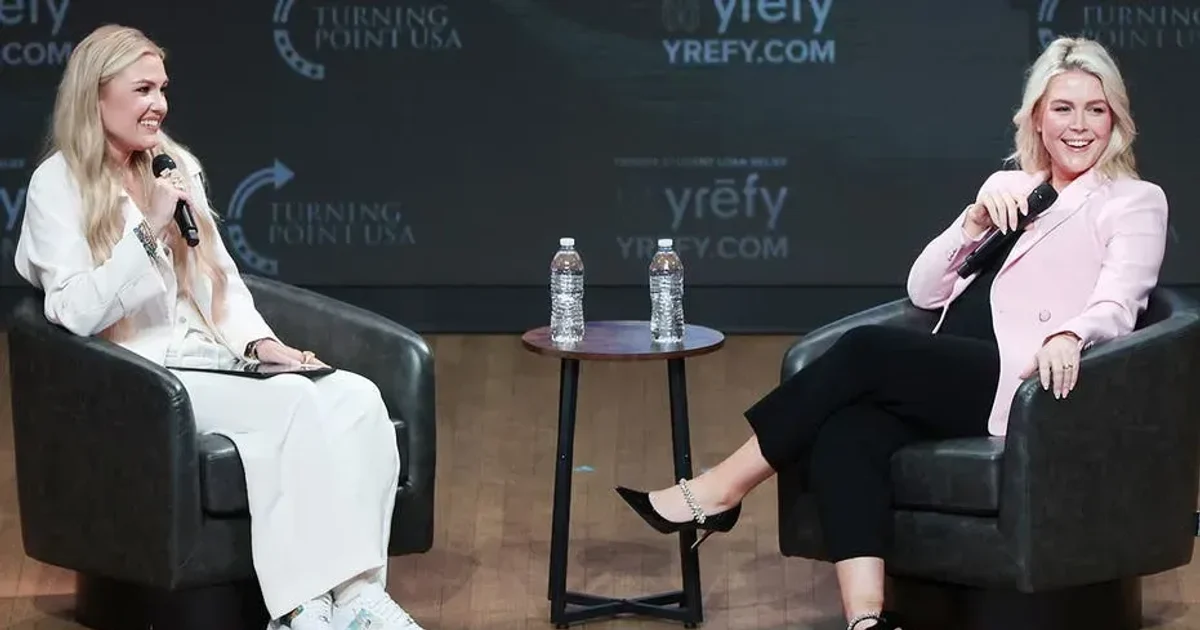
Karoline Leavitt's appearance at George Washington University put two parts of the Trump political operation on the same stage: personal loyalty inside the White House and a public defense of stricter voting rules. The event, held with Turning Point USA's Erika Kirk, moved from Leavitt's account of her rise into the press role to questions about the SAVE America Act and voter eligibility.
Combining the two themes matters because the press secretary is not only a messenger for daily briefings. In this administration, the job also extends into campus events, friendly conservative forums and policy fights where the White House wants the message delivered without institutional distance. The personnel story and the voting-law argument are connected by the same political style.
The staffing story was about trust
Leavitt's account of being told about the press secretary role through an informal Trump phone call fit the administration's preference for personal confidence and message discipline. Communications jobs always involve trust, but the casual tone made the selection sound less like a bureaucratic process and more like a direct political bond.
The informal phone call should not be overstated. Press secretaries are political appointees, and presidents usually choose people who know their instincts. The point is narrower: Leavitt presented the job as an extension of loyalty, familiarity and readiness to defend the president in public.
The press role moved beyond the briefing room
The modern White House press office does more than answer questions from reporters. It produces clips, confronts critics, frames legislation, speaks to supporters and treats public events as message distribution. Leavitt's campus appearance showed that broader function.
For Trump, the broader press model fits a long-running conflict with mainstream media and a preference for direct communication with aligned audiences. The advantage is clarity for supporters. The weak point is that governing questions can be answered as campaign combat even when the subject needs administrative detail.
The SAVE America Act needs careful wording
The voting bill at issue is commonly discussed as the SAVE Act or SAVE America Act, a proposal centered on proof of U.S. citizenship and stricter identification rules for federal elections. Supporters describe it as an election-integrity measure. Critics warn that documentation requirements could block or delay eligible voters who lack easy access to passports, birth certificates or records matching their current names.
Coverage should not treat either side's slogan as the evidence. Noncitizen voting in federal elections is already illegal, and Republicans argue that stronger documentation is needed to prevent unlawful registration. Voting-rights groups and Democrats argue that the burden would fall most heavily on people whose documents are missing, costly, outdated or difficult to obtain.
The access question is practical, not abstract
The central dispute is not whether citizenship matters for voting. It plainly does. The dispute is how the government verifies eligibility without creating avoidable barriers for citizens who are already entitled to vote.
Examples matter here: married voters whose names changed, older citizens without current documents, rural voters far from agencies, naturalized citizens, students and low-income voters can all face different burdens. A rule that feels routine for one voter can become a paperwork obstacle for another.
The campus setting sharpened the exchange
A student question forced the policy argument into a live setting rather than a controlled briefing. Leavitt responded as a defender of the bill, not as a neutral election administrator. A partisan defense is expected from a White House press secretary at a partisan-aligned event, but it changes how the answer should be read.
Coverage therefore requires clear attribution. Leavitt defended the proposal as a basic election-security measure. Critics view the same proposal as a threat to ballot access. The article's job is to show what each claim rests on and where the factual dispute remains unresolved.
Loyalty can narrow the answer
The institutional problem is that a loyalty-based communications style can be fast and forceful while leaving less room for administrative nuance. A spokesperson chosen for political trust may be highly effective at defending the president, but less likely to dwell on implementation problems that weaken the preferred message.
Leavitt's GWU appearance showed the tension in compact form. The personal staffing anecdote explained why she fits the role. The voting-law exchange showed what the role demands: defend the administration's claim, challenge critics and keep the message moving even when the policy itself turns on difficult questions of access, eligibility and proof.