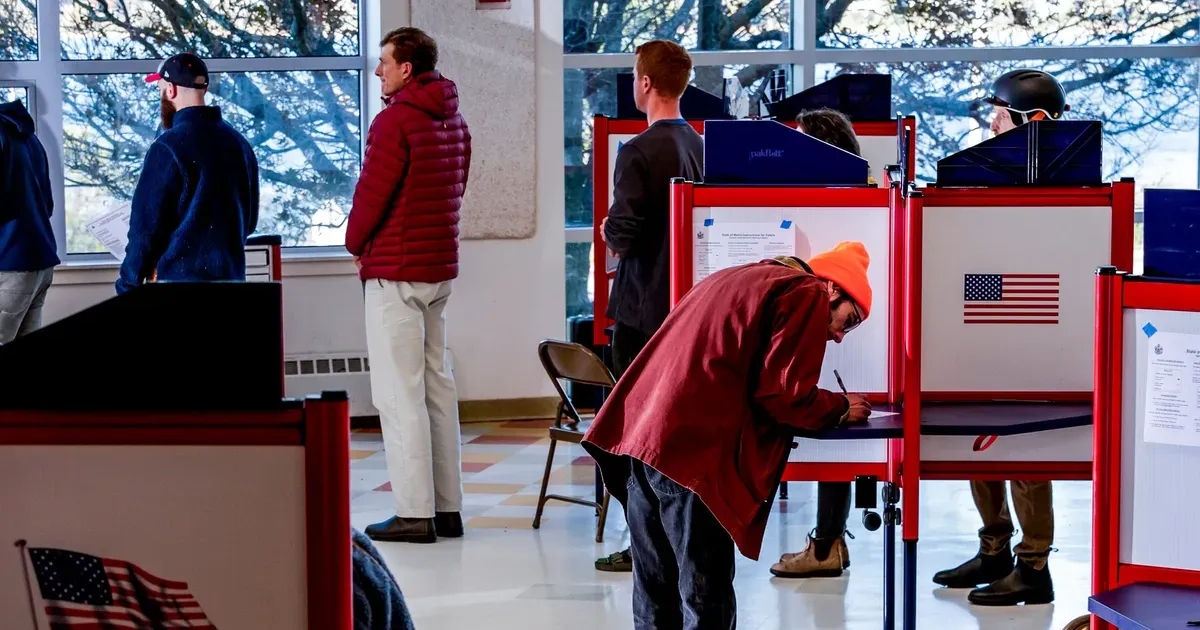
Republicans are pressing ahead with the SAVE Act even as the Senate math points toward defeat. The proposal now sits inside a wider fight over institutional trust. That leaves the proposal functioning more as a campaign signal than a legislative vehicle. By March 27, 2026, Donald Trump's pressure campaign had made the voting bill a political test for the party rather than a realistic path to enacted law.
Congressional Gridlock and SAVE Act Voting Provisions
Congressional debate over the SAVE Act has stalled as the two parties remain locked into their respective positions. Republican lawmakers have tied the bill to broader discussions about border security, suggesting that an influx of undocumented immigrants presents a direct threat to the integrity of the electoral system. They maintain that the mere possibility of illegal voting justifies the implementation of stricter verification protocols. To that end, the House of Representatives has seen multiple iterations of the bill, each adding layers of administrative requirements for state election offices.
Yet, state election officials have expressed concern over the logistical burden these requirements would impose. Implementing a national proof-of-citizenship standard would require a complete overhaul of voter registration databases and training for thousands of local poll workers. Many states already use the Systematic Alien Verification for Entitlements database to cross-reference registration rolls with citizenship status. Critics point out that adding a manual document check at the point of registration would create serious bottlenecks and administrative costs that the federal government has not yet offered to fund.
Statistical Reality Versus Republican Election Rhetoric
Data from the 2020 and 2022 election cycles confirms that non-citizen voting remains an outlier. Investigations by secretaries of state in both Republican and Democratic jurisdictions have repeatedly reached the same conclusion: the system is secure. For instance, an audit in Georgia following the 2020 election found that out of millions of votes cast, only a handful of non-citizens had even attempted to register, and none had successfully voted. These findings contradict the narrative that the SAVE Act is a response to an active and growing crisis in the electoral process.
The SAVE Act has also become a messaging vehicle for Republicans who want to link voting rules, border security and institutional trust. That political use does not resolve the administrative questions facing state election offices.
Proponents continue to cite specific instances where non-citizens were found on voter rolls as justification for the mandate. While these instances are rare and often the result of administrative errors rather than intentional fraud, they provide the rhetorical fuel needed to sustain the legislative push. Documentation from the Heritage Foundation's database of election fraud shows that while some irregularities exist, they have never occurred on a scale capable of swinging a federal election. This hasn't stopped Donald Trump from claiming that the system is riddled with vulnerabilities that only his preferred legislation can fix.
Strategy sessions within the GOP suggest that the bill is being used to define the terms of the national debate. Inflation and foreign policy setbacks are difficult issues for any party to turn into simple campaign answers. By shifting the focus to election integrity and social issues, Republicans hope to move the conversation toward terrain where they feel they have a bigger emotional advantage. Voters in key swing states often cite the economy as their primary concern, but polling suggests that cultural identity and institutional trust are also powerful motivators at the ballot box.
Campaign planning has pushed the SAVE Act into the general-election message. If the bill fails, Republicans can use it as a grievance over border security and election integrity. If it advances, critics warn it could add registration friction for eligible voters who lack easy access to citizenship documents.
The political utility of the bill also extends beyond voting mechanics. Trump has linked the SAVE Act to other cultural fights, forcing opponents to answer simplified slogans with more complicated legal and administrative arguments. That is useful campaign terrain even if the legislation itself stalls.
Voting Politics
The SAVE Act is unlikely to become law under the current Senate math, but it still gives Republicans a clear campaign message. Supporters can argue that documentary proof of citizenship is a common-sense safeguard, while opponents can point to existing federal prohibitions, rare documented cases and the risk of eligible voters being blocked by paperwork.
The practical fight will move to state election offices if the proposal advances in any future form. Officials would need funding, database access, staff training and clear guidance for voters who do not have passports or birth certificates readily available. Without those pieces, the policy debate remains less about immediate fraud prevention than about how much friction the registration system should tolerate.
For voters, the bill now functions as a test of trust. One side says tighter proof rules are necessary to protect confidence in elections. The other says confidence is damaged when rare cases are presented as a broad crisis. That disagreement is likely to outlast this version of the legislation.