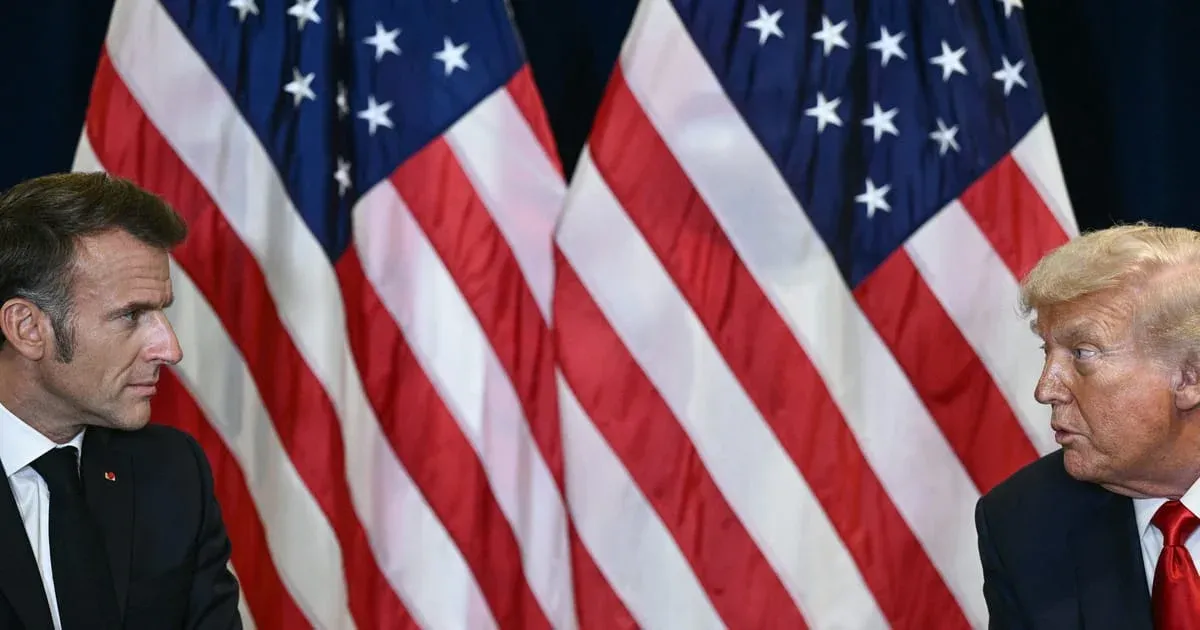
Emmanuel Macron's warning over Donald Trump's NATO rhetoric concerned deterrence, not manners. During his South Korea visit, Macron argued that a U.S. president cannot keep casting daily doubt on alliance commitments and still expect adversaries, allies and markets to treat NATO guarantees as automatic.
The timing made the criticism sharper. The Iran crisis had already split allies over maritime security, escalation risk and the reopening of the Strait of Hormuz. Trump wanted more visible allied support. European governments wanted coordination, legal clarity and a path back to diplomacy. Macron's point was that disagreement is manageable; public uncertainty over the alliance itself is more dangerous.
Article 5 Depends on Belief
NATO's collective-defense clause is a legal commitment, but deterrence works through expectation. Russia, Iran and every other strategic actor must believe the alliance would respond under pressure. Member states must believe the same thing when they plan procurement, troop posture and crisis diplomacy.
Casual threats therefore matter. NATO can be weakened without a formal withdrawal. Repeatedly implying that protection is conditional, optional or tied to unrelated disputes can reduce confidence before any treaty text changes. Deterrence can decay through doubt.
Iran Turned a Burden-Sharing Argument Into an Alliance Test
Trump's complaint about allied burden-sharing has a real foundation. Europe still relies heavily on the United States for nuclear deterrence, intelligence, strategic lift, missile defense and command capacity. Higher defense budgets do not instantly create deployable forces or ammunition depth.
But the Iran dispute changed the frame. European hesitation went beyond spending to concern about being pulled into a U.S.- and Israel-shaped conflict without a clear end state. Macron opposed treating a forced military reopening of Hormuz as a simple operational fix. For many European governments, maritime security and war participation are not the same decision.
South Korea Was Not a Random Stage
Macron made the argument in Seoul while France and South Korea discussed Hormuz, technology, energy and supply-chain cooperation. The Seoul setting mattered. South Korea depends on U.S. security guarantees and open shipping lanes. It also knows what alliance uncertainty does to planning when a larger power changes tone.
By speaking there, Macron connected European anxiety to a wider allied problem. If Washington treats guarantees as bargaining chips in one region, partners in other regions listen. NATO credibility, Asian security and maritime trade are not separate files when the same U.S. presidency sits at the center of each.
The Ankara Summit Did Not Erase the Damage
The July NATO summit in Ankara produced public reassurance. Trump praised unity, allies restated Article 5 and European governments emphasized higher defense spending and support for Ukraine. The reassurance mattered because alliances need rituals of repair, especially after months of open friction.
Still, a summit communique cannot fully undo repeated public volatility. Allies heard the reassurance, but they also saw the threats, side comments and Iran-driven pressure. The practical result is a more cautious NATO: still functioning, still militarily powerful, but less able to assume that U.S. political language will remain disciplined in the next crisis.
Strategic Autonomy Is Becoming Less Abstract
Macron has argued for European strategic autonomy for years, sometimes to the irritation of allies who feared the phrase would weaken NATO. Trump's rhetoric has made the argument easier to sell. If the U.S. commitment can swing with domestic politics, Europe has to build more capacity of its own.
France cannot replace the United States, nor can Europe quickly duplicate American capabilities, but European capitals have a stronger reason to buy ammunition, strengthen air defense, expand industrial capacity and coordinate command structures. Autonomy has become insurance against political volatility rather than a slogan about pride.
Smaller Allies Carry the Most Exposure
France has nuclear weapons, a permanent U.N. Security Council seat and expeditionary forces. Germany has industrial depth. Smaller NATO members near Russia do not have that cushion. Their security planning depends on the alliance promise sounding boring, automatic and dependable.
This is the core of Macron's warning. Trump may be right that allies should carry more of the load. He weakens that case when he makes the defense guarantee sound like a favor that can be withdrawn mid-argument. NATO can survive disputes over spending, Iran and strategy. It cannot afford to make uncertainty its normal operating language.