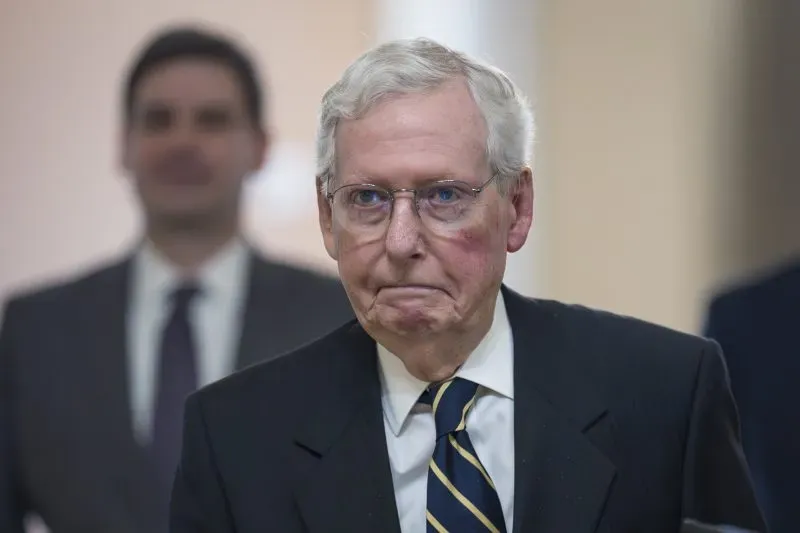
Mitch McConnell's warning that he would work with Democrats to protect U.S. membership in NATO was more than a personal break with Donald Trump. It marked one of the clearest Senate reminders that American alliance policy is not supposed to turn on one president's irritation with allies.
The warning still matters after the 2026 NATO summit in Ankara, where Trump alternated between criticism, praise and public reassurance. Allies heard the warmer language. They also remembered the earlier threats to leave the alliance, the complaints over Iran and burden-sharing, and the possibility that a president can damage confidence without signing a formal withdrawal document.
Congress Built a Legal Barrier
Congress has already tried to make a unilateral NATO exit harder. The 2023 restriction requires either Senate approval or an act of Congress before a president can suspend, terminate, denounce or withdraw from the North Atlantic Treaty. The provision was designed for exactly the kind of scenario Trump keeps reviving.
The barrier is real, but it is not total protection. Courts could still be asked to decide how far Congress can limit presidential treaty authority. A president could also weaken participation without formally leaving: reducing troop commitments, slowing exercises, questioning Article 5, withholding funds or turning every summit into a loyalty test.
McConnell's Argument Is Strategic
McConnell's position is not a sentimental defense of Europe. It is a traditional Republican argument about American power. NATO gives Washington bases, intelligence channels, interoperable militaries, air-defense networks, logistics routes and a deterrent structure that would be expensive to recreate through bilateral deals.
McConnell's strategic case gives his line weight even as the Republican Party has moved toward more open skepticism of alliances. McConnell is defending NATO as infrastructure for U.S. reach. The alliance is not charity. It is a system the United States helped build because it served American security.
Article 5 Is Part of the American Record
The clearest factual answer to the claim that NATO only protects Europe is the alliance's response after September 11. Article 5 was invoked for the United States, not against it. NATO allies then supported U.S. security operations in ways that became part of the post-9/11 military architecture.
The Article 5 history does not erase legitimate disputes over burden-sharing. European allies have often spent too little, and U.S. pressure has helped move several governments toward higher defense budgets. But higher allied spending is an argument for a stronger NATO, not an argument for abandoning the structure that channels that spending into collective deterrence.
The Republican Split Is About Power
The party divide is not only isolationism versus internationalism. It is a disagreement over what strength looks like. Traditional defense hawks see alliances as force multipliers. Populist critics see them as commitments that let partners free-ride or restrain U.S. freedom of action.
Both camps use the language of leverage. The difference is that one side thinks leverage comes from predictable commitments and shared planning, while the other thinks it comes from keeping allies uncertain. Keeping allies uncertain may produce concessions in the short term, but it also encourages adversaries to test the boundary.
Formal Withdrawal Is Not the Only Risk
Allies in Europe and Asia watch NATO debates for clues about U.S. reliability. Japan, South Korea, Australia and Taiwan do not treat alliance rhetoric as a local European dispute. They read it as evidence of how Washington understands commitments when domestic politics change.
A president does not need to leave NATO to create doubt. If military planners, diplomats and foreign governments begin to wonder whether the United States will honor the same commitments after the next speech or election, deterrence becomes less efficient. Adversaries do not need certainty; they need enough doubt to probe.
Credibility Is Expensive to Repair
McConnell's warning belongs in the credibility debate. The legal barrier protects against the cleanest version of withdrawal. It does not protect against years of rhetorical damage, hollowed-out participation or allies building backup plans because they no longer trust the U.S. guarantee.
The Senate fight is trying to contain that credibility cost. NATO is imperfect, politically frustrating and expensive. It is still cheaper than rebuilding deterrence after credibility collapses. Congress can make departure harder. It cannot make trust automatic. Trump may praise NATO one week and threaten it another, but allies and adversaries remember both.