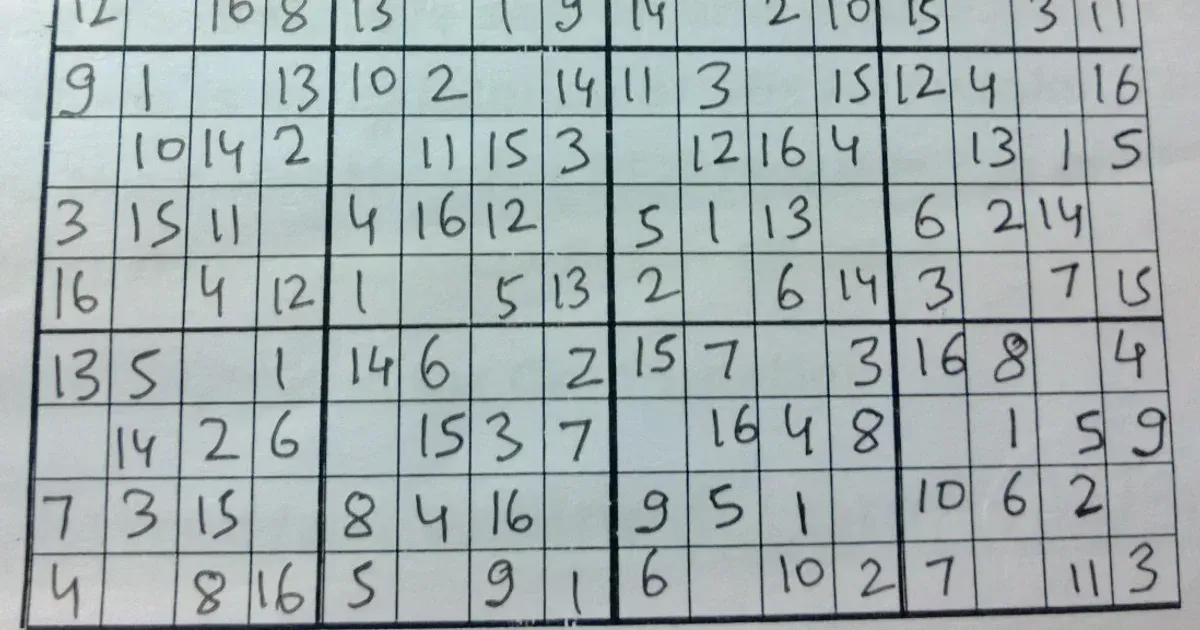
Logic enthusiasts across the globe encountered Killer Sudoku 1,016 on April 4, 2026. This specific iteration of the mathematical puzzle continues a tradition of blending standard Sudoku requirements with additive arithmetic constraints. Every solver must reconcile the placement of digits one through nine with the unique demands of localized summation zones known as cages. These dotted-line enclosures dictate that the sum of all interior numbers must match a small figure printed in the corner.
Players cannot repeat any digit within a single cage, regardless of whether that cage spans across different rows or columns. Mental stamina is the key requirement for those attempting to conquer the 1,016th entry in the series.
Arithmetic precision separates the amateur from the expert in this particular variant. Traditional puzzles require only spatial awareness and the elimination of candidates based on nine-cell blocks. Killer Sudoku 1,016 forces a deeper engagement with the properties of numbers themselves. Experts rely on the Rule of 45, a foundational mathematical principle where every row, column, and 3x3 block must sum to exactly forty-five. Subtracting known cage totals from this constant allows players to isolate specific cell values with absolute certainty. Deduction becomes an exercise in pure calculation. The Guardian Lifestyle editorial team maintains the standards for these daily challenges, ensuring that every grid has exactly one logical solution that does not require guessing.
Mathematical Complexity of Cage Constraints
Cages define the difficulty level of any Killer Sudoku 1,016 grid by their shape and the frequency of their intersections. Smaller cages containing only two cells provide the easiest entry points, especially when the target sum is a three or a seventeen. A sum of three in two cells must be a one and a two. By contrast, a sum of seventeen in two cells must be an eight and a nine. These fixed pairs act as anchors for the rest of the board. Larger cages consisting of five or six cells present rapidly more combinations, requiring solvers to cross-reference multiple rows and columns simultaneously. Mathematics dictates that a cage of three cells summing to six can only contain the digits one, two, and three.
Logic remains the only weapon against a blank grid. Beyond the simple combinations, advanced techniques like the Law of Leftovers determine success in the upper tiers of play. When a group of cages almost fills a nonet or a row, the remaining cells outside those cages must equal the difference between the cage sums and forty-five. Professional solvers identify these outies or innies to break through stalled progress. Data from competitive puzzle forums suggest that average completion times for 1,016-level puzzles range from thirty minutes to two hours. Speed varies based on the player's ability to recognize patterns in cage geometry.
Normal sudoku rules apply, except the numbers in the cells contained within dotted lines add up to the figures in the corner. The Guardian Lifestyle provides these puzzles as part of a broader commitment to intellectual fitness and leisure. This organization popularized the format in the United Kingdom during the early 2000s, riding the wave of the original Sudoku craze that began in Japan. While the base game relies on Latin Squares, the Killer variant introduced a layer of complexity that appealed to accountants and mathematicians. Historical records show that the first versions of these additive puzzles appeared under the name Samunamupure. This Japanese portmanteau of sum and number place highlights the dual nature of the challenge.
Evolution from Traditional Japanese Logic Puzzles
Howard Garns first published the precursor to Sudoku in 1979 under the title Number Place. His design focused on the nine-by-nine grid and the concept of unique placement within subgrids. Nikoli, the Japanese puzzle giant, later refined these rules and exported the game globally under the name Sudoku. The transition to Killer variants occurred as a response to players seeking greater difficulty after mastering standard elimination techniques. Miyuki Misawa is often credited with the creative leap that added the dotted-line cages to the established grid. Each iteration, including Killer Sudoku 1,016, builds upon decades of refinement in grid balance and difficulty scaling.
Japanese puzzle culture emphasizes the hand-crafted nature of these challenges. Unlike many digital versions that rely on random number generators, premium Killer Sudoku grids are often designed by human architects. These designers ensure that the path to the solution is elegant and avoids tedious trial-and-error. Every cage placement is a deliberate choice intended to lead the solver through a specific sequence of logical revelations. Historical analysis of puzzle archives shows that the frequency of Killer Sudoku publications has increased by 40% since 2015. The growth reflects a sustained demand for high-stakes mental exercise among aging populations in the West.
Mental fatigue is the main challenge. Solving a puzzle like Killer Sudoku 1,016 requires the brain to maintain multiple conflicting hypotheses while performing rapid-fire addition. Psychologists often cite these activities as prime examples of flow state, where a person becomes entirely absorbed in a task. The absorption provides a temporary reprieve from daily stressors while strengthening the neural pathways associated with working memory. The Guardian Lifestyle remains a central hub for this community, offering a standardized platform for comparison and competition. Success in the 1,016th puzzle is a badge of honor for long-term subscribers.
Cognitive Impact of Advanced Arithmetic Deduction
Studies indicate that regular engagement with complex logic puzzles may delay the onset of cognitive decline in older adults. Neurologists at various research institutions monitor how the brain processes the complex demands of Killer Sudoku. The task requires the prefrontal cortex to manage spatial data while the parietal lobe handles the numerical sums. The cross-hemisphere communication is rare in daily tasks, making the puzzle a unique form of cognitive training. Participants in long-term studies often show improved scores in executive function and attention to detail. Killer Sudoku 1,016 is a rigorous iteration of this mental workout.
Killer Sudoku Shows Advanced Puzzle Demand
Killer Sudoku keeps advanced players engaged because it combines arithmetic pressure with grid logic. The appeal is not relaxation alone; it is the satisfaction of solving a problem that resists shortcuts.