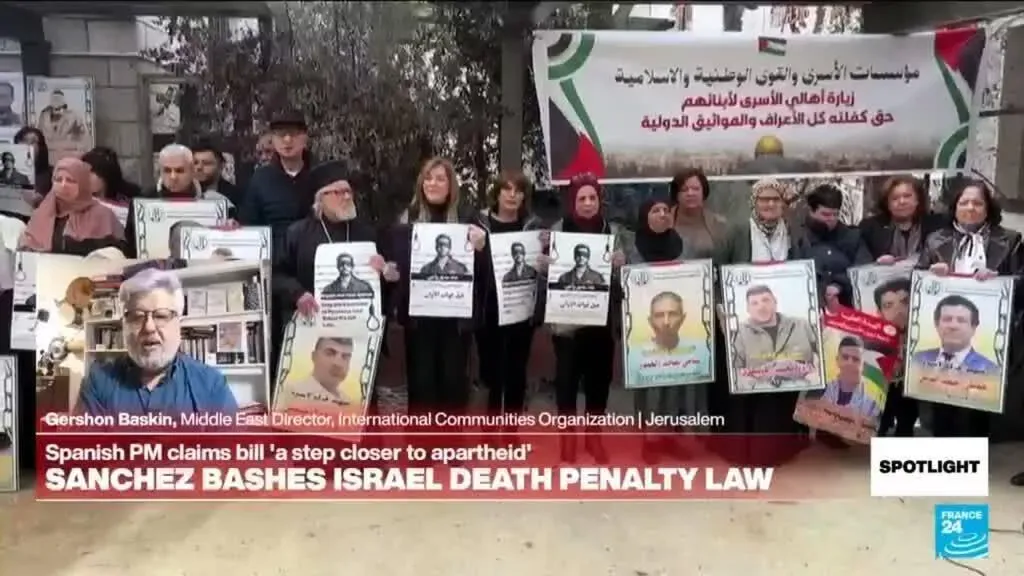
Israel's new death penalty law is one of the sharpest rule-of-law tests to emerge from the country's current security politics. The Knesset passed the measure on March 30, 2026, by 62 votes to 48, expanding capital punishment for terrorism-related killings and drawing immediate legal challenges, human-rights criticism and international condemnation.
The legal stakes are severe because the law is not being received as a neutral criminal-justice reform. Critics argue that its wording and political context make it apply in practice to Palestinians, especially those tried under systems connected to the occupied West Bank, while comparable violence by Jewish Israelis would not be treated the same way. The discriminatory framing takes the dispute beyond capital punishment itself. It asks whether a state can claim equal justice while designing the harshest penalty around identity and conflict.
The Law Puts Execution Back Into a Live Conflict
Israel has long had capital punishment in narrow historical contexts, most famously the execution of Adolf Eichmann in 1962. The new law is different because it brings the death penalty into the present Israeli-Palestinian conflict. Rights groups and legal analysts say it makes execution the default penalty for certain fatal terrorism-related offenses and requires sentences to be carried out within 90 days after a final ruling.
The 90-day timeline matters. A death penalty attached to a live national conflict carries a political charge that an ordinary criminal statute does not. It risks turning punishment into a public performance of vengeance, especially when far-right political figures present executions as proof of state strength.
Discrimination Is the Core Objection
The central criticism is that the law creates a two-track system. Human Rights Watch, Amnesty International, Israeli civil-rights groups and international-law scholars have argued that the measure is discriminatory because it is expected to apply primarily, and perhaps exclusively, to Palestinians. The UN Committee on the Elimination of Racial Discrimination has also warned that the law appears racially discriminatory in practice.
A justice system can punish murder and terrorism severely without abandoning equality. The problem arises when the identity of the accused and the political category of the violence shape whether the state seeks death. If Palestinian violence is treated as execution-worthy while comparable settler violence follows another path, the penalty becomes part of the conflict rather than a neutral rule.
Deterrence Is a Thin Justification
Supporters argue that the law will deter lethal attacks and give families of victims a form of justice. That claim carries emotional force, especially after years of mass violence, hostage trauma and civilian killings. But deterrence in ideologically motivated violence is notoriously difficult to prove. A person prepared to die during an attack may not be restrained by the threat of execution afterward.
Executions can also create martyrs, deepen grievance and give armed groups another recruiting symbol. That does not answer the pain of victims' families. It does show why the most irreversible punishment a state can impose cannot be justified by political certainty alone. The burden of proof has to be higher than anger.
Due Process Is Harder Under Pressure
Death penalty cases demand the strongest procedural safeguards because error cannot be repaired. That is exactly where critics see danger. Military-court structures, compressed timelines, limited discretion and a conflict environment shaped by intelligence evidence all raise due-process concerns. If an execution follows a flawed conviction, no later review can restore the person killed by the state.
The law also places judges in a political trap. If Israeli courts narrow or strike parts of the measure, government supporters can accuse them of blocking security policy. If courts allow broad use, critics will say the judiciary accepted unequal justice. Either outcome puts legal institutions under pressure at a moment when Israel's courts are already central to domestic political conflict.
International Condemnation Has Strategic Cost
The law has drawn criticism from rights groups, European governments, regional states and international bodies. International criticism matters because Israel is already facing intense scrutiny over Gaza, Palestinian detention conditions, military conduct and settlement violence. Expanding capital punishment in a way widely described as targeting Palestinians adds another legal and diplomatic burden.
Supporters may dismiss foreign criticism as hypocrisy or hostility. But international legitimacy is not decoration. It affects alliances, court exposure, military cooperation, trade discussions and the political room friendly governments have to defend Israel. A death penalty law that looks discriminatory makes that defense harder.
Security Cannot Replace Law
Israel has the right and duty to prosecute murder and terrorism with seriousness. Civilians have been killed, families have been destroyed and the state faces real threats. But law exists precisely to keep punishment from becoming the mirror image of rage.
The death penalty law may satisfy a demand for force while weakening the legal order it claims to defend. If the measure is applied unequally, it will not make justice stronger. It will make the courtroom another front in the conflict. A democracy can punish lethal violence severely without executing through a framework many of its own legal critics call discriminatory. If it cannot hold that line, security has stopped protecting law and started replacing it.