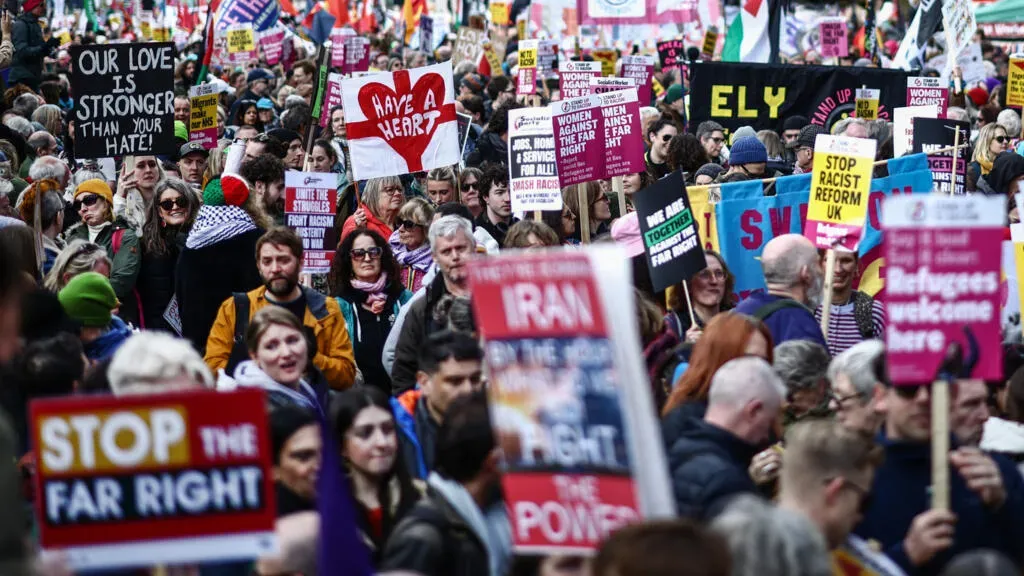
Tens of thousands of people marched through central London on March 28, 2026, in a Together Alliance demonstration against the far right. Organizers claimed half a million people took part, while police put the crowd closer to 50,000 and acknowledged the difficulty of judging a dispersed march.
The gap between those numbers became part of the story, but both figures pointed to the same political fact: anti-far-right groups had assembled one of Britain's most visible street mobilizations of the year. The march was backed by a wide coalition of unions, anti-racism campaigners, artists, faith voices, community groups and civil-society organizations.
The route began around Park Lane and moved through central London toward Whitehall, giving the event a deliberately symbolic path through the capital. Banners focused on racism, nationalism, division and the danger of normalizing far-right politics. The march was not a party rally, but it landed in a clearly electoral season, with local contests approaching and Reform UK still shaping the national argument over immigration and identity.
Crowd Size Became A Momentum Fight
Turnout matters at demonstrations because it is used as proof of momentum. Organizers described the march as historic and framed it as the largest anti-far-right and multicultural demonstration in British history. Police estimates were much lower. Supporters used the size of the crowd to argue that the tide was turning. Critics used the gap in numbers to question the claim.
That disagreement is familiar, but it should not obscure the coalition behind the march. Together Alliance brought together groups that do not all share the same day-to-day priorities but could align around opposition to racism, nationalist scapegoating and far-right street politics. That breadth gave the event moral force beyond one party or campaign.
The same breadth is also a challenge. A large coalition can fill streets more easily than it can write a shared program. After the march, the harder question is what the alliance wants councils, parties and local organizers to do next.
The Election Context Made The Timing Sharp
The demonstration came ahead of local elections, when arguments about immigration, public services, housing and national identity were already shaping political debate. A London march cannot decide those contests by itself. It can, however, force parties and local candidates to respond to visible anti-far-right organizing.
That is why the event had a dual identity. It was a civil-society statement against racism and division. It was also a pressure signal before voters went to the polls. Speakers and campaigners could frame the day as a defense of pluralism while also trying to show that far-right narratives would meet organized resistance.
Police kept a visible presence, and the march was broadly focused on message rather than disorder. That mattered for organizers. If the story had become mainly about confrontation, the coalition's size and purpose would have been easier to dismiss.
Street Protest Has To Reach Beyond London
The central weakness of any capital-city demonstration is geography. A huge London march can be portrayed by opponents as metropolitan performance unless the message travels into towns and local campaigns where far-right politics often gains ground.
That means the post-march phase is more important than the crowd shot. Anti-far-right organizing has to address the conditions far-right movements exploit: housing pressure, insecure work, public-service strain and mistrust of institutions. Condemning racism is necessary. It is not enough if voters facing real insecurity hear no practical alternative.
The strongest next step would be local rather than theatrical: meetings, voter registration, candidate pressure, trade-union work, community defense and policy language that takes insecurity seriously without adopting far-right explanations.
The March Proved Capacity, Not Persuasion
The Together Alliance showed it can mobilize at scale. That is not trivial. It proves that Britain still has a large organized constituency willing to oppose far-right politics in public space.
What it has not yet proved is persuasion. A march can strengthen supporters and warn opponents, but local voters will still ask what replaces the politics being rejected. If the alliance can answer that question in communities outside central London, March 28 may become more than a dramatic image from the capital.
If it cannot, opponents will frame the demonstration as exactly the divide it claims to fight. That is the hard test now. Anti-far-right unity can fill a street. Turning that unity into durable local politics is the work that begins after the banners are folded.