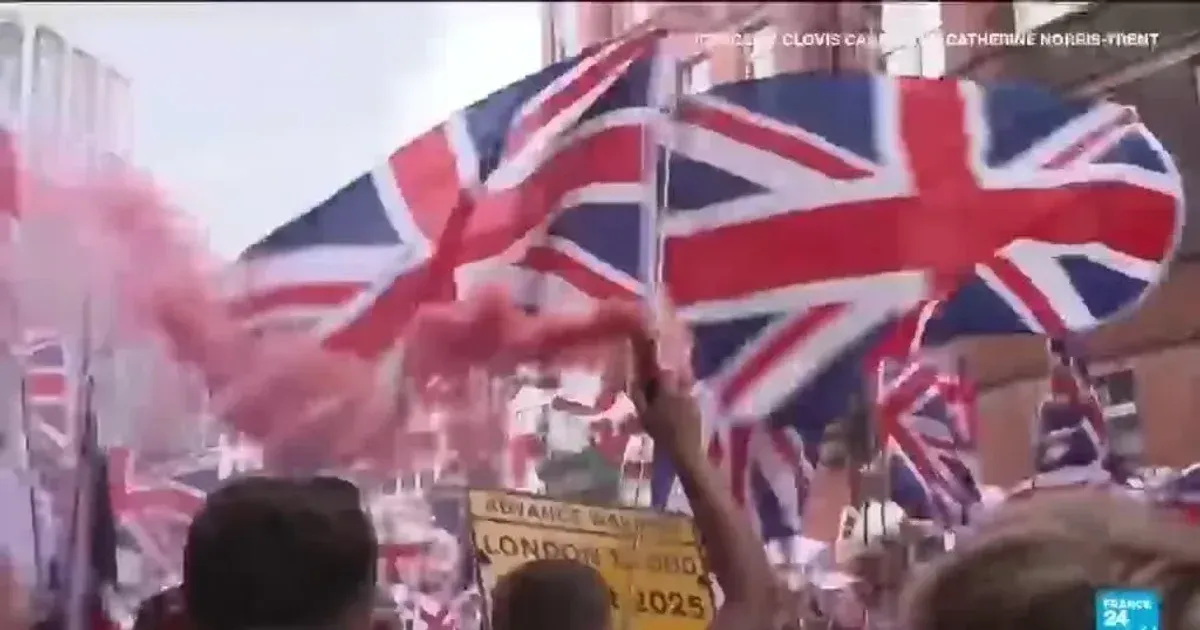
London police are preparing for a protest day shaped by rival movements, overlapping routes and a high risk of confrontation. The operation separates a Tommy Robinson-led rally from a large pro-Palestine march marking Nakba Day. Officers are relying on exclusion zones, timed routes and a heavy city-center deployment. On May 16, 2026, commanders said the goal was to keep the groups physically apart.
Metropolitan Police officials established separate zones for each group to reduce the risk of physical altercations. Far-right activist Tommy Robinson gathered thousands of supporters for a rally focused on anti-immigration rhetoric and what he termed the preservation of British identity. Robinson urged his followers to get involved immediately or risk losing their country forever, using language that sparked concerns among local community leaders.
Far-right demonstrators converged on Parliament Square, while a large pro-Palestine march moved toward Whitehall. This second group marked Nakba Day, the annual commemoration of the displacement of Palestinians during the 1948 conflict. Organizers for the pro-Palestine event estimated that tens of thousands joined the procession, carrying banners calling for a permanent ceasefire and the recognition of Palestinian statehood.
Separate Routes Under Public Order Powers
Robinson, who has a history of organizing high-profile rallies that often result in clashes with counter-protesters, stood at the center of the far-right mobilization. His presence was a catalyst for a heavy police presence. Authorities used powers under the Public Order Act to impose strict conditions on both gatherings, including designated start times and specific routes that ensured the two factions did not meet. Despite the risk of escalation, police reported that early stages of the afternoon remained relatively controlled, though verbal confrontations between fringe elements of both sides occurred near police lines.
Pro-Palestine demonstrators began their march from Victoria Embankment, winding through central corridors towards the government district. Their event coincided with the 78th anniversary of the Nakba, adding a layer of historical sensitivity to the day's proceedings. While the focus of the march was international in scope, it frequently merged with local counter-protests against the far-right rally, creating a single large bloc of opposition to Robinson's supporters.
Officers positioned themselves at every major intersection between the two protest routes. They formed human chains and used steel barriers to maintain a corridor of separation. The scale of the deployment has forced the Metropolitan Police to cancel leave for many units and bring in reinforcements from neighboring constabularies. Estimates suggest the total number of officers on duty exceeds 2,000, supported by mounted units and aerial surveillance drones.
Public safety remains the primary concern for the Home Office.
Transport Disruption Across Central London
While Robinson’s speech focused heavily on immigration and the perceived failure of government policy, the pro-Palestine speakers addressed the humanitarian situation in Gaza and the West Bank. These divergent agendas highlight the deepening social divisions within the United Kingdom. However, the immediate logistical challenge for law enforcement is the physical containment of these groups within their allotted spaces.
Authorities designated specific areas for static protests, but the mobile nature of the Nakba Day march complicates the containment strategy. Smaller splinter groups have already attempted to break away from the main march to confront far-right activists near Trafalgar Square. Police intercepted these groups before they could reach the Robinson rally, though several arrests for public order offenses were made in the scuffle.
Legal analysts suggest that the use of Sections 12 and 14 of the Public Order Act gives police broad latitude to arrest those who deviate from the agreed routes. Such measures are intended to prevent the kind of widespread civil unrest seen in previous years. Each movement carries its own set of grievances, but the convergence of these two specific groups on a single Saturday has created a unique pressure point for urban security.
Social media platforms have been flooded with live streams from both sides, further inflaming the atmosphere as participants react to real-time updates from across the police lines. Transport for London warned of severe delays across the Underground and bus networks as several roads remain closed to accommodate the crowds. Business owners in the West End reported a sharp drop in foot traffic as tourists avoided the heavily policed zones.
Rival Mass Protests Test London’s Containment Model
Does the current policing model provide a sustainable solution for the increasing frequency of rival mass mobilizations in the British capital? The heavy reliance on static containment and enormous personnel deployment suggests a reactive posture that may struggle to adapt to more fluid, decentralized protest tactics. Historically, the Metropolitan Police have successfully managed large-scale events through negotiation, yet the ideological chasm between these two specific groups makes traditional mediation nearly impossible.
Future security strategies will likely need to incorporate more sophisticated digital monitoring to anticipate splinter movements before they reach critical mass. The financial burden of these operations, often costing millions of pounds per weekend, continues to drain resources from neighborhood policing. If these dual-protest scenarios become the new standard for London, the tactical and economic strain on the force could reach a breaking point.
London today is a testing ground for how a democratic society balances the right to protest with the necessity of maintaining public order. The outcome of today’s operations will determine whether current legal frameworks are sufficient or if more restrictive measures will be debated in Parliament. The immediate security line held. The policing lesson from the day will depend on whether separation orders held without turning central London into a permanently fortified protest zone.