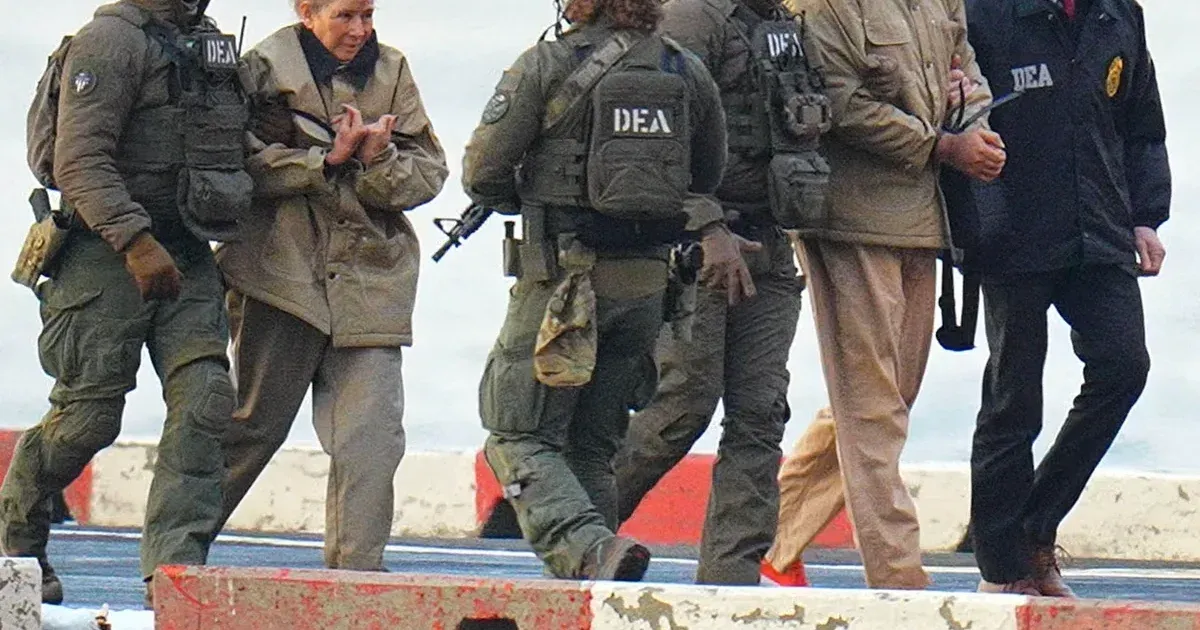
Nicolás Maduro arrived in a Manhattan federal court to face charges of narco-terrorism following his capture by American forces. Federal marshals escorted the deposed leader and his wife into the courtroom under heavy security. On March 12, 2026, Maduro's Manhattan case entered a higher-stakes legal phase. The update came on March 26, 2026.
Maduro and Flores Face Narco-Terrorism Indictment
But the legal battle in New York focuses strictly on the 2020 indictment that is the foundation for the current case. Prosecutors argue that Maduro transformed the Venezuelan state into a criminal enterprise dedicated to international drug trafficking. They allege he partnered with the FARC, a Colombian guerrilla group, to coordinate large-scale shipments through the Caribbean. Evidence includes intercepted communications and ledger entries from high-ranking military officers. Cilia Flores, the former first lady, faces accusations of assisting her husband in laundering the proceeds from these transactions. She stood beside her husband in court wearing a standard-issue jumpsuit. Her legal team requested separate proceedings, citing a lack of direct evidence linking her to the drug flights. The judge has not yet ruled on the motion for severance. The prosecution case is more concrete: the Southern District of New York has prepared a witness list that includes several former members of the Maduro inner circle. These individuals reportedly defected in the weeks leading up to the January raid. Their testimony aims to link Maduro directly to the protection of cocaine laboratories in the Venezuelan interior. Prosecutors believe these witnesses can confirm the use of government-owned naval vessels to transport illicit cargo. Court documents mention specific dates where military radar was intentionally disabled to enable these movements. Defense lawyers countered by labeling the witnesses as paid informants with no credibility. They argued the case is a political fabrication designed to justify a military intervention. The defense seeks to suppress several thousand hours of audio recordings obtained through wiretaps.
January Military Assault on Caracas Details
Still, the geopolitical consequences of the capture dominate the debate outside the courtroom. Venezuela has undergone a rapid administrative overhaul as a transitional government attempts to restore order after the 100-person casualty event. American advisors are currently working with local officials to restructure the national police force. Donald Trump, the U.S. President, has praised the military operation as a necessity for regional security. His administration maintains that the removal of Maduro was essential to disrupting the flow of narcotics into American cities. The White House has already pledged billions in aid to assist the new Venezuelan leadership. Public opinion in Caracas remains deeply divided over the legitimacy of the U.S.-led assault. Some residents celebrated the fall of the administration while others protested the loss of life during the raid. According to court records, the narco-terrorism conspiracy involved the distribution of over 250 metric tons of cocaine annually. This volume is roughly equivalent to the entire output of several major regional producers. Prosecutors intend to show that Maduro received kickbacks for every kilogram that crossed the border. The financial trail leads through several shell companies in offshore jurisdictions. Investigators have frozen bank accounts across three continents linked to the Flores family. The prosecution asserts that these funds were used to maintain a private militia for Maduro. These paramilitary groups reportedly provided the final line of defense during the January extraction. Bullet holes still mark the exterior of the Miraflores Palace where the primary engagement occurred.
The scope and magnitude of the drug trafficking alleged in this case is vast, involving the calculated use of military assets to enable the movement of narcotics.
And yet the defense maintains that Maduro enjoys sovereign immunity despite his deposition. They argue that a foreign head of state cannot be tried in a domestic court for acts committed while in office. Legal experts suggest this argument will be the primary focus of the pre-trial motions. The Department of Justice disputes this claim, citing the criminal nature of the acts alleged. They contend that narco-terrorism does not form a legitimate state function. Federal judges have previously rejected similar immunity claims in cases involving other former dictators. The precedent set by the Manuel Noriega trial in 1992 figures heavily in the current legal briefs. Both sides are expected to file thousands of pages of additional arguments before the summer.
Southern District of New York Prosecution Strategy
The prosecution has also emphasized the danger Maduro allegedly posed to American national security. They claim his ties to various insurgent groups created a permanent threat along the southern border. The indictment lists several meetings between Venezuelan officials and representatives from hostile foreign intelligence agencies. Prosecutors will use these meetings to establish a pattern of behavior beyond simple drug trafficking. They want to prove that the cocaine trade was a tool used to destabilize regional rivals. The trial will feature expert testimony on the chemistry of the seized narcotics to prove their origin. Chemical signatures match samples taken from laboratories in the Apure region. This evidence is critical for establishing the chain of custody for the illegal substances.
The defense has highlighted the high death toll from the January 3 raid to build international sympathy. They describe the operation as an illegal kidnapping that violated international law. Human rights organizations have called for an independent investigation into the civilian casualties in Caracas. These groups argue that the use of special forces in a densely populated urban area was reckless. The United Nations has requested access to the detainees to verify their health and treatment. Maduro has complained of isolation and limited access to his legal counsel since his arrival in New York.
Federal authorities insist they are following all standard protocols for high-security prisoners. His cell is located in a specialized wing of the Metropolitan Correctional Center.
The case also intersects with the global energy market, which has reacted sharply to the shift in Venezuelan power. Crude oil prices fluctuated as the transitional government announced a full audit of the state-owned oil company, PDVSA. The biggest refineries in the country are operating at half capacity due to technical failures and a lack of personnel. American energy firms are already negotiating for the rights to modernize the infrastructure. These contracts could potentially restore Venezuela as a primary supplier to the Western Hemisphere. Donald Trump has signaled his support for these deals as a way to lower domestic gas prices.
Investors are watching the Manhattan trial for any signs of instability that could derail these economic plans. The transition remains fragile as various factions vie for control of the oil ministry.
The judicial process is still moving forward despite the external chaos. The judge has scheduled the next evidentiary hearing for late April. Both Maduro and Flores will remain in federal custody without bail until the trial begins. Prosecutors have requested a gag order to prevent the defense from leaking sensitive discovery material. The defense argued this would infringe on their right to a public trial. Legal analysts expect the jury selection process to take several weeks given the high-profile nature of the case. Each potential juror will be screened for political bias regarding the U.S. involvement in Venezuela. The trial is projected to last through the end of the year.
Inside the courtroom, Maduro's physical appearance suggested the strain of the last three months. He has lost visible weight and spoke only when addressed by the judge. His wife, Cilia Flores, spent the duration of the hearing looking toward the gallery. Security personnel blocked any attempts at communication between the defendants and the press. The couple was whisked away in an armored motorcade immediately after the session adjourned. Protesters gathered outside the courthouse with signs both supporting and condemning the prosecution. Police kept the two groups on opposite sides of the street to prevent clashes. Several arrests were made for disorderly conduct in the afternoon. The judge noted the date for the next hearing.
Manhattan Prosecution Risk
The case now turns on whether prosecutors can keep the courtroom focused on evidence rather than the politics of the operation that brought Maduro to New York.