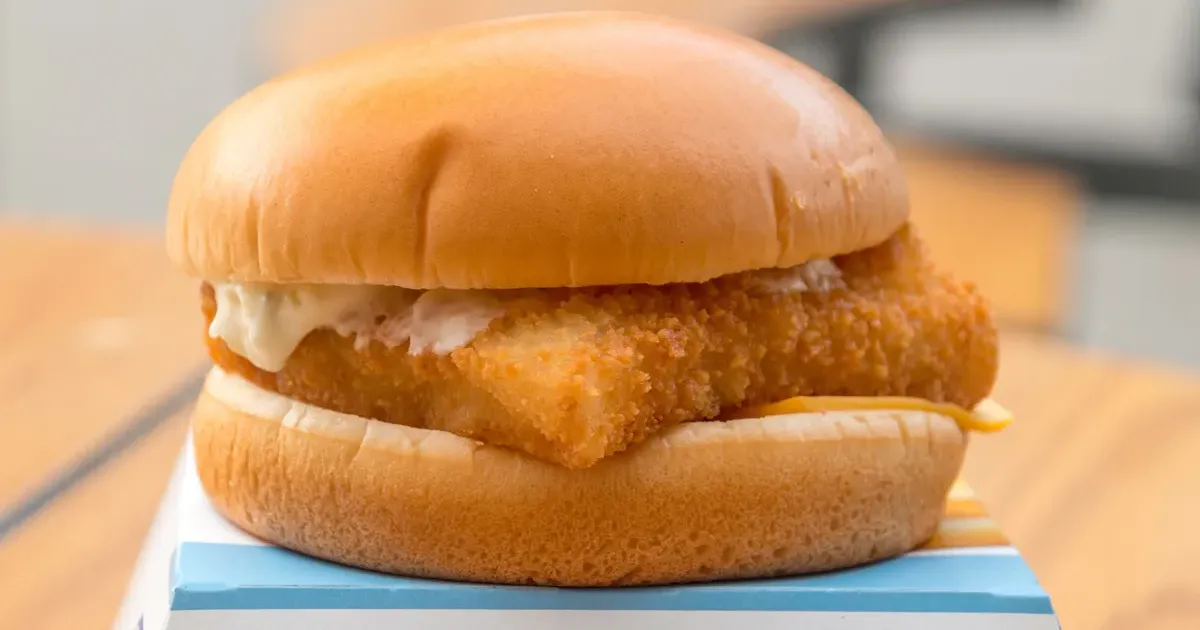
Cincinnati entrepreneur Lou Groen noticed a problem in 1962 that threatened to sink his fledgling franchise. Located in a predominantly Roman Catholic neighborhood, his restaurant saw sales plummet every Friday during Lent. Meatless Fridays were a non-negotiable religious observation for his customer base, and the standard hamburger-heavy menu offered nothing for them. Groen responded by creating a breaded whitefish sandwich, which he pitched to Ray Kroc as a solution to the seasonal revenue dip.
Kroc was skeptical and insisted on a competition. He had his own meatless alternative called the Hula Burger, which consisted of a slice of grilled pineapple and cheese on a bun. On Good Friday in 1962, both sandwiches were placed on the menu to see which sold more. Groen’s fish sandwich sold 350 units, while the Hula Burger sold only six. The Filet-O-Fish became a permanent fixture, yet its marketing journey eventually included a bizarre, forgotten character that few modern diners remember.
Forgotten Mascot Phil and Fish Sandwich Origins
Marketing efforts in the 1970s introduced a cast of characters to represent specific menu items. Ronald McDonald handled the brand overall, while Mayor McCheese and the Hamburglar focused on beef. For the Filet-O-Fish, the company introduced Phil, a small, cute cartoon character. Phil was a personified fish wearing a sailor hat, designed to appeal to children who were often hesitant to eat seafood at a burger joint. He appeared in print advertisements and television commercials, often portrayed as a friendly seafaring guide for the younger demographic.
Phil eventually vanished from the corporate roster without a formal retirement. Brand historians suggest his disappearance coincided with a shift toward more live-action and celebrity-focused advertising in the late 1980s. Unlike the Grimace, who enjoyed a massive social media resurgence in recent years, Phil remains a relic of a more whimsical marketing era. His absence marks a departure from the days when every individual sandwich required a mascot to justify its place on the menu tray.
But the whimsy of the 1970s has been replaced by the hard mathematics of 2026. Data from the first quarter shows that the cost of a Filet-O-Fish has risen sharply faster than the rate of general food inflation. Customers in urban centers like New York and London now report paying upwards of $6.50 for the sandwich alone. This price point is significant hurdle for a product that was originally conceived as a budget-friendly alternative for a specific community need.
Comparing Menu Costs with Burger King
Recent price tracking data indicates a growing gap between the Golden Arches and its primary competitors. Market analysts at The Takeout observed that Burger King has capitalized on McDonald's aggressive pricing strategy by maintaining more traditional value tiers. In head-to-head comparisons, Burger King’s Big Fish sandwich frequently retails for 20% to 30% less than the Filet-O-Fish in the same zip codes. This pricing disparity extends to other core menu items, including the flagship burgers and breakfast offerings.
Economic reports suggest that Burger King’s reliance on digital coupons and loyalty apps has allowed them to undercut McDonald's on perceived value. While a Big Mac meal now frequently exceeds $12.00 in many jurisdictions, Burger King has maintained a aggressive rotation of 2-for-1 deals and family bundles. The strategy focuses on reclaiming the middle-class families who have felt priced out of the premiumized McDonald's experience. Internal documents from franchise associations indicate that foot traffic at McDonald's has plateaued as a direct result of these cost increases.
The value proposition that defined fast food for sixty years is effectively dead, replaced by a tiered system that prioritizes margin over volume.
So, the shift in pricing has forced a change in consumer behavior. Long-time loyalists are no longer visiting out of habit but are instead performing price audits before choosing their lunch destination. In fact, social media platforms are filled with user-generated comparisons showing that a sit-down meal at a casual dining chain like Chili's often costs less than a large McDonald's combo. This reality has stripped away the primary competitive advantage that Ray Kroc worked so hard to establish in the mid-century market.
Shifting Consumer Loyalty in Fast Food
Loyalty is becoming a luxury that many American households can no longer afford. Consumer sentiment surveys conducted in early 2026 reveal that 45% of frequent fast-food diners have switched their primary brand in the last eighteen months. Cost was cited as the primary driver for 80% of those respondents. Meanwhile, Burger King and Wendy's have stabilized their market share by leaning into the 'value' identity that McDonald's seems eager to shed. That trend has created a vacuum in the industry for a truly affordable, no-frills dining option.
Franchisees are feeling the pressure of this transition. Operating costs, including labor and utilities, have forced many owners to raise prices despite the risk of alienating customers. Still, the corporate office in Chicago continues to push for premium ingredients and expensive kitchen upgrades. Such a internal tension between corporate vision and local reality often results in the erratic pricing seen at the drive-thru. One restaurant may charge $5.00 for a 10-piece nugget, while another just three miles away charges $8.00.
And the impact on brand perception is measurable. Brand equity scores for McDonald's have dipped to their lowest levels in a decade among Gen Z and Millennial cohorts. These groups prioritize price-to-quality ratios and are quick to abandon brands they perceive as exploitative. By contrast, competitors who have leaned into transparent pricing models are seeing a slow but steady increase in brand favorability. The lack of a clear, nationwide value menu has left McDonald's vulnerable to localized price wars.
Investor Pressure and Franchisee Relations
Investors remain focused on the bottom line, which currently favors the high-margin strategy. Wall Street analysts point to the company's strong dividend performance and high average check sizes as proof that the strategy works. Yet, this focus on short-term quarterly gains may be masking a long-term erosion of the customer base. If the core demographic of fast food, the working class, can no longer afford the product, the entire business model faces a structural threat. Total transaction counts are down even as total revenue remains high due to the price hikes.
Franchise owners are increasingly vocal about the need for a national pricing floor or a return to the Dollar Menu format. They argue that the current trajectory is unsustainable for suburban locations where competition is fierce and margins are thin. Separately, the rise of private label prepared foods at grocery chains like Aldi and Lidl has introduced a new tier of competition. These retailers offer high-quality, heat-and-eat meals at a fraction of the cost of a McDonald's bag.
Market dynamics in 2026 show that the fast food giant is at a crossroads. It can either double down on its transformation into a premium lifestyle brand or return to its roots as an affordable utility. For one, the forgotten mascot Phil and the $0.15 hamburger of the past seem like relics from a different planet. The current executive leadership appears committed to the premium path, betting that the brand's convenience and global footprint will outweigh the sticker shock. Recent data shows that 15% of diners now opt for smaller portions to manage costs.
The Elite Tribune Perspective
History suggests that empires rarely fall to outside forces, but rather to the rot within their own value propositions. McDonald's is currently engaged in a dangerous game of chicken with its own customer base, betting that the Golden Arches are so culturally entrenched that they can ignore the laws of economic gravity. The decision to abandon the low-income consumer in favor of higher margins is not just a business shift; it is a betrayal of the very ethos that built the company. Ray Kroc did not build an empire on $9.00 fish sandwiches. He built it on the premise that a family could eat a clean, fast meal for the pocket change found in their couch cushions.
By allowing Burger King to win the price war so easily, McDonald's has ceded the high ground of the American lunch hour. The corporate obsession with digital integration and 'premium' branding is a mask for the fact that the actual food has not improved enough to justify the 40% price hikes seen over the last five years. If the brand continues to alienate the base that made it a global powerhouse, it will eventually find itself as a boutique relic of the past rather than a leader of the future.
Greedy pricing strategies have a way of creating openings for leaner, hungrier competitors to steal the throne. The ghost of Lou Groen would likely be appalled at the current price of his Good Friday miracle.