Research published by ScienceDaily on April 4, 2026, indicated that catastrophic asteroid strikes likely were a main catalyst for terrestrial biology. Evidence suggests these collisions produced localized hydrothermal systems capable of sustaining complex chemistry for thousands of years. Early Earth lacked the stable environments modern organisms require, yet violent impacts provided the heat and mineral richness necessary to bridge the gap between inanimate matter and living cells.
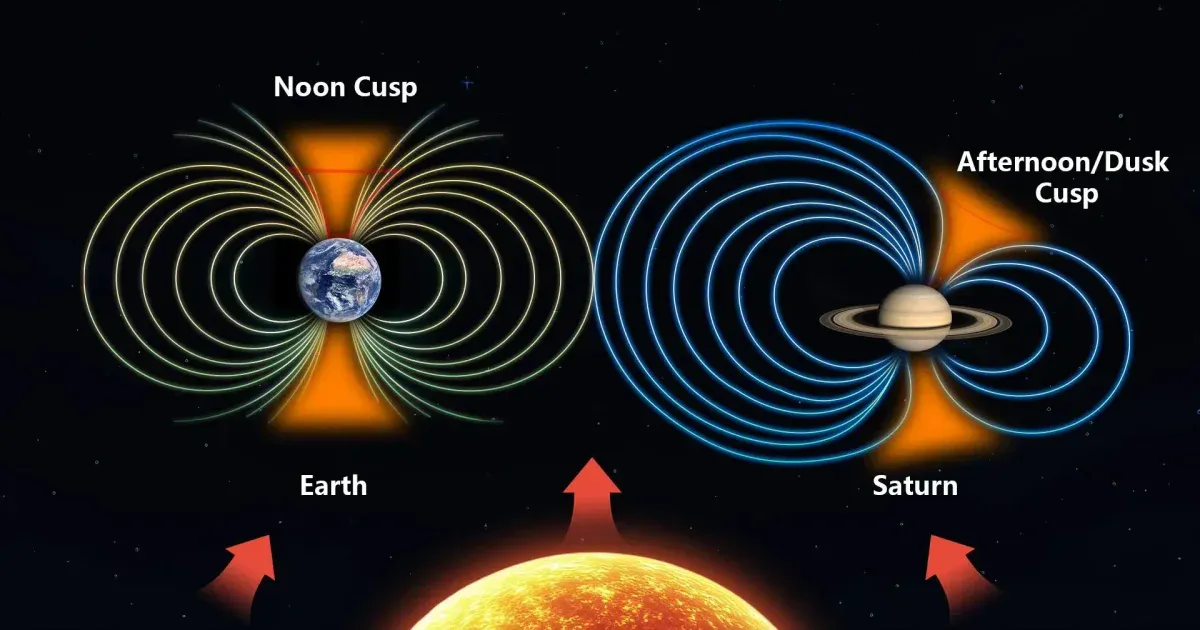
Impact-generated hydrothermal systems functioned as chemical nurseries where prebiotic molecules could assemble. Scientists now identify these craters as the most probable sites for the origin of life because they offered consistent energy sources in an otherwise frozen or desolate world. Science Daily reports that these environments remained active long enough for simple building blocks like amino acids to organize into more complex structures. While Earth's early history was defined by these transformative collisions, other celestial bodies show how different forces shape planetary environments. Researchers analyzing data from the Cassini mission have identified a distinct anomaly in the magnetic field of Saturn. Unlike the symmetrical protection surrounding Earth, Saturn possesses a skewed magnetic shield that defies standard planetary models.
Ancient Meteor Impacts and Biological Building Blocks
Heat generated during an asteroid impact does not dissipate instantly but instead cycles through the crust via subterranean water. The process turned destructive impacts into long-lived chemical environments. Moving water through heated mineral beds creates a chemical soup rich in iron, sulfur, and carbon. These specific conditions mirror the deep-sea vents often cited as potential birthplaces for life, but impact craters provided these benefits on land and in shallow seas across the entire planet.
Prebiotic chemistry requires a steady influx of energy to overcome the entropy of raw elements. Hydrothermal systems fueled by the kinetic energy of meteors offered this stability. Research indicates these systems persisted for over 10,000 years depending on the size of the initial impactor. Longevity allowed for the slow, iterative process of molecular evolution to occur without being extinguished by the cooling of the planetary crust.
Every major impact crater on Earth likely hosted a unique experiment in organic synthesis. If a single crater failed to produce viable life, thousands of other impact sites across the Hadean Eon provided additional opportunities. Planetary scientists believe this abundance of hydrothermal reactors made the emergence of life almost inevitable. The sheer volume of these environments suggests that similar processes could be occurring on moons or planets within other solar systems today.
Saturn presents a different set of physical challenges that involve magnetic instability rather than biological potential. NASA investigators spent years reviewing observations from the Cassini orbiter to understand why the planet's magnetosphere appears lopsided. Traditional physics dictates that a planet's magnetic field should align closely with its axis of rotation. Saturn, however, exhibits a measurable shift where solar particles enter the atmosphere at an angle that contradicts existing symmetry theories.
Rapid rotation plays a major role in this magnetic distortion. Saturn completes a full turn in approximately 10.7 hours, a speed that generates intense internal dynamos. This centrifugal force interacts with the surrounding plasma in ways that slower-rotating planets do not experience. Data points to a consistent displacement of the magnetic poles relative to the geometric poles of the planet. Skewed magnetic fields suggest that the internal structure of Saturn is more complex than previously estimated. Beneath the thick layers of hydrogen and helium, the metallic hydrogen core may be shifting or interacting with external pressures in an asymmetric fashion. This imbalance affects how the planet interacts with the solar wind and protects its various moons from radiation.
Enceladus Cloud Drives Atmospheric Particle Shifts
Extensive clouds of charged particles originating from the moon Enceladus are now blamed for the specific warp in the Saturnian magnetic field. Cryovolcanoes on the moon's surface eject enormous amounts of water vapor and ice into space. Once these particles reach the orbit of Saturn, they become ionized and form a thick torus of plasma. The large ring of charged matter exerts its own magnetic influence, pulling and twisting the larger planetary field toward the moon's orbital plane.
Gravity and electromagnetism compete for control over these drifting particles. While Saturn's gravity attempts to pull the debris inward, the planet's rotation flings the plasma outward. The resulting tension creates a magnetic drag that slows down the magnetosphere on one side. The interaction proves that even a small moon can fundamentally alter the physics of its parent planet.
Solar particles entering Saturn's atmosphere are shifted to one side because of this plasma interference. Scientists used the $3.9 billion investment in the Cassini mission to track these movements with historic precision. Findings confirm that the interaction between Enceladus and Saturn is not a secondary feature but a main driver of the planet's environmental profile. Saturn is a laboratory for understanding how moons influence planetary shields.
Hydrothermal Systems as Planetary Life Incubators
Searching for life in the universe now requires a focus on impact history instead of just the presence of liquid water. Impact craters on Mars or the icy crust of Europa might have once hosted the same hydrothermal nurseries that sparked life on Earth. These systems provide the necessary heat even when a planet is located far from its host star's habitable zone. Kinetic energy effectively replaces solar energy as the engine of biological development.
Observing the magnetic distortion of Saturn also provides a blueprint for studying exoplanets. If a distant gas giant shows a skewed magnetic field, astronomers can now infer the presence of an active, geologically volatile moon like Enceladus. These invisible magnetic signatures tell a story of orbital dynamics and particle physics that visual telescopes cannot capture. Every distortion in a field is a physical object or force exerting its will on the cosmic stage.
Planetary science has moved beyond simple observation into a phase of complex synthesis. Connecting the chemistry of ancient Earth craters to the magnetic anomalies of modern Saturn reveals a universe governed by violent, interconnected mechanics. These forces do not act in isolation. Instead, they define the limits of where life can begin and how planets protect themselves from the vacuum of space.
Meteor Chemistry Reopens Origins Debate
Meteor chemistry remains compelling because it connects planetary violence with biological possibility. The theory does not solve the origin of life, but it gives researchers another plausible pathway to test.