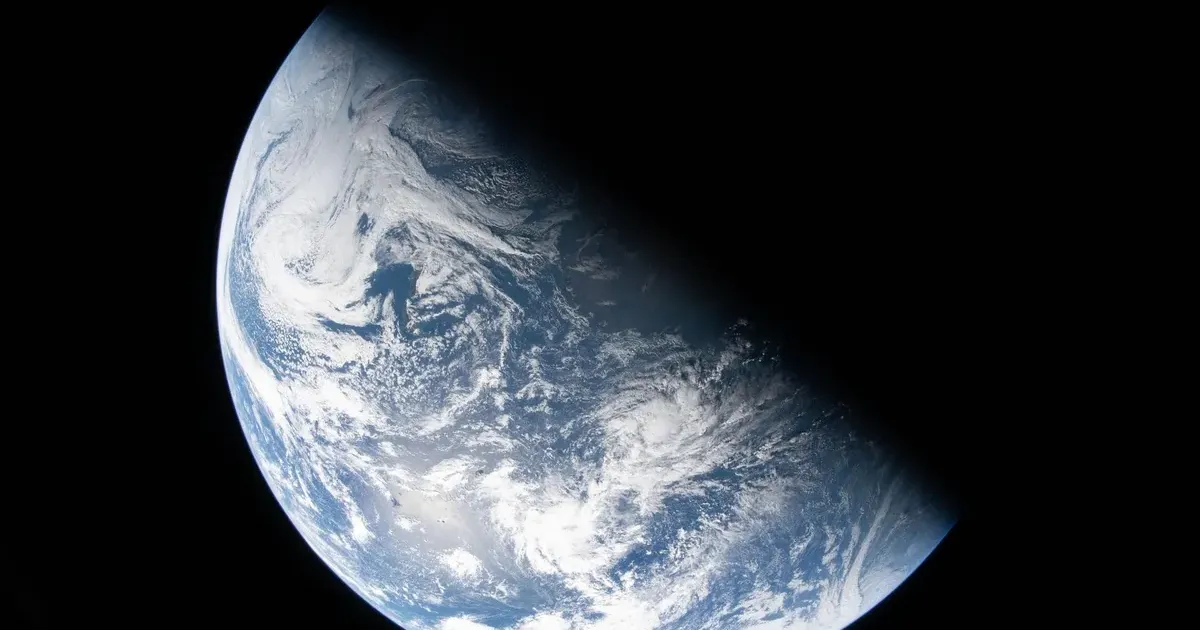
NASA astronauts Reid Wiseman, Victor Glover, Christina Koch, and Jeremy Hansen transmitted high-resolution images of Earth from their positions inside the Orion spacecraft. These photographs represent the first human-captured perspectives of the planet from deep space since the final Apollo mission concluded in 1972. The April 4, 2026 transmission gave NASA its first public visual marker from this phase of the mission. Captured from a distance exceeding 200,000 miles, the digital files reached ground stations via the upgraded Deep Space Network. Onboard sensors confirmed the craft maintained a stable trajectory while the crew documented the vanishing terrestrial horizon. Digital clarity in these images exceeds previous analog records by a factor of ten, providing scientists with atmospheric data captured from a unique orbital angle.
Every byte of data underwent rigorous encryption before traveling through the vacuum toward receivers in Australia and California. Wiseman, the mission commander, oversaw the imaging sequence to ensure the cameras captured specific geological features of the Western Hemisphere. Records indicate that the transmission occurred during a planned lull in primary flight operations. Ground teams at the Johnson Space Center processed the files within minutes of arrival to verify the integrity of the optical sensors. Orion continues to accelerate toward the lunar far side at speeds exceeding several thousand miles per hour.
Deep Space Imaging and Data Transmission Systems
High-definition cameras mounted within the Orion spacecraft windows used advanced CMOS sensors to compensate for the extreme contrast of deep space. Koch, serving as mission specialist, calibrated the equipment to prevent light bleed from the sun. Data packets moved through the Optical Communications system, which uses infrared lasers to boost transfer rates. Deep space missions historically relied on low-bandwidth radio waves, but this flight utilizes a hybrid system. Engineers noted that the laser link allowed for the transfer of a 4K video stream alongside the still photography. This milestone provides a technical blueprint for future communication with Mars-bound crews.
Communication delays between Earth and the capsule reached approximately 1.3 seconds during the photo session. Glover, the pilot, monitored the orientation of the high-gain antenna to ensure constant alignment with terrestrial receivers. Precise pointing remains critical for the success of these high-speed data bursts. Any deviation in the craft's attitude of more than one degree would cause the signal to drop. Flight controllers in Houston reported zero packet loss during the three-hour window of the primary imaging operation.
Atmospheric layers appeared as thin, electric-blue bands against the blackness of the void. Optical systems functioned without lag.
Orion Spacecraft Performance and Crew Life Support
Hansen confirmed that the internal environment of the crew module stayed within nominal parameters during the heavy power usage of the transmission. Carbon dioxide scrubbers and oxygen replenishment systems operated at peak efficiency throughout the first three days of the voyage. Liquid oxygen levels in the European Service Module remain at 92 percent of capacity. Radiation sensors located behind the crew seats monitored a minor increase in solar activity, yet the shielding within the capsule walls kept exposure well below safety limits. These readings are essential for assessing the long-term viability of the deep space habitat.
Velocity hit 25,000 miles per hour during the trans-lunar injection phase.
Heat shield integrity is a primary concern for the return trip, though current telemetry shows the external tiles are intact. Federal budget disclosures estimated the cost of this specific flight hardware at $4.1 billion. NASA technicians spent years testing the thermal protection system against simulated micrometeoroid impacts. Onboard cameras regularly scan the exterior of the craft to look for pitting or cracks. No anomalies have appeared in the visual inspections conducted by the crew so far.
NASA flight path calculations placed the Artemis II crew on a free-return trajectory that uses lunar gravity to sling the craft back to Earth. This loop requires no engine burns once the initial path is set, providing a safety net if propulsion systems fail. Fuel reserves for the return burn remain within the 5 percent margin. Current projections show the crew will reach the lunar far side in approximately 24 hours. Once the craft clears the lunar shadow, communication will resume via the S-band radio array. Trajectory corrections have been minimal due to the accuracy of the Space Launch System rocket during the ascent phase.
"The imagery provides essential data for our navigation systems while offering a perspective not seen by human eyes in five decades," a NASA mission spokesperson said during the transmission event.
Previous missions used film that required chemical processing upon return to Earth. Today, the immediate availability of raw data allows for real-time analysis of the spacecraft's optical health. Technical teams in Huntsville, Alabama, are already comparing these new images to satellite data to calibrate Orion's autonomous navigation system. Reliability of the star-tracking sensors ensures the craft can find its way home even if ground communication ceases. Every maneuver performed by Wiseman and Glover aligns with the flight plan established six months ago.
Lunar transit speed increased as the craft entered the moon's sphere of gravitational influence. Pressure within the crew module held steady at 14.7 pounds per square inch. Solar arrays extended to their full 62-foot span, providing 11 kilowatts of power to the avionics suite. NASA officials confirmed the next set of images will focus on the lunar surface as the crew approaches the 4,600-mile flyby point.
Orion Images Turn Distance Into Evidence
The first lunar views matter because they make the mission visible beyond telemetry. For NASA, the images also show that communications, orientation and crew routines are holding together as Orion moves deeper into flight.