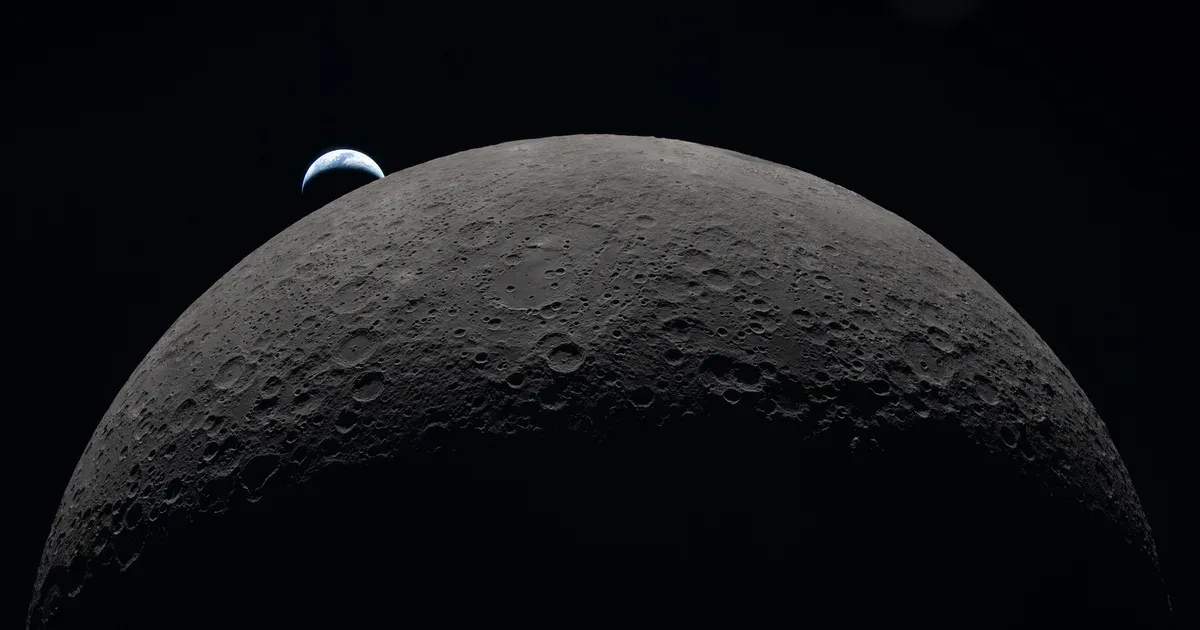
The Artemis II far-side passage is a test of isolation as much as navigation. Orion moved behind the Moon, cutting the crew off from ground stations for several hours. Mission controllers described the blackout as a planned stress point for spacecraft endurance and crew procedures. On April 6, 2026, NASA confirmed that the four-person crew had entered the lunar communication blackout zone during the mission’s free-return path.
Technical flight parameters indicate the spacecraft is maintaining a stable path as it utilizes the moon’s gravitational pull for a return slingshot. This maneuver requires precise orbital mechanics to ensure the Orion capsule gains sufficient velocity for the homeward leg. Mission control in Houston reported nominal readings for all life support systems before the signal dropped. Silence now dominates the communication channels while the crew documents the lunar surface with high-resolution imaging systems. Visual observations of the lunar far side remain a primary objective for the four specialists on board.
Lunar Far Side Communication Blackout
Radio waves cannot penetrate the large bulk of the moon, creating a predictable but tense period of silence for flight directors. Earth disappears from view entirely during this transit, replaced by the rugged, cratered expanse of the lunar highlands. Sensors on the Orion craft are programmed to operate autonomously to collect geological data and radiation measurements. Analysts expect the crew to gather thousands of images of regions that have not been seen by human eyes since the Apollo era. Previous robotic missions mapped these areas, yet the presence of humans allows for real-time adjustments to scientific priorities. Data packets will begin streaming back to the Deep Space Network once the craft clears the lunar limb.
Weightlessness and confinement pose serious psychological challenges for a crew separated from every other human by nearly 250,000 miles. NASA medical teams have monitored the astronauts’ biometrics throughout the mission to study the effects of prolonged deep-space exposure. High levels of solar radiation outside the protection of the magnetosphere remain a primary concern for long-term lunar habitation. Orion features specialized shielding in its core to protect the crew during solar particle events. Every hour spent in this environment provides critical telemetry for the eventual establishment of the Gateway station. Constant monitoring of CO2 levels and oxygen mix ensures the cabin environment remains within safe thresholds.
Technical Endurance and Mission Objectives
Engineers designed the Space Launch System and Orion to withstand the extreme thermal gradients of the lunar environment. Sunlight heats the exterior to 250 degrees Fahrenheit, while shadows drop temperatures to minus 250 degrees. Advanced insulation layers and an active thermal control system maintain a habitable internal temperature of 70 degrees. The heat shield, a critical component for the upcoming reentry, must remain intact despite the abrasive environment of space. Success for Artemis II depends on the durability of these hardware components under stress. Reliability remains the most scrutinized metric for the $4.1 billion launch architecture.
The possibility of alien life is a core consideration in mission planning, and exploring the secrets of the universe includes asking the question: Are we alone?
Jared Isaacman, a top official at NASA, framed the mission as part of a broader existential inquiry. Isaacman believes that human presence in deep space is essential for answering fundamental questions about the cosmos. While robotic probes can perform basic chemical analysis, the flexibility of human intuition often leads to serendipitous discoveries. Isaacman argued that the search for extraterrestrial life requires a more solid physical presence across the solar system. Scientific exploration frequently hits plateaus when limited to remote-controlled sensors. Human curiosity drives the mission beyond mere data collection.
Jared Isaacman on Extraterrestrial Life
Extraterrestrial biology has moved from the fringes of speculative science to a central foundation of NASA’s long-term strategy. Isaacman noted that identifying habitable environments or chemical biosignatures requires sophisticated field work. Artemis II is a precursor to landing missions that will explore the moon’s south pole for water ice. Such resources are essential for sustaining life during multi-year voyages to Mars. If water can be harvested on the moon, it will drastically reduce the mass requirements for future launches. Liquid hydrogen and oxygen derived from lunar ice could fuel the next generation of interplanetary craft. Strategic planning now focuses on the logistical chain required for permanent lunar outposts.
Critics, however, question the necessity of sending biological payloads when AI-driven rovers are becoming increasingly capable. Robots do not require oxygen, food, or psychological support. They can endure radiation levels that would be fatal to a human crew over long durations. The cost of maintaining a human life in space is vastly higher than the cost of a robotic mission. Budgetary constraints often force a choice between high-risk human flights and a larger number of low-cost autonomous probes. NASA maintains that the symbolic and cognitive value of human exploration outweighs these fiscal concerns. Public engagement historically peaks when humans are at the controls.
The far-side milestone also fed the debate over human and robotic utility, since Artemis has to justify why crewed judgment adds value beyond automated systems.
Advocates for human-centric missions point to the efficiency of human geological sampling compared to current robotic arms. A human astronaut can identify, bag, and label dozens of unique rock samples in the time it takes a rover to analyze a single pebble. This speed is essential for maximizing the scientific output of expensive mission windows. Human eyes can also detect subtle color variations in soil that cameras might miss. Artemis II is proving the viability of the Orion habitat for these extended tasks. Success here validates the design for the upcoming Artemis III landing. $4.1 billion is a huge investment in human capability.
Future missions will likely blend human expertise with robotic assistance to create a hybrid exploration model. Autonomous drones could scout lunar lava tubes while astronauts coordinate the data from a nearby base. This cooperation allows for greater safety and expanded range. Current testing on Artemis II focuses on the basic survival and navigation requirements for such a future. Once the craft completes its lunar swing, it will begin a high-speed reentry into Earth’s atmosphere. The final phase will test the heat shield at speeds exceeding 24,000 miles per hour. Recovery teams are already positioning themselves in the Pacific Ocean.
Far Side Mission Test
Reliance on biological payloads in the age of generative intelligence and autonomous robotics appears increasingly like an expensive vanity project. While NASA and officials like Jared Isaacman lean heavily on the romantic allure of the explorer, the cold reality of orbital mechanics and radiation physics suggests that humans are the weakest link in the exploration chain. Every kilogram of life support equipment replaces a kilogram of scientific sensors. We are spending billions to prove that we can survive in a vacuum where we do not belong, primarily to satisfy a 20th-century geopolitical ego that persists into the 21st.
The argument for human intuition is losing ground to machine learning models that can process multispectral data faster and more accurately than any astronaut. If the goal is truly the search for life or the mapping of resources, robots are the superior choice. They are expendable, durable, and cost-effective. NASA’s current path suggests a desperation to justify the SLS and Orion budgets by framing them as essential for the human spirit. The narrative ignores the enormous opportunity cost. For the price of one Artemis mission, the agency could have sent a dozen flagship-class probes to the icy moons of Jupiter and Saturn, where the odds of finding life are considerably higher. Humanity is choosing nostalgia over discovery.
Artemis II remains a technical marvel but a strategic anachronism.