The final leg of a lunar test flight puts routine hardware under pressure.
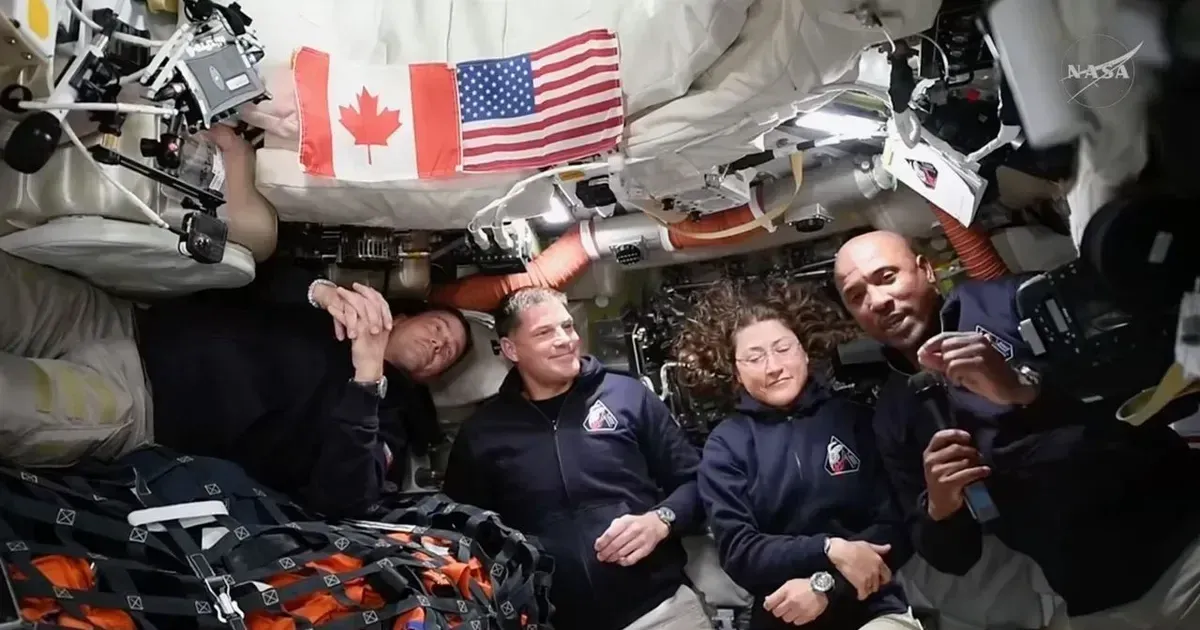
The mission is no longer only about trajectory; it is about proving crew systems. NASA astronaut Victor Glover and his crewmates accelerated toward the far side of the moon on April 5, 2026, marking the final stage of their outward journey. Mission controllers confirmed the Orion spacecraft surpassed the two-thirds distance threshold during the early morning hours. Crew members reported their first clear glimpses of complex lunar geography that few humans have ever witnessed from such proximity. These observations occurred as the capsule prepared to execute a critical gravity-assist maneuver intended to propel the team deeper into space than any previous human-rated vessel.
Orion continues to maintain a steady trajectory despite recurring mechanical frustrations within the pressurized cabin. Waste management systems began malfunctioning for the second time since launch, forcing the four-person crew to implement contingency protocols. Engineers at the Johnson Space Center spent several hours reviewing telemetry data to determine if the blockage in the Universal Waste Management System presented a risk to the mission timeline. Internal reports suggest the crew has transitioned to backup collection methods to maintain hygiene standards during the high-velocity approach.
Maintenance issues have not dampened the spirits of the participants, who spent a portion of their Sunday documenting the lunar surface. Victor Glover shared a message of reflection with ground stations, noting the significance of their position during the Easter holiday. His words traveled across more than 230,000 miles of vacuum before reaching receivers on Earth. The speed of the spacecraft currently exceeds 5,000 miles per hour, with acceleration increasing as lunar gravity exerts a stronger pull on the vehicle.
Orion Systems Get a Real Test
Technical reliability in the deep-space environment presents challenges that differ sharply from low Earth orbit operations. Earlier Artemis flights focused on uncrewed testing, but the inclusion of a human crew has strained the Orion life support infrastructure. Failure of the waste management system reflects a persistent hurdle in long-duration spaceflight design. Hardware designed for the lunar environment must function in both microgravity and the variable gravitational fields encountered during orbital insertion.
Contingency plans for such failures involve a series of manual bypasses and the use of secondary storage containers. Crew members used these tools on April 5, 2026, to ensure the cabin atmosphere stayed within safety parameters. Excess moisture or particulate matter in the cabin could interfere with sensitive electronics or the emergency breathing apparatus. Ground teams emphasized that while the situation is uncomfortable, it does not currently threaten the completion of the lunar flyby.
Hardware issues of this nature recall the difficulties faced by early explorers during the 1960s. Apollo missions frequently encountered plumbing failures that required creative engineering solutions on the fly. NASA designers attempted to modernize these systems for the 21st century, yet the vacuum of space remains an unforgiving environment for mechanical valves and fluid separators. Current mission logs indicate the crew has successfully isolated the leak.
Lunar Views Add Science Value
Visibility improved sharply as Orion closed the gap between Earth and its satellite, allowing the crew to identify specific geological features. Astronauts described an enormous rift on the lunar surface, comparing the scale and depth to the Grand Canyon in Arizona. This feature, likely a combination of ancient volcanic activity and tectonic shifts, appears more pronounced from the unique vantage point of a free-return trajectory. High-resolution cameras on board captured thousands of images for later analysis by planetary geologists.
Light conditions on the lunar surface shifted as the spacecraft moved toward the terminator line, where day meets night. Shadows stretching across the craters provided a sense of depth that orbital telescopes often fail to capture. Scientific instruments mounted on the exterior of Orion began collecting data on the lunar exosphere and radiation environment. These readings will help future missions determine the safest locations for a permanent human settlement near the lunar south pole.
Digital mapping of these regions provides essential data for the upcoming Artemis III landing attempt. Identifying hazards such as steep slopes or boulder fields is a primary objective of this fly-around. The crew reported seeing deep rilles that look like dry riverbeds winding through the lunar dust. Observations of the lunar far side are particularly valuable because that region is permanently hidden from Earth-based observers.
Apollo 13 Record Comes Into View
Orion is currently on track to break the record for the furthest distance from Earth traveled by a crewed spacecraft. This record was set in 1970 by the crew of Apollo 13, who reached 248,655 miles during their emergency return trip. Current projections indicate that Artemis II will exceed this distance by several thousand miles during the peak of its elliptical orbit. Navigational experts at NASA confirmed that the craft is maintaining its planned velocity within a fraction of a percent.
This is a time for us to remember the hope that lives within all of us and the light that shines even in the darkest reaches of space, NASA astronaut Victor Glover stated during his Easter transmission.
Achieving this distance requires precise calculation of the moon's gravitational influence. Mission planners used a free-return trajectory, which uses gravity to sling the spacecraft back toward Earth without requiring a large engine burn. This safety feature ensures that even if the primary propulsion system fails, the crew will eventually return to the atmosphere. The current path keeps Orion at a safe altitude above the lunar surface while maximizing scientific exposure.
Historical comparisons highlight the technological leap represented by the SLS rocket and the Orion capsule. Modern navigation computers process millions of instructions per second, a stark contrast to the hardware used during the mid-20th century. Reliability remains the primary metric of success for this $4 billion test flight. Every mile traveled beyond the previous record provides data on how human physiology reacts to deep space radiation and prolonged isolation.