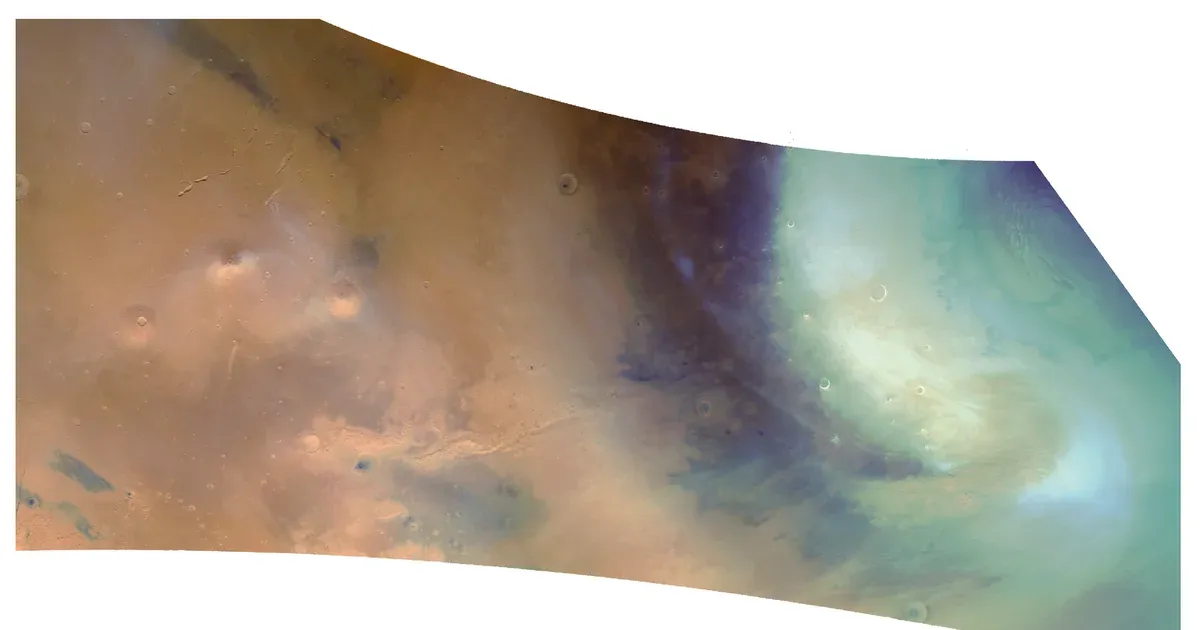
Mars dust storms may act like low-power chemical reactors, generating electrical discharges that alter the planet's surface chemistry. The result gives mission planners another environmental variable to measure. Researchers reported the findings on April 5, 2026, with implications for rovers, future habitats and the search for biosignatures. The process is driven by triboelectric charging. Dust grains collide, exchange charge and create faint sparks or glow discharges in the thin Martian atmosphere. That chemistry matters because future instruments may have to distinguish biological signals from reactions created by the storm environment itself. Rover teams and laboratory modelers will need to compare those reactions against Earth-based simulations before treating any unusual surface chemistry as a mission clue.
Static Electricity Changes Chemistry
Martian discharges are not the same as Earth lightning. They are weaker, more diffuse and shaped by a dry atmosphere, but they can still trigger chemical reactions on dust and soil particles. Those reactions may help form perchlorates, carbonates and other compounds that scientists previously associated with different environmental pathways. The distinction matters because chemistry is part of how Mars records its climate history. Researchers described the storms as capable of producing chemical fingerprints that persist after the dust settles.
Rovers and Habitats Face Added Risk
Static charge is already a practical problem for Mars missions. Dust can cling to solar panels, reduce power generation and increase wear on exposed components. Electrical arcing adds another concern. Sensitive instruments, habitat seals and surface power systems may need stronger protection if storms regularly create charged environments.
Life Searches Need Careful Context
The chemistry also complicates astrobiology. Electrical reactions can produce oxidizing compounds that damage organics, making it harder to preserve evidence of past life. At the same time, those reactions provide clues. If scientists can identify chemical signatures produced by dust-storm electricity, they can better separate atmospheric processes from water-driven or biological possibilities. The finding does not make Mars less interesting. It makes the planet more dynamic. Dust storms are not just weather events; they are part of the surface chemistry that future missions will have to read carefully. Scientists also care about scale. A faint discharge in a laboratory does not automatically mean the same chemistry dominates the entire Martian surface. Researchers have to compare experiments with rover observations, orbital data and seasonal dust patterns. Perchlorates are especially important because they affect both habitability and human exploration. They can be toxic to life as we know it, and they can complicate the handling of Martian soil by astronauts. The finding also changes how teams interpret old samples. If electrical storms can create or modify certain compounds, scientists need to avoid assuming that every chemical signature points to water or biology. For engineers, the lesson is practical. Future habitats may need grounding systems, dust-resistant seals and procedures for storm periods when static charge becomes more likely. For mission planners, the value is prediction. If certain seasons or storm types create stronger electrical effects, rovers can adjust operations to protect instruments and preserve power. Mars remains a harsh place because small environmental stresses combine. Dust blocks sunlight, coats machinery, changes chemistry and may carry charge. Understanding those linked effects is essential before humans try to live there. The research also helps explain why Mars can surprise scientists even after decades of missions. The planet looks dry, cold and geologically quiet compared with Earth, yet its atmosphere and dust can still drive active processes. A storm that appears as a visibility hazard may also be changing the chemistry of the ground beneath it. That means surface samples are not static museum pieces; they are exposed to ongoing environmental processing. Future sample-return work will need to account for that history. If a rock or soil sample carries perchlorates, carbonates or oxidized organics, scientists will ask whether those signatures came from ancient water, volcanic chemistry, radiation or dust-storm electricity. The answer may vary by region and season. That complexity is frustrating, but it is also useful. A more detailed chemical map can help missions choose where to drill, when to operate and how to protect both instruments and eventual crews.
The science teams will also need more field-like experiments that combine dust size, wind speed, atmospheric pressure and surface minerals. Mars chemistry is rarely caused by one factor in isolation.
The finding is useful for future missions for that reason. It gives researchers a better way to ask whether a chemical signature was made by ancient water, modern atmosphere or the electrical life of dust storms.
Scientists now have a stronger reason to coordinate atmospheric monitoring with surface sampling. If a dust season changes chemistry, then timing becomes part of the evidence record, not just background weather.