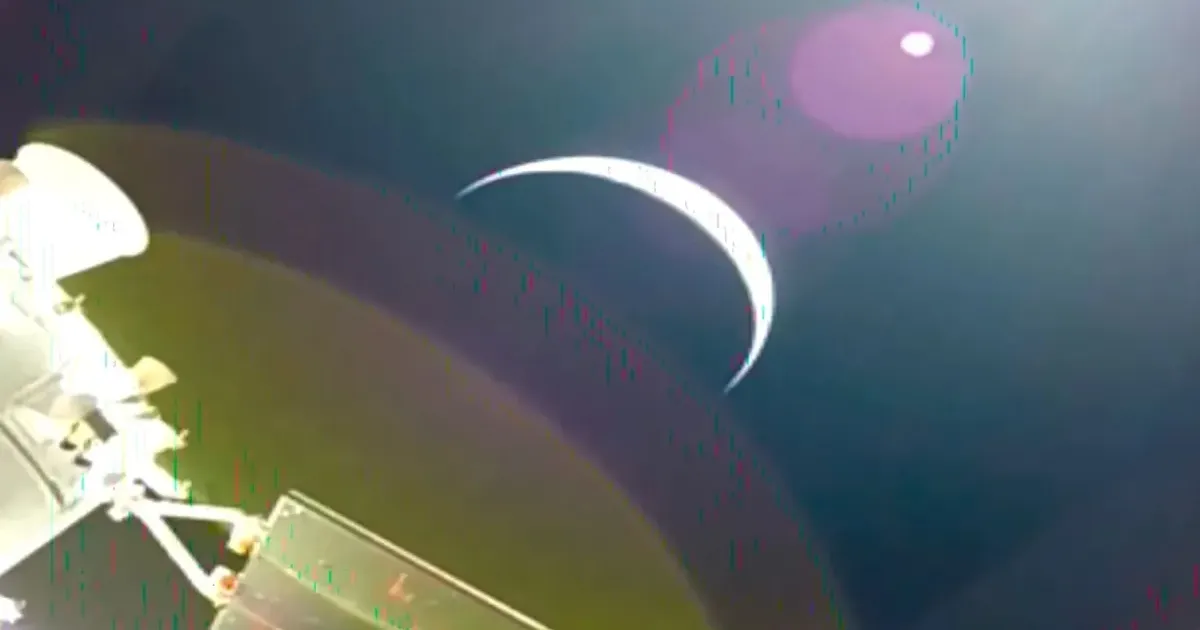
Commander Reid Wiseman confirmed that the Orion spacecraft successfully transitioned into its trans-lunar trajectory. Navigation systems indicated that the vessel, named Integrity, completed a critical engine burn to escape Earth's gravity. NASA engineers in Houston monitored the maneuver as the vehicle reached the acceleration necessary to reach the lunar environment. The exit from terrestrial orbit marks humanity's furthest expansion into the solar system in over half a century. Records confirm the firing of the main engine lasted precisely six minutes. The April 3, 2026, engine burn marked the crew’s real departure from Earth orbit.
Propulsion for the trans-lunar injection came from a six-minute burn that generated approximately 6,000 pounds of thrust. Firing the engine with such precision allowed the crew to achieve the velocity required for a ten-day journey. Crew members reported a smooth transition during the burn, despite the physical forces exerted on the capsule. NASA headquarters in Washington released data showing the craft is now on a stable path toward its rendezvous with the lunar far side. Orbiting the Earth is no longer the primary phase of the mission.
Four astronauts occupy the cabin, including Commander Reid Wiseman, Victor Glover, Christina Koch, and Canadian Space Agency representative Jeremy Hansen. Wiseman described the view of the entire globe from pole to pole as a spectacular moment during the orbital departure. Glover and Hansen managed internal systems while Koch focused on scientific protocols. The four astronauts are the first to travel beyond low Earth orbit since the conclusion of the Apollo program. Weightlessness has become the standard operating environment for the duration of the transit.
Orion Engine Burn Propels Astronauts Toward Moon
Launch preparations encountered problems on April 1, 2026, at 6:35 PM Eastern time. Technical teams identified a hydrogen leak and a helium issue that forced several short delays. Engineers eventually cleared the Space Launch System for flight once the hardware stabilization was confirmed. Separation from the launch system occurred shortly after the vehicle reached initial orbit, allowing the crew to begin manual piloting tests. These exercises evaluate how the Orion capsule will eventually dock with future lunar landing modules. Performance metrics for the manual handling phases met all pre-flight expectations.
“Today, for the first time since Apollo 17 in 1972, humans have departed Earth orbit. Orion is operating with crew for the first time in space, and we are gathering critical data, and learning from each step.”
Engineers analyze every kilobyte of data transmitted from the service module. Hardware performance during the trans-lunar injection provides a baseline for the Artemis II mission. Ground controllers at Johnson Space Center remain in constant contact with the four explorers. Stability in the communication link allows for real-time troubleshooting of internal cabin systems. Most primary systems have functioned within the expected margins of error since launch.
Technical Glitches Challenge Artemis II Crew Inside Integrity
Life aboard the spacecraft has not been without complications. Crew members reported an immediate issue with the onboard toilet shortly after reaching orbit. Christina Koch performed the necessary repairs to restore the waste management system to full functionality. Such mechanical failures are common in the early stages of a first crewed flight test. Maintaining sanitation and environmental controls is a priority for long-duration missions. Repairs were completed using standard onboard tools.
Software issues surfaced alongside the hardware malfunctions. Wiseman reported to mission control that Microsoft Outlook on the Surface Pro devices used by the crew was malfunctioning. Managing digital communication and schedule updates became difficult for the astronauts. Despite these software frustrations, the mission objectives remained unaffected. Flight systems are isolated from the consumer-grade software used for administrative tasks. Crew members used alternative methods to log their daily observations.
Solar particles can interfere with standard electronics, leading to the glitches observed in the Surface Pro units. Shielding on the Orion capsule protects the primary flight computers, but secondary devices are more vulnerable. Engineers in Houston are investigating whether the Outlook errors originated from radiation or simple software bugs. These setbacks have become a part of the daily routine for the crew. Mission control continues to push software patches across the vast distance to the spacecraft.
Geopolitical shifts have also influenced the timing of this mission. Commercial competition has intensified, with reports indicating SpaceX may pursue an IPO valued at $75 billion to fund further deep space ventures. NASA relies on these commercial partnerships for various components of the Artemis infrastructure. Private-sector advancements have forced the federal agency to accelerate its development timelines. Collaboration between government bodies and private aerospace firms is now a permanent feature of lunar exploration. This dynamic creates a complex web of procurement and technical standards.
Testing the thermal protection system during re-entry will be the final hurdle of the mission. For now, the focus remains on the approach to the Moon. The crew must maintain high levels of alertness as they move further from the safety of Earth. Emergency procedures are practiced daily to ensure readiness for any sudden depressurization or power loss. No serious anomalies have been reported in the life support systems since the toilet repair.
Mission Objectives and Lunar Far Side Trajectory
Upcoming milestones include a pass by the lunar far side on April 6, 2026. Humans have never directly viewed this portion of the Moon at such close range. The crew plans to capture high-resolution imagery of the cratered surface for geological analysis. Observations made by the astronauts will supplement data gathered by robotic probes over the last decade. The visual survey helps identify potential landing sites for the Artemis IV mission. Direct human observation provides a perspective that cameras sometimes miss.
Manual piloting tests will continue as the craft approaches lunar gravity. Wiseman and Glover take turns at the controls to simulate docking procedures. These skills are essential for the eventual integration with the Human Landing System. Mastering the physics of lunar approach requires precise timing and fuel management. The crew uses the Moon's gravity to sling the spacecraft back toward Earth. The free-return trajectory is a safety feature designed to bring the crew home even if the main engine fails later.
Orion Reliability Defines the Far-Side Leg
Why did it take fifty-four years to return to the doorstep of the Moon? The Artemis II mission is a triumph of engineering, but it is equally evidence of decades of bureaucratic inertia and shifting political priorities. While the NASA team celebrates the engine burn of the Integrity, the reality is that the United States spent half a century trapped in low Earth orbit. The mission is not a leap forward so much as a desperate crawl back to a frontier we abandoned in 1972. The reliance on civilian software like Microsoft Outlook in a deep-space environment is particularly jarring. It suggests a dangerous trend of prioritizing cost-cutting over the specialized, hardened systems that defined the Apollo era.
Commercial pressures are clearly warping the mission profile. With SpaceX eyeing a $75 billion public offering, NASA is no longer the sole designer of the heavens. The agency is now a customer, vulnerable to the timelines and profit motives of private entities. The transition may increase efficiency, but it complicates the clear-eyed pursuit of scientific discovery. When a mission commander has to troubleshoot Outlook on a Surface Pro while hurtling toward the Moon, we must ask if we are over-relying on terrestrial technology that was never meant for the rigors of the vacuum.
Artemis II is a necessary risk. However, the prestige of the mission cannot mask the fragility of the current aerospace strategy. If a simple toilet malfunction or software glitch can disrupt the routine of the world’s most elite explorers, the margin for error on a landing mission is uncomfortably thin. We are back in the deep dark, but we are carrying the baggage of a consumer-driven tech culture. Deep space still depends on hardware that does not fail.