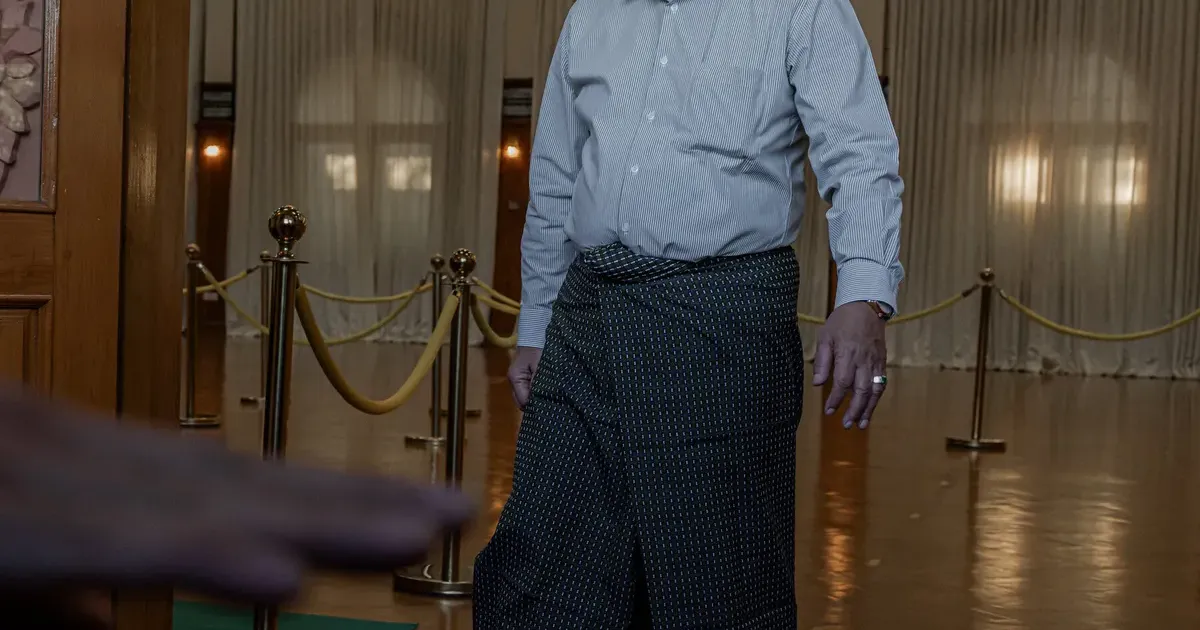
Min Aung Hlaing's move from military chief to president does not mark a democratic transition in Myanmar. It formalizes the same power structure under a different title. The uniform may move away from the centre of the stage, but the military system that seized power in 2021 remains the core of the state.
The formal step came after a heavily criticized election and a pro-military parliament that chose him as president. Al Jazeera reported that he won 429 of 584 votes cast. AP described the vote as taking place after an election that excluded key opposition forces, did not cover large parts of the country and unfolded amid continuing civil war.
The Title Change Protects Continuity
The presidency gives Min Aung Hlaing a civilian-sounding office, but the transition was built to preserve military dominance. A real civilian opening would require power to move outside the Tatmadaw's command network. This arrangement keeps the presidency, the security apparatus and the pro-military legislature aligned.
Crisis Group's description of the new administration as military consolidation, not transition, fits the facts. The regime can point to a parliament, a cabinet and constitutional procedures. None of those elements answer the central legitimacy question: whether a political order born from a coup, repression and controlled elections can claim the consent of a country still at war with it.
Ye Win Oo Keeps The Military Chain Close
The most important personnel move may be Ye Win Oo's rise to commander-in-chief. He is a close Min Aung Hlaing loyalist and former chief of Military Security Affairs, the internal security apparatus often described as the junta leader's eyes and ears. His background is more revealing than the ceremonial language around the handover.
If the new military chief comes from the intelligence and internal-security core, the message is continuity and loyalty. Min Aung Hlaing can hold the presidency while a trusted security figure controls the armed forces. That is not a separation between civilian and military authority. It is a command arrangement with civilian packaging.
The Opposition Was Not Allowed Back In
Myanmar's political reality remains defined by exclusion. The National League for Democracy has been dismantled as a viable parliamentary force, Aung San Suu Kyi remains jailed, and opposition parties, resistance groups and ethnic armed organizations were not brought into a credible national settlement.
The regime's supporters can argue that institutions have been restored. The facts point to a narrower result: institutions have been rebuilt around the military's survival. A parliament dominated by pro-military forces cannot repair the legitimacy damage created by the 2021 coup or by years of arrests, airstrikes, displacement and censorship.
The War Still Defines The State
The military faces pressure from ethnic armed organizations and People's Defense Forces across borderlands and central regions. Airstrikes, disrupted trade, displacement and attacks on civilian areas have deepened the humanitarian crisis. Neighboring states such as Thailand, India and China have to manage refugees, border instability and infrastructure concerns even when they maintain working ties with Naypyidaw.
The war limits what a presidential title can accomplish. A state that controls office buildings but loses territory, roads or towns to resistance forces has an authority problem that paperwork cannot solve. The junta can claim formal hierarchy. It still has to govern a country where large parts of society reject the system behind that hierarchy.
Recognition Becomes More Complicated
Internationally, the presidency creates a recognition problem. ASEAN has struggled to make its peace plan meaningful, while Western governments continue to rely on sanctions and diplomatic isolation. China and Russia have kept more pragmatic channels open, but neither can erase the regime's core weakness: it governs by force over a country that has not accepted its authority.
The new title may make diplomatic protocol easier for some governments. It does not legitimize that engagement. Every meeting with the president also becomes a meeting with the coup leader who converted military rule into civilian form after elections widely criticized as neither free nor inclusive.
Legitimacy Cannot Be Rebranded
The economic cost belongs in the same story. Investment has fallen, the currency has been under pressure and electricity shortages have made ordinary life harder. Military-linked businesses and security spending remain central, while civilian services carry the burden of conflict and isolation.
The junta is trying to convert battlefield survival into state legitimacy. Change titles, stage procedures, call the result order. But Myanmar's crisis is not a paperwork problem. It is a contest over who has the right to rule after a coup, mass repression and years of war. Min Aung Hlaing can become president. That does not make the presidency sovereign in the eyes of a country still fighting the system behind it.