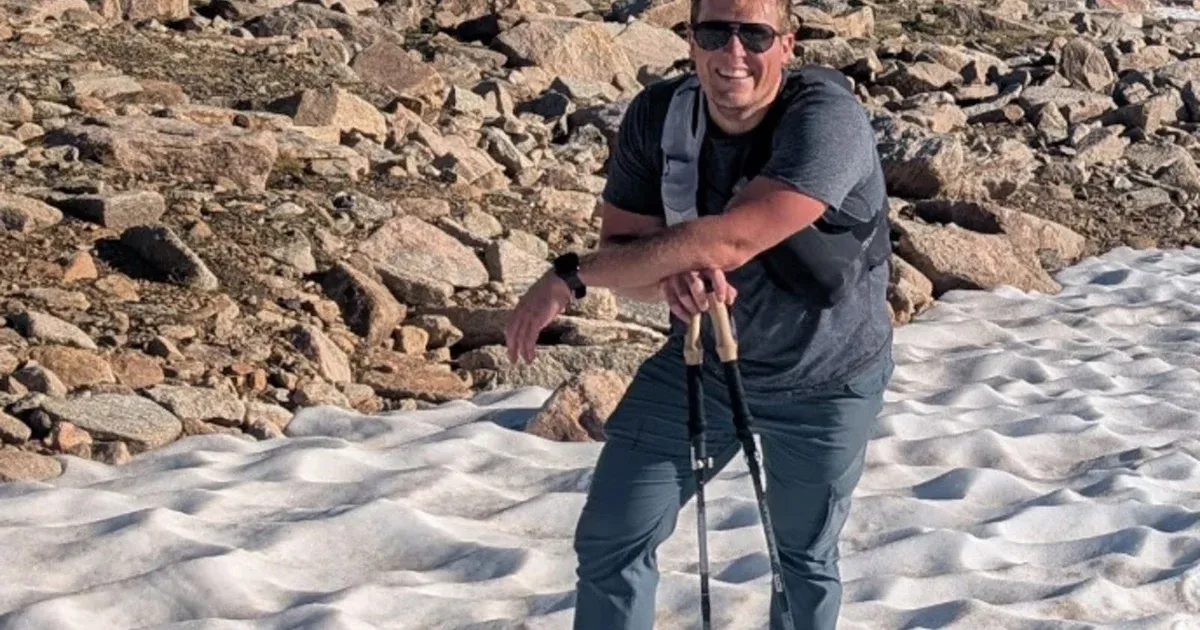
A fall near the top of Montana's highest mountain left David Cifaldi impaled on his own trekking pole. The emergency-room nurse then completed a 10-mile descent with two climbing partners, spending six and a half hours on the route before hospital surgeons could remove the pole.
On July 20, 2026, Cifaldi was climbing with Jesse Ross and Brad Reich when the accident ended their summit attempt. Their safe return depended on an unusual combination: the pole had missed vital organs, Cifaldi remained stable enough to move, his medical training helped him interpret what he felt, and his partners reorganized around the descent. A satellite communicator gave the group a link to authorities even as they chose to move under their own power.
A Fall 1,000 Feet Below the Summit Changed the Route
The three men had started at 3:30 a.m. and were roughly 1,000 feet below the summit when Cifaldi slipped on rock. The shaft entered his torso below the left armpit and came out at the lower back. He could feel it below the skin and could still breathe deeply. The position was visually severe, but Cifaldi did not detect signs that his condition was immediately collapsing.
His background mattered. As a nurse with emergency and wound-care experience, Cifaldi checked for bleeding, loss of sensation and lightheadedness. He believed the pole was stable and that no vital organ had been struck. That was a clinical judgment made in the field, not a guarantee that the descent would remain safe.
The group used a satellite communicator to alert authorities before moving. Cifaldi then chose to return along the route they had climbed instead of waiting at high elevation for an extraction. The decision still required hours of exposure to uneven terrain. It also required the pole to remain fixed while every step transferred motion through his torso. The alert meant the self-rescue was known outside the group, even though outside help did not carry him down.
Ross and Reich turned the return into a three-person system. One stayed behind Cifaldi to monitor his balance on the rugged descent. His other partner went in front so people farther down the route had warning, particularly families with children. Their roles reduced surprise on the trail and kept Cifaldi from managing the route, other hikers and his own stability at once. The formation also let both friends watch different hazards at the same time.
Reaching the trailhead did not end the medical response. Cifaldi first went to a nearby clinic. The group then spent another two hours driving to Billings. Surgeons there performed the removal. Cifaldi later said a shift of only a few inches could have produced a very different outcome. The group plans another summit attempt after he heals.
His Survival Was a Judgment Call, Not a Backcountry Rule
The outcome can look like a simple story of endurance: an injured climber refuses to stop and walks himself out. The more important detail is the information behind the choice. Cifaldi could assess his breathing and circulation, his companions could support the descent, the pole appeared stable, and the group had already made contact through a satellite device. Remove any one of those conditions and the same decision could carry a different risk.
Granite Peak adds no margin through convenience. At more than 12,800 feet, its broken terrain turned 10 miles into a six-and-a-half-hour movement problem. Cifaldi was fortunate enough to remain mobile, but mobility did not make the injury minor. The later surgery confirms that reaching a vehicle was only one stage of the rescue. So did the deliberate walking formation: the team treated every mile as an active emergency, not a return to an ordinary hike.
Cifaldi's composure and his friends' discipline deserve attention because they kept an extraordinary injury from becoming a second accident on the descent. The lesson is not that determination can replace rescue capacity. It is that good decisions depend on the condition actually present, the people and communications available, and the willingness to keep reassessing as the route changes. That distinction matters well beyond this mountain. A rare success becomes dangerous the moment it is flattened into a universal rule.