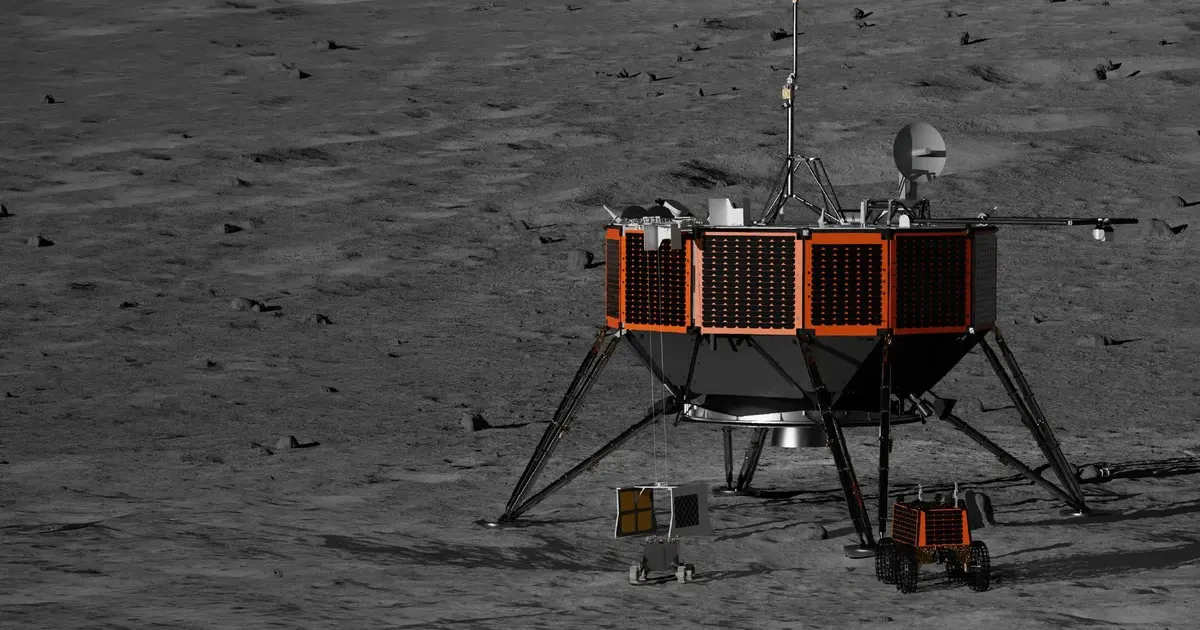
NASA's latest lunar lander award shows that the Artemis program is still moving hardware toward the Moon, but a recent astronaut medical scare keeps the human risk impossible to ignore. The two stories are not the same event, and they should not be collapsed into one. Intuitive Machines received a major NASA award for a future lunar payload delivery, while veteran astronaut Mike Fincke's unexplained medical episode aboard the International Space Station raised separate questions about what happens when a crew member becomes impaired far from full hospital care.
Fincke has said he suddenly lost the ability to speak during an ISS episode in January 2026. Public reporting said the incident lasted about 20 minutes, that he felt no pain, and that doctors had not publicly identified a clear cause after evaluation. The episode was serious enough to sharpen debate around emergency medicine in orbit and beyond. It does not prove that lunar missions are unsafe, but it exposes how thin the margin can be when the human body becomes the weakest system in a mission plan.
The lander award, announced separately, keeps NASA's robotic lunar campaign moving. NASA selected Intuitive Machines of Houston for a $180.4 million Commercial Lunar Payload Services delivery to the Moon's South Pole region. The mission is expected to carry seven science and technology payloads, including five NASA-funded payloads, to study lunar regolith and the radiation environment that future crews will have to understand before longer surface stays become credible.
Intuitive Machines Secures Major Artemis Contract
The $180.4 million award gives Intuitive Machines another high-profile role in NASA's CLPS program. The planned delivery is aimed at the South Pole region, where permanently shadowed areas, volatile deposits and harsh lighting conditions make the science valuable and the operations difficult. NASA is using commercial landers to gather data before committing astronauts to longer and more complex surface activity.
Joel Kearns, deputy associate administrator for exploration in NASA's Science Mission Directorate, framed the award as part of a broader effort to advance lunar science through commercial deliveries. That matters because Artemis does not only need rockets and spacesuits. It needs a working map of the terrain, better measurements of radiation and a realistic understanding of what equipment can survive at the sites where crews may eventually operate.
"NASA continues to progress lunar science and exploration by enabling commercial lunar landings," said Joel Kearns, deputy associate administrator for exploration, Science Mission Directorate, at NASA Headquarters in Washington.
The payload list is designed to reduce uncertainty, not eliminate it. Instruments can measure surface composition, environmental conditions and hazards that are hard to model from Earth. Rovers and lander systems can scout ahead of astronauts and help NASA decide which assumptions about the South Pole are solid and which are still wishful thinking. Robotic missions do not make human missions easy. They make ignorance harder to excuse.
Biological Barriers to Deep-Space Exploration
Fincke's medical episode is a separate warning about crew health. The ISS is close enough for emergency return planning, supported by constant communications, and stocked with equipment that has been refined through decades of orbital operations. Even there, a sudden loss of speech during a mission was alarming. A similar impairment near the Moon would be harder to manage because evacuation, diagnosis and crew workload all become more complicated.
Space medicine already tracks risks from microgravity, radiation exposure, fluid shifts, vision changes, isolation and stress. Public accounts of Fincke's episode did not establish a definitive cause, so the responsible conclusion is narrow: the incident shows that unexplained medical events can happen even to experienced astronauts. It does not justify inventing a diagnosis, and it does not allow confident claims about what would happen at the lunar South Pole. It does force NASA to treat medical autonomy as a mission requirement, not an afterthought.
The lunar environment adds pressure. Crews beyond low-Earth orbit will face higher radiation exposure, limited immediate return options and smaller medical teams. Communication delays are short compared with Mars, but they still matter during a fast-moving emergency. Ground doctors can advise; crew members must act. That is why medical training, onboard diagnostics and clear emergency authority are as important to Artemis as navigation or landing precision.
Robotic precursors are the ethical bridge between ambition and exposure. They can map terrain, measure radiation and test equipment without putting astronauts into avoidable uncertainty. But the robots cannot answer every biological question. NASA still has to decide how much unknown human risk is acceptable before public exploration rhetoric becomes operational gambling.
South Pole Data and Crew Safety
The South Pole is attractive because it may hold resources and science targets that support a longer lunar presence. It is also unforgiving. Lighting angles, cold traps, rough terrain and radiation exposure all complicate operations. A lander mission that studies regolith and the local radiation environment can give mission planners practical data for habitats, suits, power systems and traverse routes.
That data will shape shielding decisions and surface procedures. It may also influence how long crews remain outside, where habitats are placed and how much medical contingency has to be built into each mission. The issue is not whether NASA can land payloads. The issue is whether it can turn science measurements into rules that protect people once the mission leaves the world of instruments and enters the world of human judgment.
Commercial partnerships add speed and flexibility, but they do not remove responsibility from NASA. If private landers fail, stumble or return incomplete data, the agency still owns the risk decisions that follow. Artemis cannot outsource its biological uncertainty to contractors. It can only use commercial systems to narrow the unknowns before astronauts inherit them.
Human Risk Comes First
The medical crisis involving Mike Fincke should serve as a cold dose of reality for anyone intoxicated by the romance of Artemis. NASA can spend hundreds of millions of dollars on commercial landers, rovers and payloads, but none of that changes the central fact: the human body remains the least redundant system in spaceflight. A lander can be redesigned, a payload can be replaced, and a rover can be written off. A crew member losing speech in orbit is not a procurement delay. It is a direct warning.
The agency's reliance on robotic precursors is not just a scientific strategy; it is an admission that the human element is the weakest link in the exploration chain. If a veteran of Fincke's caliber can suffer a mysterious communications-threatening episode in the relatively supported environment of the ISS, NASA has no right to treat lunar medical readiness as a secondary checklist item. Robots can map regolith and measure radiation, but they cannot solve the problem of human fragility.
NASA must prioritize biological resilience with the same intensity it applies to lander contracts, or Artemis will be remembered as a series of expensive robotic triumphs followed by a preventable human failure. The lunar surface does not care about manifest destiny, political branding or contractor milestones. It offers cold, darkness, radiation and silence. It is time Washington stopped pretending those conditions will bend to ambition.