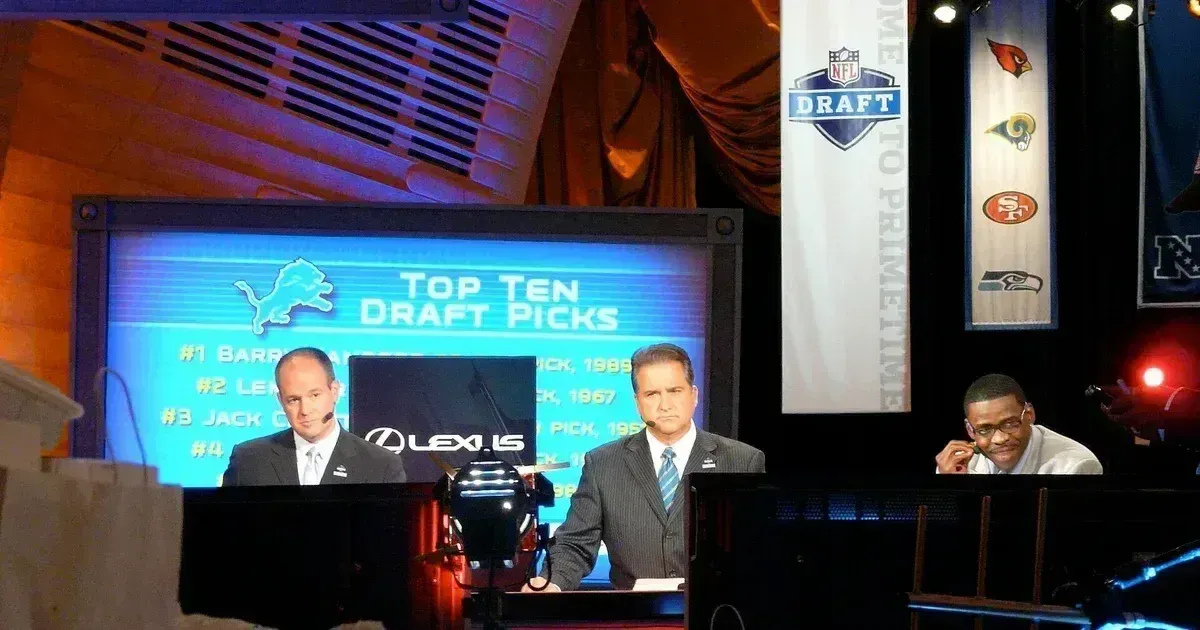
The Washington Commanders and the New York Jets were navigating a draft board defined by high-ceiling offensive prospects on April 23, 2026. Front offices across the league spent the morning reviewing final medical reports and character assessments as the first round approaches. Scouts describe this year’s wide receiver class as uniquely deep in top-tier speed. Projections suggest that multiple teams will trade up to secure specific pass-catchers before the mid-point of the night.
Washington Commanders officials have focused their internal discussions on providing Jayden Daniels with a legitimate second option alongside Terry McLaurin. Rookie quarterbacks typically struggle when defensive coordinators can bracket their primary target without fear of repercussion. Adding a college prospect who produced 1,800 receiving yards would fundamentally change how opponents approach the Commanders' secondary. Scouting reports indicate several candidates meet this statistical profile. Jayden Daniels enters his second year needing an expansive vertical threat to maximize his arm talent.
Market value for veteran receivers continues to soar, making rookie-scale contracts the most valuable asset in professional football. General managers view these four-year deals as essential tools for managing the salary cap. Washington maintains substantial cap space but prefers to allocate those funds toward defensive reinforcements or offensive line depth. Selecting a high-volume receiver at the top of the draft provides four years of cost-controlled production. Terry McLaurin remains a primary focus for opposing cornerbacks. Jayden Daniels completed 64 percent of his passes last season. Washington Commanders staff believe a new WR2 will increase that efficiency.
Washington Commanders Prioritize Jayden Daniels Support
Draft night success for Washington hinges on their ability to identify a player who complements the existing roster structure. Recent mock drafts place the team in a prime position to select a receiver with elite physical traits. Many analysts expect the Commanders to target a player with a diverse route tree and the ability to win contested catches. Jayden Daniels showed flashes of brilliance during his rookie campaign despite a lack of consistent options beyond McLaurin. Providing the young quarterback with a weapon who recorded nearly two thousand yards in a single college season offers immediate relief. Success in the modern NFL requires multiple players capable of generating 100-yard games.
Teams often wait until the second round to address specific depth needs, but Washington appears ready to strike early. Internal sources suggest the coaching staff wants a playmaker who can transition smoothly into a high-volume role. Jayden Daniels would benefit from a receiver capable of stretching the field vertically. Defenses frequently stacked the box against Washington last year to neutralize the run game. A dynamic WR2 forces safeties to play deeper, opening lanes for the ground attack. Coaches often emphasize the importance of spacing in their offensive philosophy.
While some experts suggest a defensive focus, the consensus points toward offensive weaponry. Jayden Daniels has expressed confidence in the current roster but acknowledges the need for more explosive plays. The 1,800-yard mark in college often correlates with NFL readiness and high target share. Washington scouts have reportedly spent substantial time on campuses in the SEC and Big Ten evaluating these specific players. Jayden Daniels finished his first year with over 3,000 passing yards. Adding an elite rookie could push that total past 4,000 in 2026.
New York Jets Seek Tactical Advantage in First Round
New York Jets leadership approaches the 2026 draft with a different set of priorities centered on maximizing their current window. General managers in high-pressure markets often look for a "steal", a player whose talent exceeds their draft position due to specific board movements. Rumors circulating through league circles suggest a run on quarterbacks could push elite skill players down into the Jets' range. Such a scenario would allow New York to acquire a blue-chip prospect without the cost of trading up. Staff members at the facility in Florham Park have run hundreds of simulations to prepare for every potential slide. New York Jets draft rooms often prioritize positional value over immediate need. The New York Giants are similarly monitoring the wide receiver market as they retool their roster for 2026.
Building a roster around an aging or expensive core requires a constant influx of cheap, high-end talent. Jets have struggled with offensive consistency in recent seasons, particularly when injuries thinned their depth. Analysts argue that landing a potential steal in the first round could provide the spark needed to stabilize the offense. Scouting departments emphasize that value is found when other teams reach for positional needs like tackle or edge rusher. New York remains ready to exploit any volatility in the top ten picks. Revenue from jersey sales and ticket packages often spikes after a high-profile offensive selection.
Drafting a premium weapon also is an insurance policy against veteran decline. New York needs a player who can command attention from defensive coordinators. If a top-five talent falls to the Jets, the decision becomes a matter of talent over scheme fit. Coaches prefer players who require minimal developmental time before seeing the field. The organization has invested heavily in modern scouting technology to track player movement and fatigue. New York Jets executives have kept their final board under strict secrecy. Reporters at the facility noted an increase in activity among the scouting staff this morning.
Los Angeles Rams Evaluate First Round Offensive Depth
Los Angeles Rams head coach Sean McVay continues to favor an aggressive, pass-heavy approach that demands elite talent at every skill position. Mock drafts produced by insiders like Peter Schrager suggest the Rams are eyeing another elite offensive weapon in the first round. The organization has a history of trading away first-round picks for established stars, but the 2026 draft presents a different opportunity. Recent financial constraints have forced Los Angeles to value the draft more highly than in previous cycles. A new pass-catcher would join a core that already stresses opposing secondaries. Los Angeles Rams scouts have prioritized lateral quickness and yards-after-catch ability.
McVay’s system thrives when multiple receivers can win their individual matchups consistently. Adding an elite weapon in the first round would give the Rams a level of depth that few teams can match. Scouts have noted that this year’s class features several players with the versatility to play both inside and outside. Los Angeles frequently uses pre-snap motion to create mismatches for their primary playmakers. A rookie with high-end speed would worsen these problems for defensive coordinators. The team’s offensive output ranked in the top ten last year. $11 billion in stadium and infrastructure investment puts constant pressure on the team to remain a Super Bowl contender. Drafting a receiver in the first round is a departure from recent Rams strategy, but the logic is sound given the current market. Peter Schrager’s reporting suggests the Rams have identified a specific player who fits the McVay mold perfectly. Analysts believe this move would signal a long-term commitment to a modern, explosive offense. Success in the postseason often comes down to which team has the most options in high-leverage situations. Los Angeles fans expect the team to be aggressive on draft night. The Rams have not picked in the first round frequently over the last decade. Executives in the front office have expressed a desire to maximize their scouting department’s hard work.
Salary Cap Management and Rookie Value Analysis
Financial implications of the first round extend far beyond the football field. A first-round pick signed under the current collective bargaining agreement costs a fraction of a top-tier veteran. Teams like the Commanders and Jets must balance their desire for winning now with the need for long-term fiscal health. Wide receiver contracts for veterans now exceed $30 million per year in some cases. A rookie selected in the middle of the first round will cost approximately $4 million to $6 million annually. This discrepancy allows teams to sign multiple veteran defensive players with the savings. Salary cap managers are often the unsung heroes of draft night.
The value of a first-round wide receiver on a rookie contract is the single greatest competitive advantage in the current NFL economic structure, according to an executive from the Washington Commanders.
Drafting for need is a risky proposition that often leads to reaching for inferior talent. Most successful teams follow a "best player available" philosophy while keeping an eye on positional scarcity. Wide receivers have become the second most important position on the field after the quarterback. This shift in priority is reflected in the way scouts are deployed and how boards are built. Jets and Rams both have systems that can accommodate multiple elite targets. Washington has a unique opportunity to build a powerhouse offense around Jayden Daniels while he is still on his initial contract. Statistics show that teams with high-performing rookie receivers are more likely to make deep playoff runs. Competition for these prospects will be fierce as the clock starts tonight. Multiple teams have reportedly contacted those in the top five to gauge the cost of moving up. The Commanders, Jets, and Rams each possess the draft capital to make a move if their preferred target starts to slip. Scouts have remained in constant communication with college coaches to verify the latest injury data. Every decision made tonight will be scrutinized by fans and analysts for years. Jayden Daniels will be watching the ticker closely from the team facility. The first pick is scheduled for 8:00 PM Eastern Time.
Rookie Receiver Economics Distort Draft Value
Is the obsession with rookie wide receivers a symptom of scouting excellence or a desperate admission of financial failure? The current NFL landscape suggests it is the latter. Teams like the Washington Commanders and the New York Jets are no longer drafting for talent alone; they are drafting for a reprieve from a broken veteran market. The escalation of wide receiver salaries has created a vacuum where a rookie is not a player but a cap-relief mechanism. This commodification of young athletes puts an unfair burden on 21-year-olds to perform like $30 million veterans from the first snap. If a prospect fails, the franchise does not just lose a player; it loses its entire fiscal strategy for the next three years. Washington's fixation on a 1,800-yard college producer is a gamble on translation that rarely pays off in the physical reality of the professional game. Production at the college level is often a product of scheme and inferior competition. Expecting Jayden Daniels to thrive simply because the front office added a shiny new toy is a simplistic view of offensive chemistry. The Los Angeles Rams and New York Jets are equally guilty of chasing the "steal" narrative to mask deeper roster deficiencies. A draft pick is a lottery ticket, yet these organizations treat them like guaranteed bonds. The result is a league of top-heavy rosters that crumble the moment a rookie-scale starter inevitably hits the reality of the NFL learning curve. Desperation drives the board.