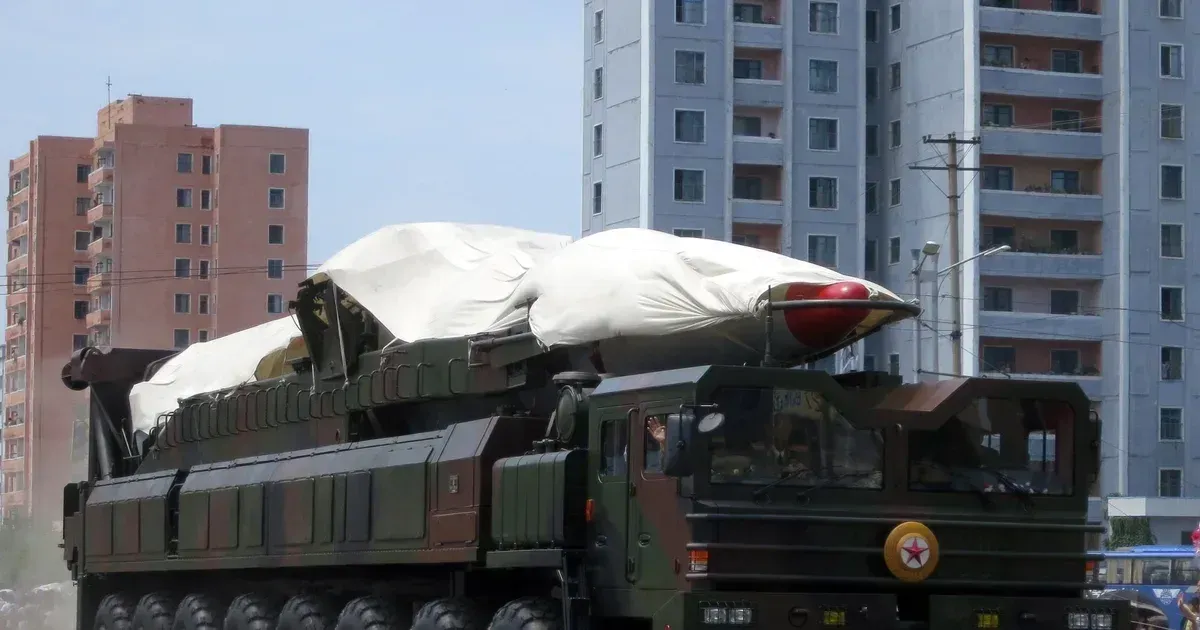
North Korea's missile salvo off the eastern coast renewed pressure on Seoul and Tokyo. North Korean military units fired several short-range ballistic missiles on April 19, 2026, from the coastal Sinpo region toward the East Sea. Intelligence reports from the South Korean Joint Chiefs of Staff confirmed the launches took place in the early morning hours, marking the seventh major weapons test conducted by the regime this year. Defense officials in Seoul monitored the flight paths as the projectiles traveled approximately 140 kilometers before splashing into the water. This rapid succession of launches has forced regional defense systems into high alert during a period of heightened cross-border friction. Initial data suggest the weapons were tactical ballistic missiles designed for rapid deployment and precision strikes against localized targets.
Military observers noted the specific choice of the Sinpo area for the launch site. Sinpo is a critical hub for the North Korean submarine program and is frequently a testing ground for naval-based weaponry. Short-range ballistic missiles launched from this vicinity provide Pyongyang with the ability to demonstrate force without exhausting its supply of intercontinental assets. Flight patterns indicated a low-altitude trajectory common with modern solid-fuel projectiles that are difficult for traditional radar systems to intercept. Every launch recorded on April 19, 2026, originated from mobile platforms rather than fixed silos.
Security in the Pacific remains a primary concern for the United States and its regional allies. These weapons tests often coincide with joint military exercises or diplomatic shifts in the region. North Korea has consistently used these displays to signal its refusal to dismantle its missile infrastructure. This particular event follows a pattern of escalating frequency in missile trials seen throughout the first quarter of 2026. Experts at the JCS are currently analyzing whether the missiles were a known variant or a new iteration of the KN-23 series.
Sinpo Launch Site and Coastal Security
Sinpo is the primary shipyard for North Korean naval development, housing the infrastructure necessary for both surface vessels and the Sinpo-class submarine. Deployment of ballistic missiles from this location indicates a high level of coordination between the ground forces and the naval command. Coastal batteries in the area are often integrated into broader defensive networks that protect the eastern flank of the country. Analysts believe the April 19 launches may have been intended to test the integration of new guidance systems in a maritime environment. South Korean naval vessels patrolled the exclusion zone shortly after the debris entered the East Sea.
Submarine-launched ballistic missile technology often undergoes land-based trials in Sinpo before moving to underwater platforms. While these specific missiles were ground-based, the location choice suggests a clear link to the naval modernization efforts led by Pyongyang. Military intelligence suggests that the 140-kilometer range specifically covers several strategic ports in the southern half of the peninsula. Japan's Ministry of Defense also tracked the projectiles, noting they landed outside of Japan's Exclusive Economic Zone. Radar stations in the Miyako Strait provided secondary confirmation of the terminal flight phase.
"North Korea fired multiple short-range ballistic missiles toward the East Sea," the JCS stated in a report to local media.
Detection happened almost instantly due to the deployment of new thermal imaging satellites. Rapid response units in South Korea moved to designated shelters as a standard precaution during the initial moments of the flight. Pyongyang has not yet released an official statement regarding the objectives of the test. Previous announcements from the Korean Central News Agency have justified such actions as necessary for self-defense. Military hardware displayed in recent parades matches the profiles of the missiles detected on April 19, 2026. Recent testing activities have heightened scrutiny of the Sinpo South Shipyard, which remains central to the regime's naval and missile development programs.
South Korea Joint Chiefs of Staff Tracking Data
Data recovered from the tracking stations show a flight duration of less than ten minutes. High-speed cameras and Aegis-equipped destroyers provided a multi-layered view of the ascent and descent phases. North Korea appears to be focusing on the maneuverability of its short-range inventory to bypass the Terminal High Altitude Area Defense systems. Technical experts from the JCS highlighted the importance of the 140-kilometer distance as a metric for battlefield readiness. Most short-range systems in the North Korean arsenal are now using solid propellants to reduce launch preparation time.
Solid-fuel technology allows for a much faster response than liquid-fuel variants, which require lengthy fueling processes in the field. South Korea has responded by accelerating the development of its own preemptive strike capabilities under the Kill Chain initiative. Intelligence sharing between Seoul, Tokyo, and Washington has reached record levels of efficiency to counter these frequent tests. Each of the seven tests in 2026 has shown a consistent improvement in the reliability of the missile engines. Tracking assets recorded no visible failures during the April 19 flight sequences.
Tactical advantages gained from these tests include refined targeting and improved resistance to electronic jamming. North Korea continues to iterate on its designs despite international sanctions targeting its aerospace and metallurgical sectors. Procurement networks in third-party countries enable the flow of critical components necessary for these high-tech weapons. Analysis of previous debris has revealed a mix of domestic engineering and imported electronic modules. The JCS continues to monitor the Sinpo shipyard for signs of further activity.
Regional Missile Proliferation and Defense Readiness
Geopolitical tensions in East Asia have intensified as North Korea ignores calls for a return to the negotiating table. Both the South Korean government and the U.S. State Department have condemned the April 19 launches as violations of United Nations Security Council resolutions. Sanctions regimes currently in place have done little to slow the pace of the weapons program. Pyongyang views its missile capability as a non-negotiable tool for regime survival and regional leverage. Seven tests within four months represent a substantial increase in operational tempo compared to the same period in 2025.
Nuclear-capable short-range missiles represent a specific threat to local military bases and civilian centers. Tactical nukes are a stated priority for the North Korean leadership, and these short-range tests serve as the delivery platform for such warheads. Defense readiness across the peninsula is being adjusted to handle the threat of simultaneous launches from multiple locations. Mobile launchers allow North Korea to hide its assets in the rugged mountainous terrain of the eastern provinces. Sinpo remains a focal point for these mobile deployments due to its existing military tunnels and bunkers.
Commercial satellite imagery from early April 2026 showed increased vehicle movement around the Sinpo launch facilities. Analysts at the JCS had been anticipating a test for several days prior to the event. Information gathered from the April 19 launches will be used to update interceptor algorithms in the Patriot and THAAD batteries. Future tests are expected to include longer-range systems as the summer training season approaches. Tracking data confirmed the missiles reached an apogee of 35 kilometers before descending.
Missile Salvo Tests Seoul Readiness
Containment of Pyongyang has failed, and the April 19 launches serve as the final evidence that the current international sanctions regime is functionally dead. While diplomats in New York and Washington issue repetitive condemnations, North Korea is successfully perfecting a tactical nuclear triad that will eventually render traditional missile defenses obsolete. The choice of Sinpo for these tests is a calculated move to demonstrate that North Korean naval power now extends beyond a coastal defense force. Relying on South Korea to maintain a balance of power is a strategy that ignores the reality of North Korean technological acceleration. These missiles are not mere provocations; they are calibrated instruments of regional hegemony.
History suggests that Pyongyang only pauses its testing cycles when it has achieved a specific technical milestone or when its internal logistics are overextended. With seven tests completed in just over 100 days, the regime is clearly in a high-intensity developmental phase that aims to overwhelm regional radar networks through saturation. The 140-kilometer range of the April 19 test is a specific threat to the port of Busan, the primary entry point for American reinforcements. Continued inaction by the global community will only embolden other actors to ignore proliferation treaties. Deterrence is crumbling in real time.
Strategic patience was a failed policy a decade ago, and its persistence in 2026 is an active security risk for the West. Pyongyang has effectively normalized its ballistic program. The West must prepare for a nuclear-armed North Korea that can no longer be ignored or sanctioned into submission.