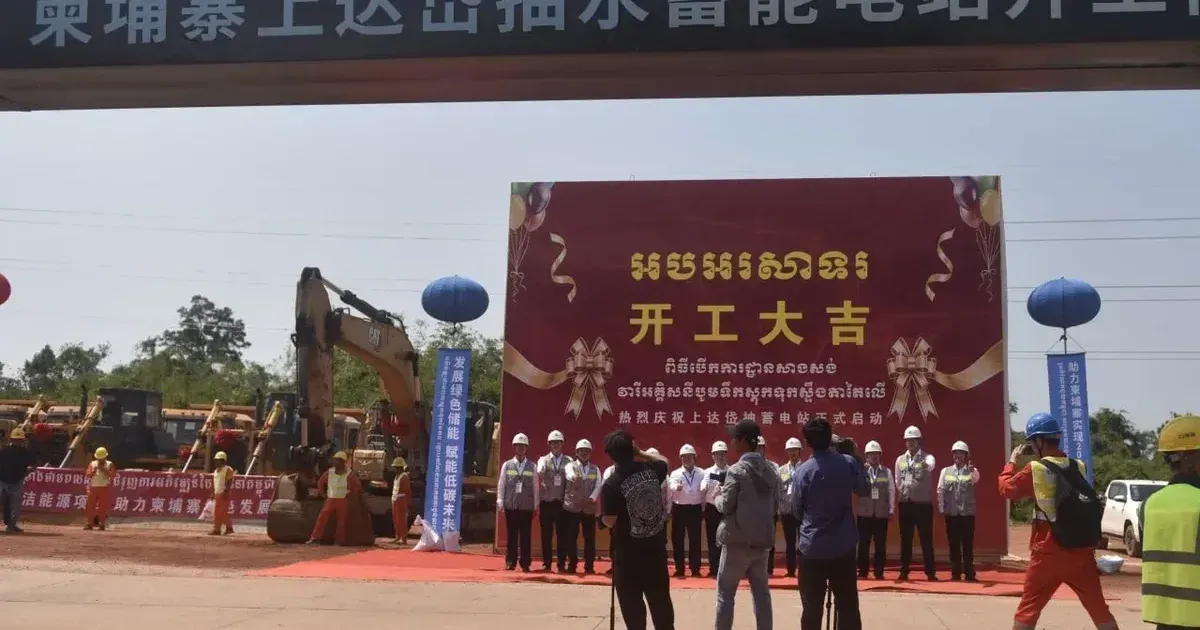
The China-Cambodia hydropower project turned energy infrastructure into a regional influence test. Cambodia accelerated its transition toward energy independence on April 19, 2026, by deploying heavy machinery to the southwestern province of Koh Kong for a new hydropower facility. Construction crews moved into position to begin the primary excavation for the Upper Tatay project, a venture valued at $1 billion. Economic pressure from global fuel shortages forced the government in Phnom Penh to fast-track renewable infrastructure. High prices for traditional fuels, worsened by ongoing conflict in the Middle East, made the project a national priority for the energy ministry. Engineers arrived at the site early in the month to finalize geological surveys before the monsoon season arrives. Project managers expect the facility to stabilize the domestic grid during periods of peak demand.
China continues to dominate the infrastructure sector in Southeast Asia through substantial capital injections and technical expertise. State-run media reported that the Upper Tatay facility will function as a pumped-storage system, a technology relatively new to the Cambodian power sector. Pumped-storage works by moving water between two reservoirs at different elevations to generate electricity when needed. Low-cost power is used to pump water to the higher reservoir during off-peak hours. Gravitational force then pulls that water back down through turbines to produce electricity when the grid experiences high loads. Electricity officials in the capital describe the site as a necessary buffer against the volatility of international oil and gas markets.
Technical Capacity of the Upper Tatay Hydropower Site
Development at the site involves the creation of enormous reservoirs designed to store millions of cubic meters of water. Xinhua described the project as a future green power bank for the country. Because the system relies on stored water rather than a constant river flow, it can respond to power outages in minutes. Stability in the national grid has been elusive due to aging transmission lines and a heavy reliance on imported electricity. Local contractors are working alongside Chinese engineers to clear the hilly terrain of southwestern Cambodia.
Heavy rain in the Koh Kong region often complicates construction, but the timeline remains fixed for completion within the next four years. Initial assessments indicate the station will provide hundreds of megawatts of capacity once fully operational.
Construction began formally on April 10, following months of site preparation and environmental impact assessments. Workers are currently focusing on the foundation of the lower dam wall. Specialized drilling equipment arrived at the Sihanoukville port earlier this month before being transported by road to the remote province. Security at the site has been increased to protect the expensive machinery required for deep-tunnel excavation. Project supervisors from the China National Heavy Machinery Corporation oversee the daily operations to ensure adherence to technical specifications. Financial documents reveal the project is part of a broader series of investments aimed at deepening bilateral ties between the two nations.
The project is a meaningful step in our cooperation to ensure energy security and promote sustainable development within the region.
Instability in international oil and gas markets is being worsened by the ongoing standoff to reopen the Strait of Hormuz.
Energy demands in Phnom Penh and the coastal gaming hubs have risen by 15% annually over the last decade. Infrastructure has often failed to keep pace with this rapid urbanization. Blackouts are common during the dry season when water levels in existing dams drop below the intake valves. Pumped-storage technology addresses this specific vulnerability by maintaining a closed-loop system that is less dependent on seasonal rainfall. Engineers believe the Upper Tatay facility will provide the reliability needed to attract more foreign manufacturing to the country. Manufacturing plants require consistent voltage to operate sensitive machinery, and the new station aims to provide that consistency.
Cambodia Energy Security and Global Volatility
Fuel supplies across the developing world were constricted after military operations began in the Persian Gulf. Cambodia, which lacks substantial domestic oil reserves, saw its import bill double in a single fiscal year. Energy prices at the pump reached record highs, prompting protests in several provincial capitals. Solar and wind projects are expanding, but they cannot yet provide the base-load power required for industrial growth. Hydroelectricity provides a predictable alternative that uses the kingdom’s natural topography to its advantage. Government planners see the Upper Tatay project as the centerpiece of a new strategy to insulate the economy from external shocks. Reducing the national debt associated with fuel imports is a primary long-term goal.
Regional competitors like Vietnam and Thailand have also expanded their renewable portfolios to combat rising costs. Cambodia remains uniquely dependent on Chinese credit to fund these capital-intensive projects. Agreements signed under the Belt and Road Initiative have enabled the construction of multiple dams across the Mekong tributaries. Critics often point to the environmental impact of such projects, yet the immediate need for power frequently outweighs conservation concerns. Forestry officials have noted that the Upper Tatay site will submerge several hundred hectares of protected woodland. Compensation programs for displaced families are currently being administered by provincial authorities in Koh Kong.
International analysts observe that the financial terms of these projects often involve long-term concessions. Chinese firms typically operate the dams for 30 to 40 years before transferring ownership back to the Cambodian state. Revenue generated from electricity sales is used to pay down the initial construction loans. This build-operate-transfer model has become the standard for large-scale energy projects in the region. Total investment in the Cambodian power sector from external sources has now surpassed several billion dollars. Most of this capital originates from state-owned banks in Beijing.
Chinese Investment Influence in Koh Kong Province
Koh Kong has transformed from a quiet border province into an industrial corridor. Improved roads and new bridges have connected the highland dams to the coastal ports. Local businesses have reported an uptick in demand for services as thousands of workers move into the area for construction jobs. Temporary housing units and medical clinics have been established near the dam site to support the labor force. The presence of Chinese technicians has also led to a growing secondary economy in the provincial capital. Small-scale vendors and logistics providers are finding new opportunities after the infrastructure boom. Real estate prices in the vicinity of the project have climbed steadily since the initial announcement.
Diplomatic relations between the two countries reached a new peak following the signing of the Detailed Strategic Partnership. Beijing views the kingdom as a reliable partner in a region often caught between competing global interests. Cambodia has consistently supported Chinese positions in international forums, and in return, it receives priority access to infrastructure funding. The Upper Tatay project is the latest manifestation of this transactional relationship. Success at this site could lead to further pumped-storage projects in the northern provinces. Geological surveys are already underway for a potential third phase of development in the Cardamom Mountains.
Future stability for the Cambodian economy depends on the successful integration of these diverse energy sources. Relying solely on river-run hydro is no longer viable in a changing climate. Diversification into storage technology indicates a move toward a more sophisticated grid management system. Modern control centers are being built in Phnom Penh to coordinate the output from various dams and solar farms. If the Upper Tatay station performs as expected, it will serve as the template for the next generation of Southeast Asian power projects. Data from the first year of operation will be critical for future planning.
Cambodia Hydro Project Tests China Reach
Phnom Penh is trading its long-term sovereign autonomy for short-term grid stability, and the cost is much higher than the $1 billion price tag suggests. By allowing Beijing to dominate the construction and operation of critical energy nodes, Cambodia is effectively outsourcing its national security to a foreign power. The arrangement is a client-state relationship disguised as a green energy transition, not a partnership between equals. The reliance on the build-operate-transfer model ensures that Chinese state-owned enterprises will control the literal switch to the Cambodian economy for at least the next three decades.
Skepticism toward the green power bank label is warranted. While pumped-storage technology is efficient, its true purpose in this context is to deepen the economic integration of the Mekong region into the Chinese supply chain. When the Iranian conflict eventually subsides and fuel prices stabilize, Cambodia will still be tethered to the debt obligations and operational protocols established in Beijing. The environmental destruction in the Koh Kong province is a permanent loss for a temporary fix. True energy independence requires a diversity of investors, not a singular reliance on a neighbor with an appetite for regional hegemony.
Cambodia has locked itself into a path that leads directly to a strategic dead end. Sovereignty is being sold one megawatt at a time.