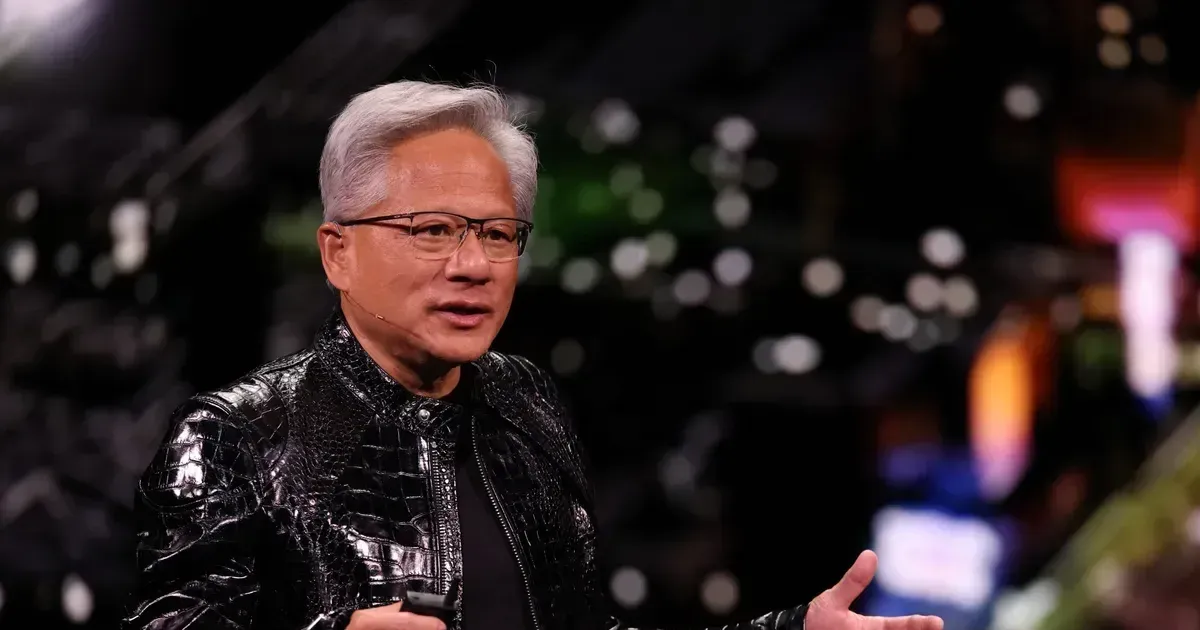
Nvidia is turning automakers into another front in its AI hardware strategy, moving its chips deeper into vehicles as data-center growth becomes only one part of the story. Jensen Huang stood before a packed audience at the GTC conference on March 16, 2026, to reveal a strategy that anchors his company’s future in the global automotive sector. Wearing his signature leather jacket, the chief executive detailed how the intersection of silicon and transportation will define the next decade of industrial output.
Automakers Become the Next AI Platform
Moving beyond the data centers that fueled the initial generative AI boom, the company is now embedding its Blackwell and Rubin architectures into the very fabric of global transit. Nvidia announced the release of the Groq 3 LPX, a specialized system designed to handle inference workloads with speeds 35 times faster than previous generations. This hardware represents the first major fruit of a $20 billion deal struck with chip startup Groq in late 2025. By licensing Groq technology and absorbing its top engineering talent, the Santa Clara giant has effectively neutralized a rising competitor while strengthening its defense against hyperscalers developing their own internal silicon.
Inference Is the Industrial Prize
Huang told the audience that the inflection point of inference has arrived. Data from internal projections suggests that demand for these advanced systems will reach $1 trillion by 2027. This is a massive escalation from previous estimates of $500 billion for the 2026 fiscal year. While competitors have attempted to chip away at the dominance of graphics processing units, or GPUs, the integration of specialized inference technology ensures that the company remains the primary architect of the AI economy.
Chip Power Meets Vehicle Data
Nvidia Groq 3 LPX and Inference Markets
Inference refers to the stage where an AI model makes decisions or predictions based on data it has already learned during training. While training requires massive clusters of GPUs, inference is often handled by more specialized, efficient chips. The Groq 3 LPX bridges this gap by pairing Groq specialized architecture with the Rubin platform. The automaker push also sits beside wider AI infrastructure debates, including the recent Seattle AI data center moratorium, because computing power is now a public-policy issue as well as a product strategy. Cars and factories generate data-heavy workloads that can use Nvidia hardware outside the traditional cloud market. Automotive timelines are long, safety rules are strict and revenue can lag far behind announcements.
Execution Risk Moves to the Road
Samsung is set to manufacture the new chips, with shipping expected to begin in the second half of 2026. The inflection point of inference has arrived, and our new systems will speed up these workloads by 35 times while maintaining the efficiency required for mobile and edge applications. By contrast, earlier iterations of AI hardware struggled to balance the raw power needed for complex reasoning with the energy constraints of modern data centers. The new system targets the specific bottleneck of latency. In fact, the ability to process tokens at nearly instantaneous speeds allows for more natural human-computer interactions in real-time environments.
Success in this area prevents the commoditization of the AI stack. Still, the manufacturing partnership with the South Korean electronics giant signifies a strategic hedge. Relying on multiple foundry partners ensures that the supply chain remains resilient against geopolitical fluctuations in the Taiwan Strait. To that end, diversifying production away from a single source allows the company to meet the trillion-dollar demand forecast without the delays that plagued previous product cycles.
Hyundai and BYD Join Nvidia Automotive System
Automotive expansion has become the primary pillar of growth outside of traditional enterprise AI.
Nvidia recently added Hyundai and BYD to its roster of self-driving technology partners, joining a list that already includes most European luxury manufacturers. These partnerships involve not just providing chips for infotainment systems. They center on the Drive Thor platform, which acts as the centralized brain for Level 4 autonomous driving capabilities.
Meanwhile, the inclusion of BYD is particularly significant given the Chinese automaker’s aggressive expansion into global markets. By providing the underlying compute for BYD’s fleet, the American chipmaker maintains a footprint in the world’s largest electric vehicle market despite ongoing trade restrictions. For instance, the software-defined vehicle architecture allows manufacturers to sell recurring subscriptions for autonomous features, creating a new revenue stream for both the car maker and the silicon provider.
The technology is not limited to passenger cars. Heavy trucking and logistics firms are testing the Rubin-based systems for long-haul routes where human fatigue remains a primary safety concern. In particular, the ability of the Groq-integrated chips to handle edge-case scenarios with low latency is the selling point for these safety-critical applications. These systems must process millions of data points per second from lidar, radar, and cameras to make life-or-death decisions on the highway.
Tesla Challenges Nvidia With Proprietary Chip Fab
Tesla remains the most vocal outlier in this consolidated system.
Elon Musk has pushed his company toward a massive foray into making its own AI chips, a move that analysts suggest could cost hundreds of billions of dollars. This strategy aims to reduce dependence on third-party silicon and improve hardware specifically for the Full Self-Driving, or FSD, software suite. But the financial burden of building and maintaining a leading-edge semiconductor fabrication plant is immense.
Critics of the Tesla plan point to the high failure rate of internal silicon projects at other tech giants. While firms like Google and Amazon have successfully built chips for their own servers, none have attempted to build a full-scale commercial fab of the magnitude Musk has proposed. Controlling the silicon means controlling the margin, a necessity as EV price wars continue to compress the profitability of the hardware itself.
Separately, the cost of research and development for such a project would likely require Tesla to divert funds from its core manufacturing operations. $100 billion is the baseline estimate for a modern fab capable of producing 3-nanometer or 2-nanometer chips. For one, the talent pool for semiconductor manufacturing is global and highly competitive, making it difficult for an automotive company to poach the necessary experts from established firms like TSMC or Intel.
Nvidia Is Turning Cars Into Compute Territory
Nvidia’s automotive push is not a side business. It is an attempt to make the vehicle another endpoint in the same AI hardware empire that already dominates the data center. If cars become rolling inference machines, the company does more than sell chips into a new market. It writes the technical grammar for how automakers monetize autonomy, safety and software subscriptions.
That is why the automaker deals matter more than another conference headline. The risk is execution, because vehicle cycles are slow, regulators are unforgiving and safety failures do not look like cloud outages. But the reward is enormous: a durable hardware position inside an industry that is desperate to become software-defined. Tesla wants to escape that dependency by building its own silicon fortress. Everyone else may decide it is cheaper to live inside Nvidia’s walls.