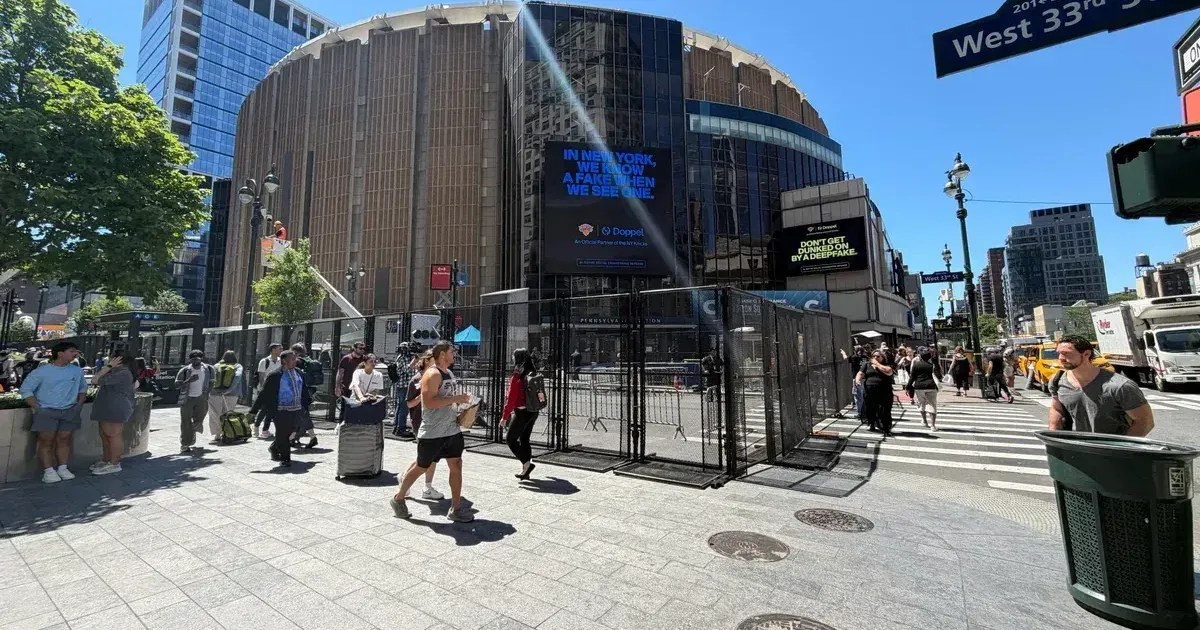
Madison Square Garden officials and federal agents prepared the arena for a high-intensity security overhaul. The plan reflects the unusual overlap of a Finals crowd, presidential security protocols and Midtown commuter traffic. The safety plan was announced on June 8, 2026, ahead of Game 3 of the NBA Finals. The joint operation involves coordination between the NYPD and the Secret Service to manage thousands of spectators entering the Midtown Manhattan district. Stricter protocols now govern arena entrances, screening lanes and the streets closest to the championship crowd.
Stretches of streets surrounding the world-famous arena are now completely off limits to unauthorized vehicles. Security personnel have established a specialized secure area that extends beyond the usual game-day barriers. Local residents and commuters must navigate heavy checkpoints and restricted sidewalks as federal agents monitor all movement near the venue. Access to the immediate perimeter requires specific credentials or valid game tickets that must be scanned at outer layers of the cordon.
Federal and Local Security Response
Agencies confirmed that the heightened measures are necessary to protect high-profile attendees and the sheer density of the crowds in the Penn Station area. Federal involvement usually suggests the presence of protected government officials or a National Special Security Event designation. Heavy metal barriers now line Seventh and Eighth Avenues, forcing pedestrians into narrow channels controlled by uniformed officers. The deployment includes K-9 units and specialized surveillance technology to monitor the surrounding blocks.
Commuters heading to Penn Station are already feeling the impact of these lockdowns. Transit officials suggest arriving at least one hour earlier than usual to clear the outer security layers. Bag checks have become more rigorous, and the use of portable X-ray machines has slowed the flow of foot traffic. Local businesses within the restricted zone are still operating, yet their delivery routes face meaningful delays due to the vehicle ban on 31st and 33rd Streets.
Corporate Philanthropy and Courtside Access
Winners of the highly publicized charity auction for celebrity-row courtside seats have been revealed by arena management. The giveaway raked in a total of $1 million to support youth programs across the city. Two firms, Gibson, Dunn & Crutcher and Veritas Capital, split the winning bid for the coveted seats. These tickets provide unmatched proximity to the action as the Knicks face the San Antonio Spurs in the high-stakes matchup.
Gibson, Dunn & Crutcher and Veritas Capital are now part of a small group of corporate entities willing to pay premium prices for Finals access. Proceeds from the auction are earmarked for New York City youth services, focusing on athletic and educational development. This donation reflects the intersection of high finance and professional sports during the team’s deepest playoff run in decades. The seats often host actors and musicians, but the corporate bidders chose this moment to fund public interest initiatives.
Younger New Yorkers under the age of 30 have expressed a specific form of relief during this championship pursuit. Previous decades were defined by sports-related suffering and disappointment for this demographic. Many fans in their twenties have never seen the team reach this stage of the competition. The current atmosphere around the Garden is a departure from the cynical outlook that often follows the franchise. Supporters are gathering in bars and public squares to celebrate a team that many feared would stay in a permanent state of rebuilding.
Knicks supporters are focusing on the emotional weight of the series. While older fans recall the physical battles of the 1990s, the younger generation sees this as a new period of basketball in the city. Public gatherings near the arena have grown so large that the NYPD has expanded the footprint of the fan zones. These zones allow those without tickets to participate in the energy of the Finals while staying within the protected police lines. The city remains on high alert until the final whistle of the series.
Penn Station Geography Complicates the Perimeter
Protecting a venue in the heart of the most densely populated borough creates logistical hurdles that federal agents must now address. Madison Square Garden sits atop a major transit hub, meaning any security failure could have cascading effects across the regional rail network. The presence of the Secret Service indicates that the threat assessment now extends beyond ordinary game-day crowd control. Federal planners must balance the need for visibility with the reality of an urban environment where thousands of people move through underground tunnels every minute.
Crowd control is a secondary risk that cannot be ignored. The mix of intense fan emotion and restrictive physical barriers often creates bottlenecks that lead to accidental injuries. If the series continues to a potential clinching game, the density of the crowds on Seventh Avenue will likely exceed the capacity of current security buffers. Law enforcement is still adjusting the perimeter daily based on intelligence and traffic patterns. Managing the sheer volume of unauthorized spectators who flock to the arena just to be near the atmosphere is the greatest challenge for the NYPD. Police also have to preserve normal emergency access around the arena district, because a security perimeter that blocks ambulances or fire response would create a different public-safety problem.