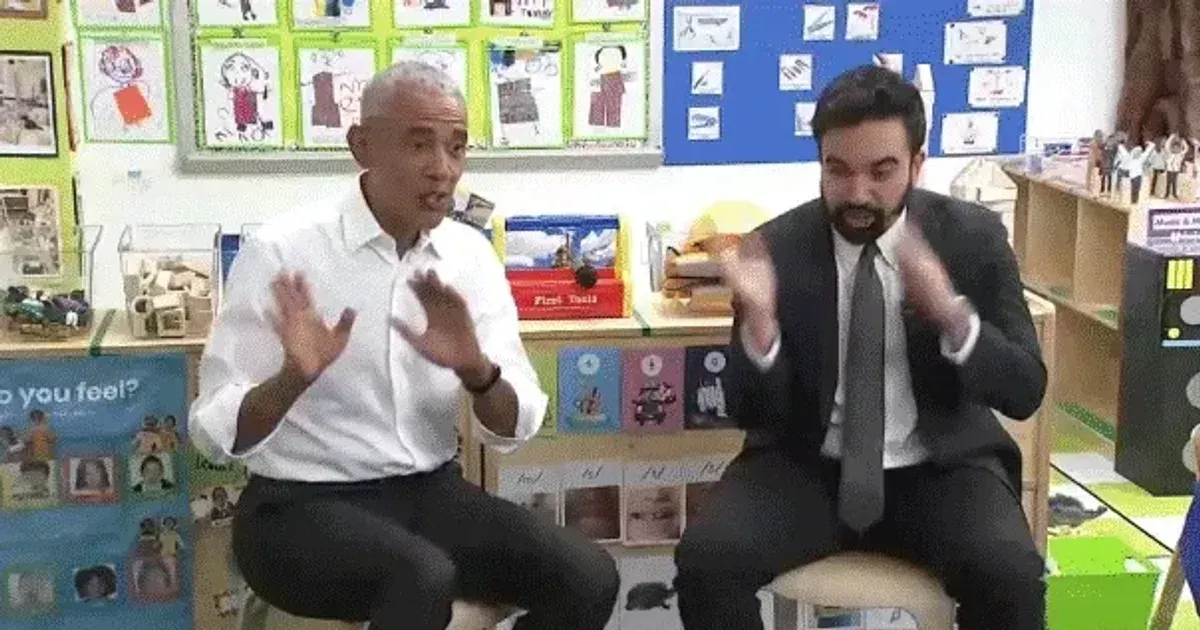
The development drew immediate attention from officials and the public. Leaders at the Learning Through Play Pre-K Center hosted the event, which was the first formal public meeting between the former president and the self-described socialist mayor. Videos captured the pair performing a rendition of the children’s song Wheels on the Bus while interacting with families from the surrounding neighborhood. Barack Obama and Mayor Zohran Mamdani sat inside a South Bronx classroom on April 19, 2026, to engage with local preschoolers and discuss municipal policy. Public records indicate this facility provides early childhood education to a community often overlooked by high-level political delegations. Staff members observed the two figures sharing books and laughing with the students during the Saturday morning session.
Mamdani took the opportunity to outline his legislative priorities for the city during a brief discussion with parents and educators. Barack Obama, who reportedly contacted the mayor-elect before his inauguration to offer guidance, acted as a veteran sounding board during the visit. Obama focused much of his attention on the children, reinforcing the idea that early childhood stability dictates future civic health. City Hall staff characterized the meeting as a chance to emphasize the importance of giving New York’s youngest residents a strong start.
Critics of the mayor noted that the appearance coincided with his 100th day in office, a timeframe traditionally used to measure executive momentum. The mayor’s office did not release a full transcript of the private policy discussions.
Bronx Childhood Development and Political Imagery
Learning Through Play Pre-K Center occupies a critical niche in the South Bronx, where educational outcomes often lag behind more affluent boroughs. Barack Obama arrived at the site under heavy security, marking a rare appearance in this specific sector of New York City. Mayor Zohran Mamdani used the platform to highlight the necessity of public investment in child care infrastructure. Children at the center received copies of books used during the reading session, a gesture intended to promote literacy among low-income households. Observations from the event suggest a deliberate attempt to humanize the mayor’s radical policy platform through traditional retail politics. The singing of nursery rhymes provided a stark contrast to the often-combative rhetoric found in City Council chambers.
Political observers noted the strategic nature of the venue choice. Barack Obama remains a powerful figure in Democratic circles, and his presence alongside Mamdani indicates a specific type of intra-party cooperation. Mamdani, who has frequently clashed with more moderate elements of the party, appeared comfortable in the presence of the 44th president. Parents expressed surprise at the high-profile visit, which was not publicized until the motorcade arrived. Teachers at the facility led the group in various educational games designed to foster social skills. The event concluded with a round of photographs involving the children and their families.
Policy Discussions and Government Grocery Initiatives
Mamdani used the gathering to reiterate his commitment to establishing five government-run grocery stores by the conclusion of his term in 2030. These proposed entities aim to combat food deserts in neighborhoods like the South Bronx, where access to fresh produce is limited. Barack Obama listened as the mayor explained the logistical hurdles of state-managed retail environments. Funding for these grocery stores remains a point of contention in the city budget. Mamdani argued that the current private-sector model fails to serve the nutritional needs of impoverished communities. Business leaders in Manhattan have voiced opposition to the plan, citing concerns about unfair competition and market distortion. The mayor maintains that his mandate includes direct intervention in the local economy.
“I am committed to creating five government-run grocery stores by the end of my first term on Jan. 1, 2030, to ensure every neighborhood has access to affordable food,” Mamdani said.
Logistical details for the grocery program involve complex supply-chain management and labor negotiations. Mamdani has proposed using city-owned land to house the initial storefronts. Potential locations in the Bronx and Brooklyn are currently under review by the Department of City Planning. Barack Obama did not publicly endorse the specific grocery store plan, though he praised the mayor’s focus on community well-being. Projections for the project suggest a multimillion-dollar initial investment. Economic analysts suggest that the success of the first store will determine the feasibility of the remaining four. Skepticism persists among fiscal conservatives regarding the long-term viability of municipal retail.
National Implications of the Socialist Mayoralty
Mamdani continues to define his administration through a socialist framework that challenges traditional Democratic governance. National political figures are watching the New York experiment closely to see if socialist policies can scale beyond local districts. Barack Obama has maintained a relationship with Mamdani since the mayoral campaign, suggesting an interest in the evolution of the party’s left wing. Internal polling from the mayor’s team suggests that voters are more interested in real results than ideological labels. Mamdani has aligned himself with Governor Kathy Hochul on certain issues, a move that surprised some of his more radical supporters. This alliance suggests a pragmatic streak that contradicts his outsider persona. Recent legislative victories for the mayor include expanded tenant protections and increased funding for public transit.
Opposition groups argue that the mayor’s focus on socialist ideals will eventually lead to capital flight. Wealthy residents have expressed concern over proposed tax hikes intended to fund Mamdani’s social programs. Barack Obama has not commented on the specific tax proposals currently moving through the state legislature. Historically, New York City mayors who drift too far from the center face serious challenges in re-election campaigns. Mamdani appears undeterred by these historical trends, focusing instead on his core constituency. The South Bronx visit served to reinforce his connection to the working-class families he claims to represent. National media coverage of the event highlighted the rare pairing of a centrist icon and a socialist leader.
Public Opinion and Mamdani’s Performance Metrics
Data from FOX 5 New York indicates that 48% of city residents approve of the mayor’s performance after 100 days. A meaningful portion of the electorate, roughly 23%, remains unsure about the direction of the administration. Disapproval sits at 30%, largely concentrated in the city’s more conservative enclaves. Despite the split in approval, 56% of residents believe the city is headed in the right direction under Mamdani. This figure is a major increase from October, when only 31% of respondents held a positive outlook. The shift suggests that the mayor’s early actions have connected with a broader segment of the population than initially expected. Younger voters and residents of color include the bulk of his supportive base.
Pollsters attribute the rise in optimism to the mayor’s visibility in struggling neighborhoods. Barack Obama’s visit likely provided a temporary boost to these numbers by lending an air of establishment legitimacy to the mayor’s office. Mamdani faces the challenge of maintaining this momentum as the city approaches the summer months. Public safety and housing costs continue to be the primary concerns for New York residents. Critics point to the 23% of undecided voters as evidence that the mayor’s long-term success is far from guaranteed. Success in implementing the government-run grocery stores could sway these undecided constituents. Failure to meet campaign promises could, by contrast, lead to a rapid decline in support. The mayor’s office continues to track these metrics closely.
Campaign Optics
Barack Obama’s decision to stand alongside Zohran Mamdani in the South Bronx is not a simple gesture of goodwill. It is a calculated move to bridge the widening chasm between the Democratic establishment and the surging socialist wing of the party. By engaging in the theater of nursery rhymes and classroom visits, Obama is essentially acting as a political heat shield. He provides the moderate cover necessary for Mamdani to pursue a radical economic agenda that includes the first-ever creation of state-run retail. This legitimization of socialism in the nation’s largest financial hub should alarm anyone who values market-driven stability.
The 44th president is more than a sounding board; he is an enabler of a shift that could permanently alter the American urban landscape.
Mamdani’s 48% approval rating is strikingly low for a honeymoon period, yet the 56% "right direction" metric suggests a public desperate for any change, no matter how disruptive. The disconnect reveals a city during an identity crisis, where residents are willing to tolerate socialist experimentation in exchange for the promise of basic services like affordable groceries. The mayor’s plan for government-run stores is a logistical nightmare waiting to happen. History shows that municipal governments are poorly equipped to manage the complexities of retail supply chains.
When the first store inevitably faces cost overruns or inventory shortages, the political fallout will be severe. Mamdani is betting his entire mayoralty on a command-economy model that has failed repeatedly in other contexts.
The alliance between the socialist mayor and the centrist former president is a marriage of convenience. Obama seeks to keep the youth vote within the party fold, while Mamdani needs the gravitas that only a global statesman can provide. The partnership will likely face its first true test when Mamdani’s tax-and-spend policies begin to impact the city’s credit rating. For now, the image of two leaders singing with children is a convenient distraction from the looming fiscal challenges. Whether this strategic partnership survives the realities of the New York budget process is a question of political survival. The Bronx classroom appearance put the optics of power ahead of the children.