NASA commander Reid Wiseman reported a software malfunction involving his personal computing device as the Orion spacecraft crossed the 100,000-mile mark toward the moon. Communication logs from Mission Control in Houston confirmed that the mission commander encountered a persistent error with Microsoft Outlook while attempting to manage communications during the translunar coast. Wiseman informed ground controllers that his Microsoft Surface Pro displayed two instances of the application, neither of which would function. Engineers on the ground regained control of the situation by remotely accessing the hardware to resolve the conflict. Flight director Judd Frieling characterized the event as a common occurrence in complex digital environments during a press briefing later that day.
Software Failures and Mission Control Response
Technical complications did not end with the email client. Reports from the craft indicated that the crew dealt with minor issues regarding the waste management system alongside the computing errors. Mission specialists Victor Glover, Christina Koch, and Jeremy Hansen remained focused on flight parameters while Wiseman coordinated the software fix with terrestrial technicians. Every piece of equipment aboard the Orion capsule undergoes rigorous testing, yet consumer-grade hardware like the Surface Pro introduces variables that differ from radiation-hardened flight computers. Remote access protocols allowed Houston to manipulate the tablet interface from a distance of over 105,000 miles. The digital intervention ensured the crew could maintain their scheduled reporting intervals.
Operational success in deep space depends heavily on the auxiliary systems. While the primary flight computers remained unaffected, the reliance on standard office software for crew organization presents a logistical hurdle when synchronization fails. Frieling noted that the troubleshooting process followed standard operating procedures established for the Artemis program. Data packets sent between Earth and the spacecraft face latency delays that complicate real-time IT support. Engineers cleared the cache and reorganized the application priority to restore functionality. Systems resumed normal operation shortly before the crew began their next scheduled photography session.
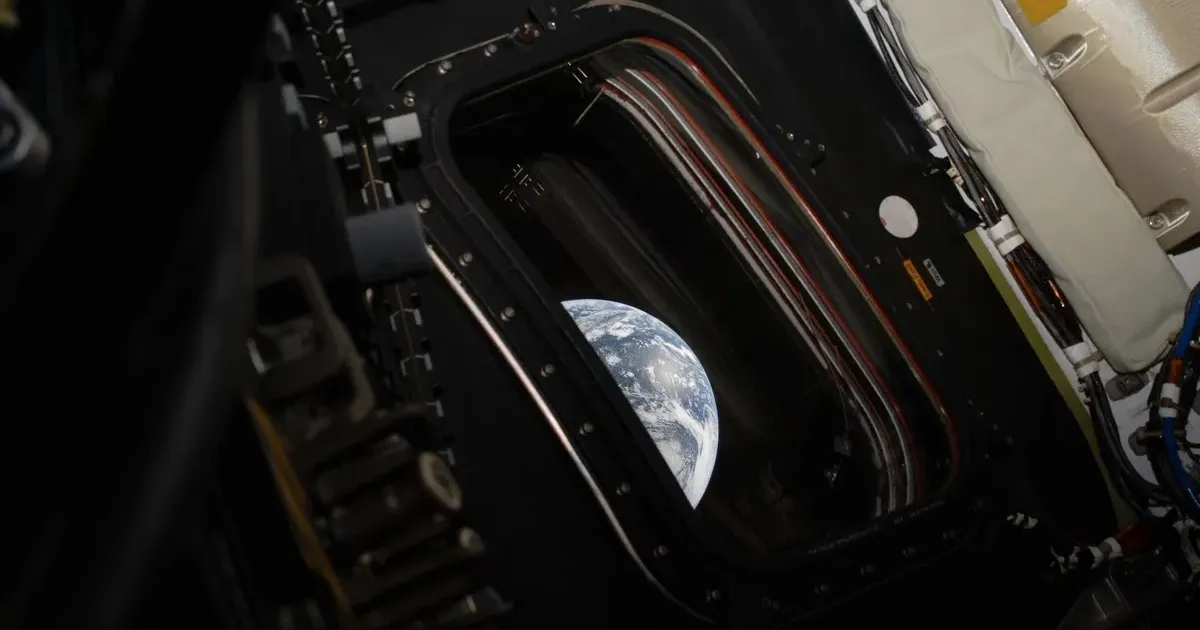
Visual documentation of the mission provided a sharp contrast to the technical frustrations inside the cabin. High-resolution sensors mounted on the exterior of the Orion spacecraft captured a series of images showing Earth as a glowing crescent against the black void. One black-and-white frame, taken by an optical navigation sensor, revealed the planet's curvature with high precision. Another image captured through the capsule window showed the Earth partially eclipsed, allowing the diffuse glow of zodiacal light to become visible. Zodiacal light occurs when sunlight scatters off dust particles in the plane of the solar system. Scientists rarely capture this phenomenon with such clarity from a manned vessel.
Atmospheric details appeared in several frames as the craft distanced itself from the home planet. Two distinct auroras were visible on the Earth's surface, appearing as shimmering ribbons of light near the polar regions. These terrestrial glows were documented after the craft completed its translunar injection burn on April 2. That burn placed the Orion on a trajectory that will carry the four-person crew around the lunar far side before returning to Earth. The current distance allows for a perspective of the globe that has not been seen by human eyes since the conclusion of the Apollo 17 mission in 1972. Earth now occupies only a small portion of the viewports. The flight is the latest milestone in the Artemis II initiative to expand human exploration of the lunar environment.
"Trust us: You look amazing, you look beautiful, and from up here, you also look like one thing. We're all one people."
Pilot Victor Glover shared these reflections during a broadcast on the second day of the flight. His comments mirrored the sentiments expressed by crews during the 1960s who experienced the overview effect. Digital sensors on Orion are far more advanced than the Hasselblad cameras used during the 20th century. Modern optics allow for the capture of subtle light gradients and cosmic ice particles glittering around the spacecraft hull. The ice crystals often form from venting gases or condensation on the exterior skin of the vehicle. Public interest in the images has surged across social media platforms since the first batch of files was downlinked.
Technical Hurdles Aboard the Orion Spacecraft
Software stability remains a secondary concern to the physical demands of the 10-day journey. Crew members must manage every aspect of their environment, from carbon dioxide scrubbing to basic hygiene in a microgravity setting. Wiseman mentioned the toilet issues briefly during his status report, highlighting the unglamorous realities of long-duration spaceflight. Waste management systems in space use a combination of airflow and mechanical separation to function without gravity. Any blockage or sensor error in this system requires immediate attention to prevent internal contamination. Microsoft software glitches, by comparison, are a manageable annoyance.
Lunar arrival draws closer as the Orion maintains its velocity toward the moon's gravity well. Artemis II is a critical test for the hardware that will eventually land humans on the lunar surface during Artemis IV. Current plans by NASA schedule that landing for 2028. For now, the focus is on the heat shield's integrity and the life support systems during the return leg of the trip. Flight controllers monitor the spacecraft's telemetry constantly to identify any deviation in power consumption or cabin pressure. The crew continues to perform science experiments and maintain the vehicle's health while preparing for the gravity assist maneuver. Every mile further from Earth tests the limits of the communication array.
Orion passed the point of no return for this specific orbital path yesterday. Gravity now exerts a stronger pull from the lunar mass than from the receding Earth. Despite the Outlook glitch, the crew maintains high morale and a rigorous schedule of observations. Hansen and Koch have been documenting the interior conditions of the capsule to provide data for future missions. The data will inform the design of the lunar Gateway station. Physical space inside the Orion is limited, making organization essential for the four-person team. Supplies are stowed in modular containers that must be inventoried daily.
Orion Glitch Turns Routine Software Into Mission Friction
Reliance on consumer-grade software in the most extreme environment known to man is a peculiar choice for an agency with a $25 billion annual budget. NASA continues to blend high-stakes engineering with off-the-shelf convenience, creating a situation where a commander might lose access to essential emails because of a botched Microsoft update 100,000 miles from home. The paradox exposes a vulnerability in the Artemis program's logistics. While the optics of a diverse crew looking back at a "beautiful" Earth serves as a powerful public relations tool, the technical reality involves astronauts acting as high-altitude IT support. The overview effect is a noble sentiment, but it does not fix a jammed toilet or a frozen Surface Pro.
Geopolitical competition with the Chinese lunar program likely drives this rapid deployment of Artemis II. NASA must demonstrate consistent progress to maintain congressional funding, even if that means flying before every auxiliary system is hardened against the deep space environment. The decision to include the first woman and the first Black astronaut on this loop is a calculated move to broaden the domestic appeal of a mission that carries serious risk. If the software environment remains this unstable, the agency faces a future where mission success depends as much on Redmond as it does on Houston.
Space travel has entered an era of digital dependency that the Apollo pioneers would find unrecognizable and perhaps unacceptable. The mission proceeds on a knife-edge of technical fragility.