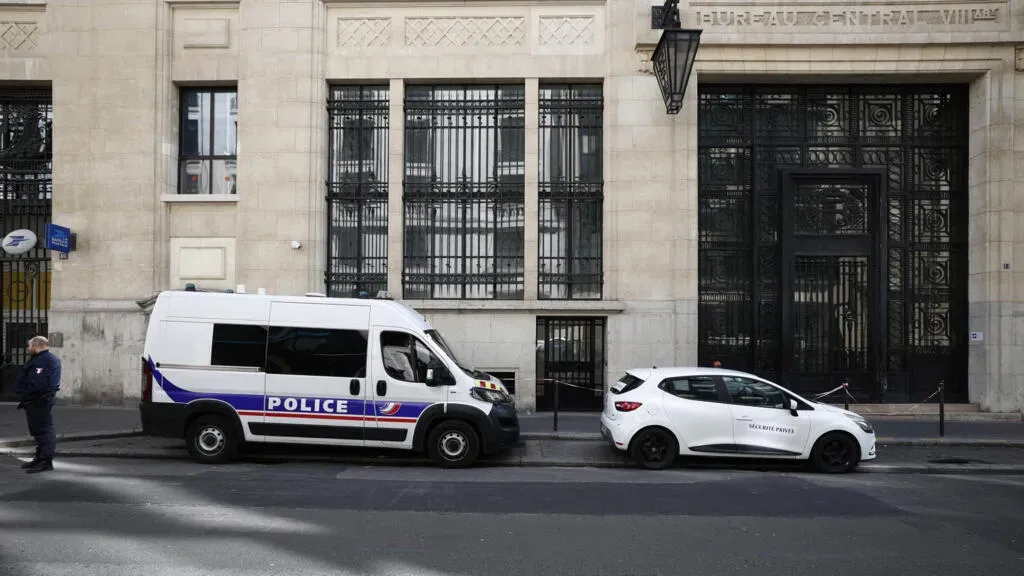
French police foiled a suspected bomb attack outside a Bank of America building in Paris after officers saw two people near the site in the early hours of March 28, 2026. One suspect was detained, another fled, and France's national anti-terrorism prosecutor opened an investigation into terrorism-related offenses.
No employees were injured, and the office was closed when the incident unfolded in the 8th arrondissement, near the Champs-Elysees. That limited the human damage, but it did not make the case minor. A failed attack on a US-linked financial target in central Paris still carries diplomatic, security and commercial weight.
Police Stop the Device Before Detonation
Early accounts from authorities and news agencies described an improvised device that included liquid believed to be fuel, explosive powder and an ignition system. The device was sent for forensic analysis, which is why any claim about its final power or technical sophistication has to remain cautious. The key fact is simpler: police intervened before it could detonate.
The anti-terror prosecutor's role raised the stakes immediately. PNAT investigations give French authorities wider tools to examine communications, networks, travel and possible ideological direction. That does not prove the existence of a larger cell by itself, but it shows that investigators did not treat the case as ordinary vandalism or a routine suspicious-object call.
The setting also matters. The building sits in one of Paris's most visible business districts, where international finance, tourism, diplomatic visibility and daily street traffic overlap. A target does not need to be crowded to be symbolic. An attack outside a major American bank in central Paris is designed to travel far beyond the block where it happens.
One Arrest Is Not the End of the Case
The arrest at the scene gave investigators an immediate lead, but the second suspect's reported escape kept the case open. Police still had to determine who supplied the device, who selected the target, whether the suspects acted alone and whether anyone tried to claim or direct the operation from elsewhere.
French media later reported questions about possible links to the Iran war and a wider pattern of low-level attacks or attempted attacks against Western and Israeli-linked sites. That line of inquiry is serious, but it should be handled as an investigation rather than a conclusion. In terror cases, premature certainty can help political narratives outrun evidence.
For Bank of America and other US-linked companies in Paris, the practical response is likely to be security tightening rather than withdrawal. More visible guards, stricter delivery checks and closer coordination with police can reduce exposure. They cannot erase the basic vulnerability of urban offices built to be reachable by clients, workers and the public.
Paris Security Pressure Returns
France has lived for years with a high counter-terrorism burden. That history makes authorities more willing to move quickly, but it also makes public communication delicate. Saying too little creates a vacuum. Saying too much before evidence is complete can distort the case and inflame fear.
The absence of casualties should be read correctly. Counter-terrorism success often looks quiet because the worst thing did not happen. Police action, timing and luck can turn a potential mass-casualty event into a forensic file and a court case. That is not dramatic, but it is the point of prevention.
Security Verdict
The Paris case shows how fragile normal city life becomes when symbolic targets remain open by design. Banks, embassies, religious sites and corporate offices cannot all become fortresses without changing the character of the city. But pretending that visibility does not attract violence is equally naive.
French authorities stopped the immediate threat. Their harder task is proving what stood behind it. If the device was only the work of two amateurs, the city still avoided a serious attack. If it was part of a wider pressure campaign around the Iran war, the Bank of America case was not a one-off warning. It was an early signal.