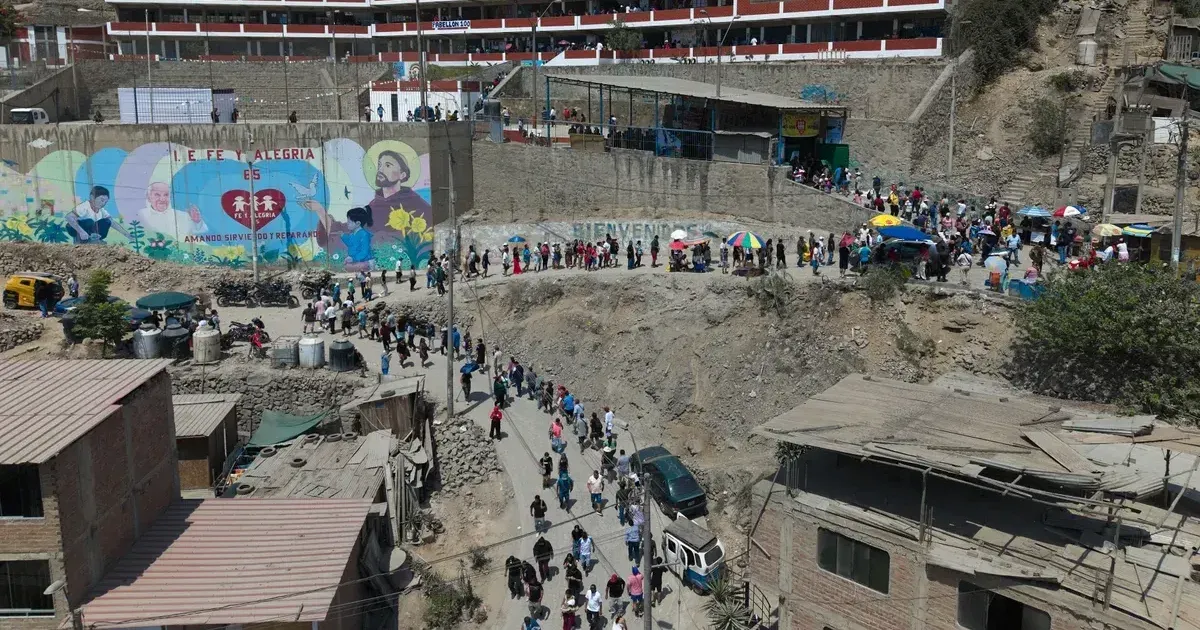
Peru's election count slowed after logistical failures left thousands of voters unable to cast ballots on schedule. Lima officials said that results would be delayed while affected polling stations completed an emergency voting extension. The breakdown raised immediate questions about ballot custody, rural access and confidence in the final tally. By April 13, 2026, Piero Corvetto, head of the National Office of Electoral Processes, stated that transport delays in the Andean highlands prevented dozens of trucks from reaching their destinations on schedule. These trucks carried essential kits including paper ballots, biometric scanners, and indelible ink for 600,000 potential voters. Because of these systemic failures, the electoral board authorized an emergency 24-hour extension to prevent mass disenfranchisement. Voting will continue through Monday morning in specific districts where the arrival of materials lagged by more than four hours. Logistical delays are common in the varied geography of Peru, but the scale of this disruption caught many observers off guard. Records indicate that the $45 million logistics contract was supposed to guarantee delivery to even the most remote corners of the Amazon basin. Still, local media reports from Cusco and Arequipa suggest that hundreds of volunteers never arrived to staff the tables. This staffing shortage compounded the lack of physical ballots, leaving many stations unable to legally open their doors to the public.
Ballot Shortages and Polling Delays
Voters in the San Martin de Porres district of Lima reported waiting since 6:00 a.m. on Sunday without seeing a single official. Angry crowds gathered outside school gates as the temperature rose, demanding their right to participate in the presidential selection. Similar scenes unfolded in the northern city of Trujillo, where ballot boxes arrived without the necessary security seals. Public frustration peaked when news broke that the National Jury of Elections was considering a total annulment in certain districts. That move was eventually discarded in favor of the time extension.
Logistics failed where democracy was supposed to thrive.
Election observers from the Organization of American States monitored the situation closely as tensions mounted near the Government Palace. Their preliminary reports highlight a lack of coordination between the central distribution hub and regional offices. While the urban centers of Lima usually see high efficiency, the peripheral shantytowns experienced a total breakdown of the system. Authorities scrambled to redirect supplies from surplus areas, but the traffic congestion in the capital made rapid redistribution impossible.
"The extension was not a choice but a necessity driven by the failure of the distribution network to reach the furthest provinces," said Jorge Luis Salas Arenas, president of the National Jury of Elections.
Legal challenges to the extension began almost immediately after the announcement. Opposition parties argued that allowing a second day of voting creates an opportunity for electoral fraud. They claimed that the overnight storage of already cast ballots in unsealed schools presents a serious security risk. Despite these objections, the National Jury of Elections maintained that the constitutional right to vote outweighs the procedural concerns regarding the timeline. Security forces have been deployed to guard the remaining ballots until the final count begins on Monday afternoon.
Election Authorities Extend Voting
Projections for the presidential race are currently on hold as the one-day extension shifts the data pool. Early exit polls suggested a neck-and-neck race between the top three candidates, making every missing vote potentially decisive. Historically, Peruvian elections are decided by fewer than 50,000 votes, a margin much smaller than the number of people affected by Sunday's delays. Candidates have urged their supporters to stay calm while the National Office of Electoral Processes works to rectify the errors. The biggest television networks have pulled their projection models until the rural tally arrives.
Personnel from the National Jury of Elections spent Sunday evening verifying the identities of those who were unable to vote. They used mobile registration units to ensure that only citizens who were present during the initial failure could return on Monday. Critics point out that this manual verification process is prone to error and may lead to further legal disputes once the winner is declared. The tallying process will only start once every single ballot box from the extended period is safely transported to the central processing facility in Lima.
Urban voters expressed deep skepticism about the sudden logistical collapse. Many compared the situation to the 2021 election, where claims of irregularities sparked weeks of protests and legal battles. To avoid a repeat of that instability, Piero Corvetto promised full transparency during the final counting phase. He invited international observers to sit inside the counting rooms as each digital record is uploaded to the central server. The first official bulletin is now expected late Monday night.
Mountainous terrain often dictates the pace of Peruvian democracy. In the Apurimac region, election materials must be carried by mules to reach villages situated at 4,000 meters above sea level. Heavy rains on Saturday night washed out several key roads, leaving the mule trains stranded. Instead of calling for air support, local coordinators attempted to find alternate land routes, which added ten hours to the journey. These geographic hurdles are a persistent challenge for the National Office of Electoral Processes every five years.
Economic markets in Lima responded to the uncertainty with a slight dip in the value of the sol. Investors typically prefer a quick resolution to presidential contests to avoid the policy vacuum that follows contested results. Financial analysts expect volatility to continue until a clear winner emerges or a runoff is officially confirmed. The central bank has not yet intervened, but the board is monitoring the situation as the delay stretches into its second day. Public schools and government offices remained closed on Monday to accommodate the extended voting schedule.
Districts with high concentrations of indigenous voters were among the hardest hit by the distribution failures. Leaders in these communities have long complained about being secondary priorities for the central government. They view the current logistical breakdown as a continuation of historical neglect. If these votes are not counted fairly, the resulting government may face immediate questions about its legitimacy in the southern provinces. The final delivery of ballots to the Puno region occurred just before midnight on Sunday.
Trust Risks Around the Count
Peru operates on a cycle of political self-immolation that would exhaust any other nation. Stability in the Andes has become a ghost chased by bureaucrats while the machinery of the state grinds to a halt. This recurring paralysis reveals a nation where the architecture of democracy is far too heavy for the crumbling foundation of its logistics. Peru does not suffer from a lack of will; it suffers from a lack of infrastructure that can withstand the weight of its own polarized ambitions. Every election becomes a stress test that the system inevitably fails, leaving a power vacuum that populist shadows are all too eager to fill.
Observers often mistake these delays for procedural caution, but they are actually symptoms of a deeper rot in the administrative capability of the National Office of Electoral Processes. If a state cannot guarantee the arrival of a paper ballot, it cannot guarantee the legitimacy of the winner. The National Jury of Elections might grant extensions, yet no amount of extra time can mend a broken supply chain or restore the faith of a skeptical public. Peru stands at the edge of a ledge, and the wind is picking up.