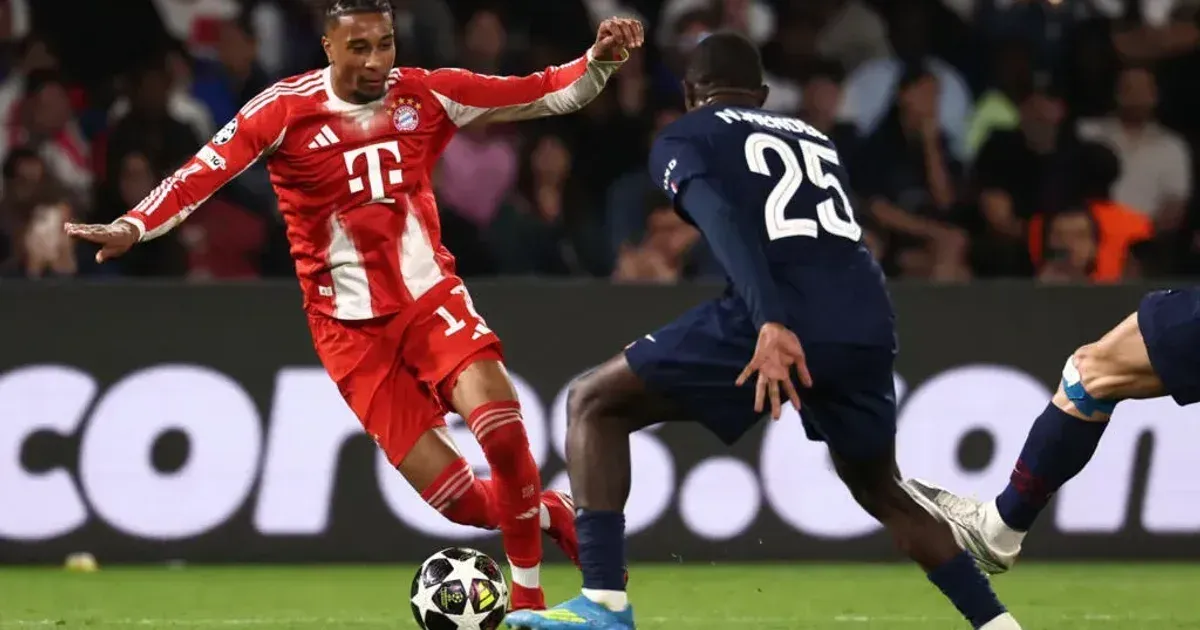
The semifinal became a scoreline story before it became a tactics story. Paris Saint-Germain held off a late Bayern Munich surge to win 5-4 in the first leg of their Champions League semi-final. The match at the Parc des Princes on April 28, 2026, became the highest-scoring semi-final in the competition’s history, with Khvicha Kvaratskhelia and Ousmane Dembele each scoring twice for the hosts. Bayern still left Paris with a narrow deficit after turning a 5-2 scoreline into a one-goal tie. The result also changed the way the tie will be remembered: not as a narrow European semifinal but as a match in which both defensive lines kept losing control of transition moments. Coaches on both sides now have to explain why so many clear chances appeared in a fixture that was expected to be managed more cautiously.
Early momentum moved back and forth quickly. Harry Kane gave Bayern the lead from the penalty spot before Kvaratskhelia equalized and Joao Neves headed PSG in front. Michael Olise made it 2-2, but Dembele converted a penalty before halftime to send the defending champions into the break ahead. By that point, neither back line looked comfortable defending space behind midfield.
PSG appeared to take control after the interval. Kvaratskhelia scored again from an Achraf Hakimi assist, and Dembele soon added another low finish to make it 5-2. Bayern refused to let the tie drift away. Dayot Upamecano headed in from a Joshua Kimmich free kick, and Luis Diaz added Bayern’s fourth after breaking through the Paris back line late in the match.
Scoring Record Falls in Paris
Nine total goals surpassed the previous scoring mark for a Champions League semi-final. Al Jazeera described the game as an extraordinary first leg, while France 24 highlighted the same nine-goal margin in its match report. PSG therefore travels to Germany with an aggregate lead, but the scoreline also showed how unstable the matchup can become when either side loses control of transitions.
Bayern’s response mattered because the away-goals rule no longer decides Champions League knockout ties. Four goals in Paris do not carry separate tiebreaker value, but they showed that Vincent Kompany’s side can repeatedly break through PSG’s defensive structure. That is the real warning for Luis Enrique before the return leg at the Allianz Arena.
The matchup also connects directly to recent knockout form. Bayern’s quarter-final win over Real Madrid had already shown its attacking ceiling, and PSG’s earlier Champions League win over Liverpool established the French side as a credible title defender. Tuesday’s scoreline put both trends in the same match and left the tie balanced between PSG’s finishing and Bayern’s pressure.
Bench Decisions Add Another Subplot
Yonhap News focused on the South Korean players who did not enter the game. Lee Kang-in remained on the PSG bench, while Bayern defender Kim Min-jae was also unused. Their absences should not be treated as the single explanation for the defensive problems, but the choice left both managers with selection questions before the second leg.
For PSG, the late collapse raised concerns about midfield control and defensive spacing once Bayern increased the tempo. The home side still produced enough attacking quality to win, but the final stretch showed how quickly the match could tilt when Paris stopped controlling second balls and transition lanes. Kvaratskhelia and Dembele supplied the decisive goals; the broader structure did not look secure.
Bayern can frame the defeat as recoverable. Kane and Diaz kept the German side within one goal, and Kompany’s players finished the match with enough pressure to make the return leg feel open. PSG avoided an equalizer, yet the margin is thin enough that one strong Bayern spell in Munich could change the tie.
PSG’s 5-4 Lead Is an Advantage Too Fragile to Defend Passively
A 5-4 win is both an advantage and a warning for PSG. Luis Enrique’s team travels to the Allianz Arena with the lead, but conceding four times at home leaves little room for a conservative second-leg plan. PSG will need a cleaner balance between its front-line speed and the defensive cover behind it, especially if Bayern again pushes fullbacks and midfield runners into advanced areas.
Bayern, meanwhile, proved that the tie is still alive without needing a complicated scenario. A clear home win would be enough to move ahead, and the first leg showed where PSG can be attacked. The second leg will likely turn on which side imposes more structure after a first meeting defined by finishing, open space and late pressure. For PSG, that means protecting the lead without abandoning the attacking rhythm that created it; for Bayern, it means turning late momentum into sustained control from the opening whistle in Munich.