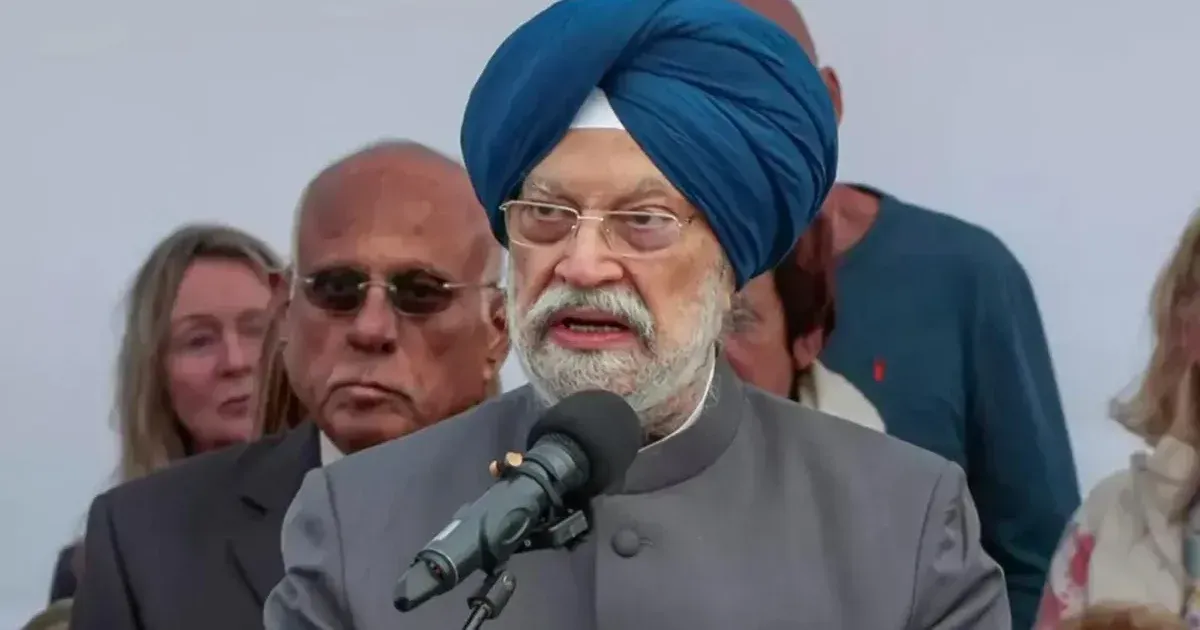
Hardeep Singh Puri arrived in Doha to protect India's long-term energy security after strikes damaged part of Qatar's gas infrastructure. The April 9, 2026, visit focused on contract continuity, emergency cargoes and repair timelines. The Indian petroleum minister entered talks as regional volatility threatened domestic fuel prices. The disruption has exposed how directly Gulf infrastructure risk can reach Indian households and industry.
Energy markets responded immediately to the infrastructure damage with a sharp increase in spot prices for liquefied natural gas. India depends on Qatar for nearly half of its total LNG imports, making any technical failure in Doha a direct threat to the Indian industrial sector. Negotiators from the Ministry of Petroleum are now racing to secure firm commitments that prioritize Indian shipments over competing European buyers. Failure to finalize these terms would leave Indian state-run utilities exposed to the volatile spot market where prices have already climbed by double digits since the first quarter.
Iranian Strikes Cripple Qatari Natural Gas Infrastructure
Military officials in the region confirmed that recent precision strikes hit the Ras Laffan industrial complex, which is the heart of Qatari gas production. Engineers on the ground are still assessing the duration of required repairs for the cooling units and storage tanks damaged in the exchange. Qatar maintains its position as a primary supplier to Asian markets, but the sudden reduction in output has forced the state-owned QatarEnergy to declare force majeure on several minor contracts. Indian officials are seeking exemptions from these declarations to ensure that the flow of gas to the subcontinent persists without interruption.
Doha remains the most cost-effective source for Indian energy due to the proximity of its ports and the maturity of the bilateral shipping lanes. Diversifying toward American or Australian gas involves far higher transport costs and longer transit times through contested waters. Qatar has signaled a willingness to prioritize long-term partners, yet the physical constraints of the damaged infrastructure limit the volume available for immediate export. Indian tankers have reported longer waiting times at the Port of Ras Laffan as loading schedules are reorganized to accommodate the reduced capacity.
Security in the Persian Gulf is the primary concern for the Indian delegation.
Indian Fuel Prices Surge During Global Supply Disruption
Domestic energy costs in New Delhi and Mumbai have already begun reflecting the global scarcity of natural gas. Industrial consumers in the fertilizer and power sectors are reporting increased operational costs that threaten to spill over into general inflation figures. Hardeep Singh Puri is tasked with securing a price cap or a fixed-rate mechanism in the new contracts to shield the Indian economy from these external shocks. While earlier agreements were pegged to crude oil prices, the current negotiations are exploring a hybrid pricing model that accounts for the regional security premium.
Inflationary pressure has forced the Indian government to reconsider its current subsidy structure for cooking gas and transport fuels. If the talks in Doha do not yield a favorable pricing structure, the fiscal deficit could widen as the state absorbs the cost of imported energy. Separately, private refiners are seeking clarity on the availability of Qatari condensate, which is a critical byproduct of gas extraction used in the production of high-value petrochemicals. Market analysts suggest that any prolonged shortfall in Qatari exports will force India to tap into its strategic petroleum reserves.
Hormuz Chokepoint Risks Persist Despite Recent Ceasefire
A fragile ceasefire between the United States and Iran has temporarily halted active missile exchanges, but the Strait of Hormuz is still a source of extreme anxiety for maritime insurers. Nearly 20 percent of the world's daily oil and gas consumption passes through this narrow waterway, which Iran has repeatedly threatened to close. Even with a pause in kinetic warfare, the presence of sea mines and the threat of ship seizures has driven insurance premiums to record levels. These additional costs are now being passed on to the Indian consumer at the pump.
Naval escorts from the Indian Navy have been deployed to protect tankers as they navigate the Gulf of Oman and the entrance to the Persian Gulf. Regardless of the ceasefire's longevity, the structural risk of relying on a single transit route for essential energy remains a strategic vulnerability for the Modi administration. Puri is expected to discuss the possibility of alternative pipeline routes or expanded storage facilities in Qatar that could be accessed during future maritime blockades. These long-term projects require large capital investment and years of diplomatic coordination between several regional powers.
Regional stability is not guaranteed by a piece of paper signed in a third-party capital.
Long-term contracts are the only viable defense against the volatility of the spot market in the current geopolitical climate. New Delhi is pushing for a 20-year extension on existing deals that were set to expire in the coming years. Qatar traditionally prefers long-duration agreements to justify the billions of dollars spent on expanding its North Field production capacity. The current negotiations focus on the exact volume commitments for the 2028-2048 period, with India asking for an increase in annual supply to meet its growing manufacturing needs.
Competition for Qatari gas has intensified as European nations attempt to replace Russian pipeline supplies with ship-borne LNG. Doha has leveraged this demand to seek better terms, but India's status as a stable, high-volume customer provides substantial bargaining power. Negotiators are now debating the flexibility of delivery points, which would allow India to divert shipments to different domestic terminals depending on regional demand. Finalizing these details is essential for the completion of the National Gas Grid project that aims to connect every major Indian city to a stable fuel source.
India Energy Security Risk
Can a nation truly claim energy sovereignty when its primary fuel source travels through the most volatile naval chokepoint on the planet? The visit of Hardeep Singh Puri to Doha is less an act of diplomatic routine and more a desperate attempt to patch a sinking hull. New Delhi has spent decades talking about energy diversification while doubling down on its reliance on the Persian Gulf. This dependency is an invitation for geopolitical blackmail from any regional actor capable of launching a drone or deploying a naval mine. Reliance on Qatari gas has transformed from a strategic asset into a glaring geopolitical liability for the Indian state.
The ceasefire between Washington and Tehran is a polite fiction that ignores the underlying reality of an arms race in the Gulf.
While 17 percent of Qatar's capacity is offline today, a coordinated strike could easily take 70 percent tomorrow. India needs to stop treating these visits as victory laps and start acknowledging the existential risk of its current energy portfolio. The conclusion is clear: without an immediate and aggressive pivot toward domestic renewables and nuclear power, India will remain a hostage to the whims of the Middle East. Security is not found in a contract signed in Doha, but in the independence of the domestic grid. The current policy is a gamble on regional peace that history rarely rewards.