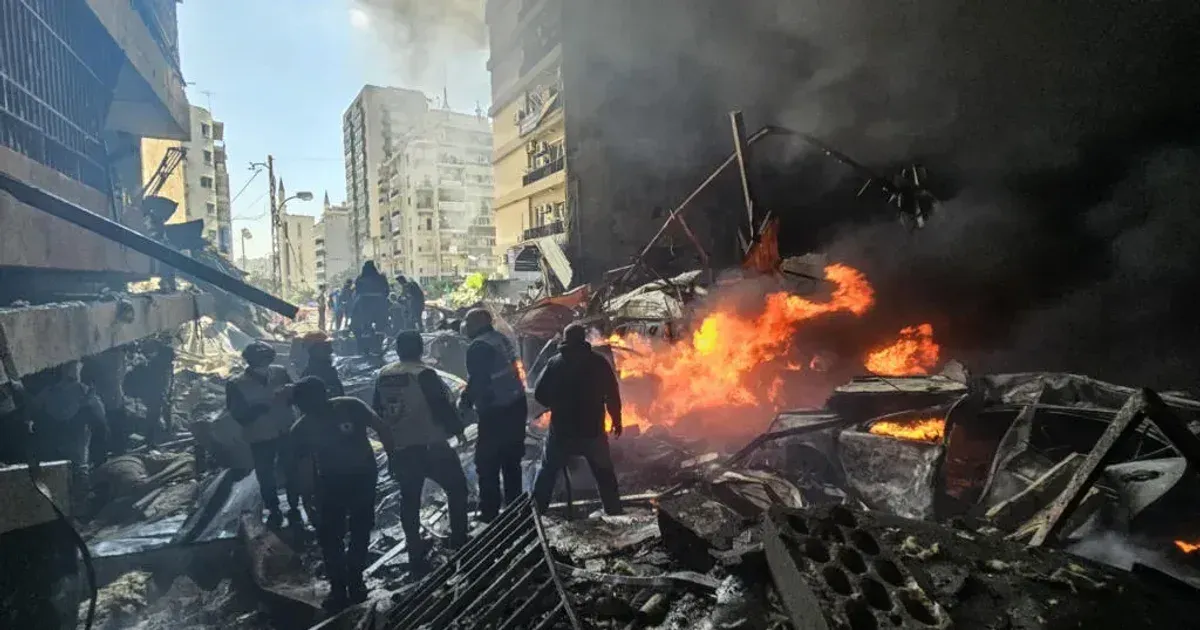
Vice President JD Vance prepared to lead high-stakes negotiations with Tehran even as the Iranian Revolutionary Guards warned of a return to active hostilities. Diplomatic efforts to preserve a fragile 14-day truce hit a major obstacle when Israeli fighter jets launched bombardments across southern Lebanon. The strikes quickly became a test of whether Washington could keep the truce separate from Israel's conflict with Hezbollah. The issue is no longer confined to one front. Any attack now carries diplomatic meaning beyond the target list. The April 9, 2026, warning showed how quickly a fragile pause could be pulled back toward regional war.
Iranian officials now claim the ceasefire is effectively void if Israeli operations against Hezbollah do not cease immediately. Reports from the region indicate that the bombardment targeted several command centers and logistics hubs. Tehran maintains that any escalation against its regional partners constitutes a direct violation of the spirit of the Washington agreement. Military commanders in Iran issued a series of statements through state media outlets to reinforce this position.
Records from the Lebanese Ministry of Health indicate that the latest sorties resulted in dozens of casualties in residential areas. Beirut residents described the sounds of low-flying jets and subsequent explosions that rocked the southern suburbs. Israeli officials stated the targets were legitimate military assets poised for an imminent strike against northern Galilee. The exchange of fire threatens to pull the United States back into a direct confrontation with Iranian proxies.
Lebanon Bombardment Strains Diplomatic Relations
Prime Minister Benjamin Netanyahu signaled that Israel would not be bound by a bilateral agreement between Washington and Tehran that ignores the northern border threat. Israeli intelligence services tracked the movement of precision-guided munitions into Lebanon during the first day of the truce. While the White House sought a cooling-off period, Israeli Defense Forces prioritized the neutralization of these threats before they could be deployed. This tactical decision created a friction point between the two closest allies.
Beirut remains a central theater for this proxy struggle despite the absence of its name in the formal ceasefire documents. French diplomats in the city attempted to mediate between the Lebanese government and Western powers to prevent a total collapse of the border security framework. Their efforts, however, struggled to gain traction because the underlying disputes over territorial sovereignty are still unresolved. Every missile strike further diminishes the possibility of a diplomatic de-escalation.
Tehran responded by placing its ballistic missile units on high alert across the western provinces. Foreign ministry spokespeople in Iran argued that the United States could not separate its support for Israel from the terms of the regional truce. Instead of a localized pause, the Iranian leadership demands a thorough halt to all Western-aligned military activity in the Levant. Failure to secure these terms would likely result in the resumption of drone launches against American installations in Iraq and Syria.
Iranian Revolutionary Guards Issue Direct Warning
Military leadership in Iran took the unusual step of issuing a specific ultimatum regarding the survival of their paramilitary allies. The Revolutionary Guards declared that their commitment to the ceasefire is contingent on the safety of the broader network often called the Axis of Resistance. They specifically cited the recent Israeli sorties as a provocation that demands a symmetrical reaction. This move indicates a shift from diplomatic posturing to active tactical preparation.
“Any attack on Hezbollah is an attack on Iran,” the Revolutionary Guards said.
Intelligence agencies in the West are now monitoring the movement of Iranian naval vessels in the Persian Gulf. These maneuvers often precede attempts to disrupt commercial shipping or target energy infrastructure. Satellite imagery shows increased activity at the Bandar Abbas naval base where fast-attack craft are being readied for deployment. Iranian commanders have used these assets in the past to exert pressure on global markets during periods of diplomatic stalemate.
Washington observers noted that the Iranian rhetoric has become much more aggressive since the strikes in Lebanon began. While JD Vance plans to arrive for the talks with a mandate for peace, his Iranian counterparts appear ready to use the Lebanon crisis as leverage for broader concessions. They seek the removal of several layers of economic sanctions that were not included in the original ceasefire framework. The price of stability in the Middle East appears to be rising by the hour.
White House Defense of the Exclusion Strategy
President Donald Trump clarified the administration's stance on Wednesday by confirming that Lebanon was never a signatory to the current U.S.-Iran agreement. He expressed confidence that the ongoing campaign against Hezbollah would not undermine the primary goal of preventing a direct war with Tehran. White House officials argue that the two conflicts are distinct entities that require separate diplomatic tracks. Tehran disagrees with this assessment and views the separation as a strategic trap.
French officials expressed concern that this exclusion creates a blind spot that could lead to a regional miscalculation. They argued that any truce ignoring the most volatile border in the world is inherently unsustainable. Despite these warnings, the U.S. State Department continues to push for a narrow focus on direct U.S.-Iran hostilities. The approach aims to reduce the risk to American personnel stationed in the region without limiting the tactical freedom of regional partners.
Resistance from the Iranian side has already slowed the progress of the preliminary talks scheduled for the weekend. Negotiators in Geneva reported that the Iranian delegation spent the initial session listing grievances related to the Lebanon strikes. They refused to move forward with the discussion on nuclear monitoring or maritime safety until the Israeli bombardment ceased. The momentum for peace generated earlier in the month is rapidly dissipating.
Escalation Risks for Regional Security
Analysts at the Pentagon are reviewing contingency plans in case the ceasefire collapses within the next 48 hours. They are particularly concerned about the potential for coordinated attacks against U.S. bases in eastern Syria. These facilities are vulnerable to short-range rocket fire and loitering munitions often supplied by the Revolutionary Guards. Security protocols at these sites were elevated to the highest level following the latest threats from Tehran.
JD Vance must now navigate a diplomatic minefield where every concession to Iran could be viewed as a betrayal of Israeli security interests. His task involves convincing the Iranian leadership that the Lebanon conflict is a local matter while ensuring that Israel does not expand its operations into a full-scale ground invasion. Margins for error are nearly non-existent. A single errant missile could trigger a chain reaction that the current agreement is not designed to contain.
Statesmen frequently confuse tactical exhaustion with strategic surrender. The Trump administration's attempt to bifurcate the Middle East into separate boxes, one for Iran and another for its proxies, is a maneuver of deep geopolitical arrogance. It ignores the fundamental reality that Hezbollah is not a separate entity but the primary muscular extension of the Iranian state. By excluding Lebanon from the ceasefire, Washington has created a loophole so large that an entire regional war can fit through it. It was not an oversight but a calculated attempt to have a truce while allowing a proxy to be dismantled, a gamble that is now failing spectacularly.
Tehran will never allow its most valuable regional asset to be neutralized while it sits idly by under the constraints of a U.S.-brokered peace. The Revolutionary Guards have made it clear that their survival is closely linked to the survival of the Resistance Axis. If the White House expects the Iranians to honor a ceasefire while their primary deterrent in the Levant is pounded into dust, they are dealing in fantasy. We are no longer looking at a fragile peace but a strategic pause that both sides are using to reload. The Vance mission is a diplomatic corpse before it even arrives. Prepare for the fire.