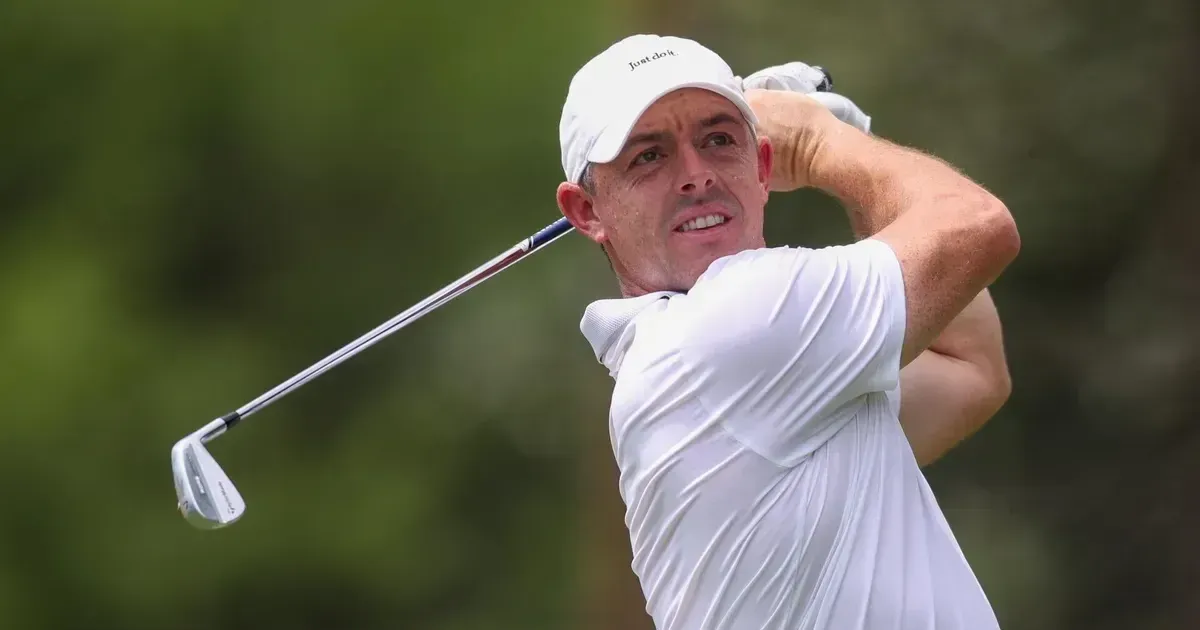
Rory McIlroy returned to Augusta National as both defending champion and historic career Grand Slam winner. That changes the emotional shape of his 2026 Masters week. McIlroy arrived on April 6, 2026, carrying the green jacket he won a year earlier. The conversation around him now blends legacy, course fit and betting-market expectations instead of the old question of whether he could finally finish the Grand Slam.
Rory McIlroy and the Grand Slam Legacy
Entering the 2026 tournament, Rory McIlroy faces the unique pressure of being the hunted rather than the hunter. Only ten men in the history of golf and tennis had achieved the career Grand Slam prior to the recent runs by McIlroy and Alcaraz. The list includes icons such as Ben Hogan, Gene Sarazen, and Rod Laver, men whose names are synonymous with the foundations of their sports. Novak Djokovic and Rafael Nadal maintained this standard for the modern era, but golf had not seen a new member in this club since 2000.
Winning all four majors requires a versatility that few players possess. A golfer must master the fast greens of Augusta, the punishing rough of the U.S. Open, the varying conditions of the PGA Championship, and the links style challenges of the Open Championship. McIlroy needed ten specific attempts to close out the slam after winning his third unique major. His victory solidified his standing among the greatest to ever play the game, yet his focus now shifts toward a successful title defense.
Scottie Scheffler Searches for Mechanical Consistency
Scottie Scheffler enters the 2026 Masters facing questions about his recent ball-striking and putting performance. While he remains a perennial favorite due to his high floor, a visible blip in his statistical profile has analysts concerned. His approach shots, usually his greatest weapon, have lacked the laser-like precision that defined his dominant 2024 run. Precise irons are a requirement for navigating the tiered greens at Augusta National.
Mechanical issues often lead to psychological hurdles in the heat of a major championship. Scheffler possesses the temperament to overcome these struggles, but the field has grown far deeper since his last victory here. Competitors no longer view him as invincible, a shift that changes the dynamics of the leaderboard on moving day. Putting continues to be the metric that determines his ceiling in any given week.
Augusta National bedeviled McIlroy for a decade and a half before he finally mastered it in 2025.
Title Defense Brings Different Pressure
Defending champions often struggle with the ceremonial obligations that accompany the green jacket. Media requirements and the Champions Dinner can disrupt the rigid routines established by top-tier professionals. Results from previous years indicate that back-to-back victories are among the rarest feats in golf history. Tiger Woods and Nick Faldo are among the few who successfully navigated the pressures of the year following their initial triumphs.
Small errors in reading or speed become magnified on these surfaces. Scheffler has spent the early part of the week working with his team on the practice range, attempting to rediscover the rhythm that made him the world number one. His ability to bounce back from this recent dip will define the narrative of the 2026 season. Redemption is found in the dirt of the practice tee.
Betting markets have soured on certain veterans as the opening round approaches. Tyrrell Hatton is facing meaningful skepticism from analysts who believe his volatile temperament is ill-suited for the current setup at Augusta. Brady Kannon, a respected golf expert at SportsLine, is actively fading Hatton in his best bets for the week. Experts suggest that the Englishman's game does not align with the specific demands of the course this year.
Investment models have shifted toward longshot parlays instead of betting on established but inconsistent names. One specific SportsLine simulation, run 10,000 times, identifies a potential return of $420,000 on a $10 wager. This model relies on a combination of specific props and underdog winners to generate such high multiples. High-risk strategies are becoming more popular as the predictability of the top ten finishers decreases.
A Champion Meets the Market
Professional golf is currently cannibalizing its own soul in favor of algorithmic betting slips and artificial cross-sport comparisons. The narrative surrounding Rory McIlroy is a prime example of this degradation. Instead of celebrating his 2025 victory as a singular achievement of skill and endurance, the media has packaged it as a commodity to be compared against Carlos Alcaraz's tennis record. These comparisons are intellectually lazy and serve only to create a false sense of convergence in a fragmented sporting landscape.
Market analysts are no better, pushing ridiculous $420,000 parlay pipe dreams to a public that should know better. The promotion of these high-risk longshots is predatory, masking the reality that the house always wins when the data is this volatile. We see a sport where the actual mechanics of the swing and the strategy of the course are being replaced by gambling props and manufactured drama. Scottie Scheffler's so-called blip is likely nothing more than the natural variance of a difficult game, yet it is treated like a terminal decline by those desperate for a new betting angle.