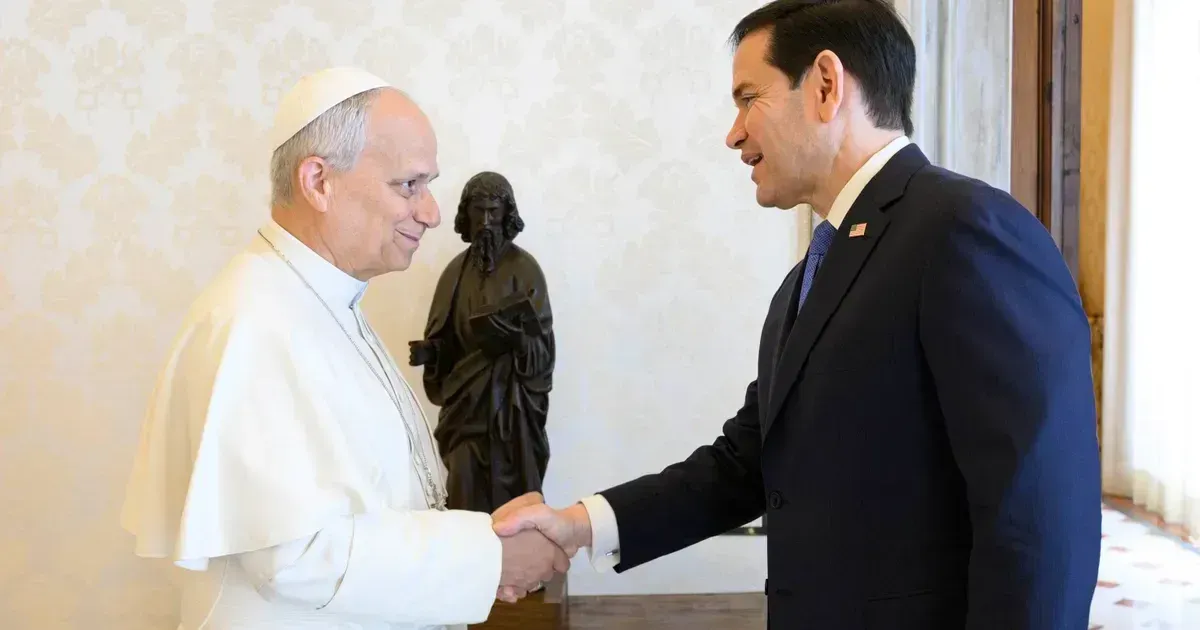
Rubio's Vatican meeting puts US diplomacy inside a sensitive religious and political setting. Pope Leo XIV is still defining his public role, while Trump's comments have already created strain. The visit therefore carries symbolic weight beyond the formal agenda. Catholic leaders will also watch whether the meeting separates policy disagreement from personal friction. On May 7, 2026, the Vatican meeting became a test of tone as much as diplomacy. Secretary of State Marco Rubio met Pope Leo XIV at the Vatican on May 7 in a fence-mending visit complicated by President Donald Trump's criticism of the Chicago-born pontiff. The audience put one of Washington's most prominent Catholic officials in the middle of a dispute over the U.S.-Israeli war in Iran and the Vatican's public calls for peace.
The visit was already sensitive before Rubio arrived. It followed weeks in which the Vatican and Washington were speaking past each other, with church officials emphasizing humanitarian restraint and Trump emphasizing the need to maintain pressure on Iran. Trump had accused Leo of endangering Catholics with his criticism of the war, while the Holy See has maintained that its position is rooted in concern over civilian suffering and the moral limits of military force. That public clash gave the meeting a sharper edge than a routine diplomatic call. It also raised the cost of any misunderstanding, because Vatican statements can shape opinion among Catholic leaders in Europe, Latin America and the United States. It also created a credibility test for Rubio, who had to show Vatican officials that formal U.S. diplomacy could still operate even when presidential rhetoric was moving in the opposite direction.
Rubio's task was to keep practical channels open. AP reported that the agenda included the Iran war as well as Cuba and other Western Hemisphere issues, where the Vatican has long maintained influence through bishops, aid networks and quiet diplomacy.
Iran War Shapes the Vatican Meeting
Iran was the immediate backdrop. Tehran is reviewing a U.S. proposal to end the war, and Trump has publicly argued that a deal could come quickly. The Vatican, by contrast, has pressed for an end to fighting without adopting Washington's military framing of the conflict.
That difference matters because the pope's criticism carries global weight beyond Catholic voters in the United States. The Holy See has diplomatic relationships across the region and can influence how bishops, charities and Catholic political figures describe the war. A public Vatican rebuke can complicate allied diplomacy, especially when Washington is trying to present its Iran policy as both strategically necessary and morally defensible.
AP reported that Trump accused Pope Leo of endangering Catholics through his stance on the Iran war.
Rubio gives the administration a different messenger. He can defend U.S. policy while recognizing the religious vocabulary of the Holy See, a balance that is harder for Trump after days of direct attacks. The question is whether that personal diplomacy can reduce friction or merely manage it. In either case, the meeting offered a channel that is less volatile than public exchanges between Trump and the pope.
Cuba and Regional Diplomacy Also on Agenda
The Vatican meeting was not limited to Iran. Rubio said Cuba and the Western Hemisphere would also be part of the conversation, a natural subject given the Catholic Church's role in Latin American civil society and past mediation efforts.
For Washington, Vatican engagement can help in places where U.S. leverage is politically sensitive. Church networks often have access to local communities, political prisoners and humanitarian channels that formal diplomats cannot easily reach. That makes the Holy See useful even when it disagrees sharply with U.S. policy elsewhere. Cuba is a clear example because church leaders can speak to families, dissidents and officials in ways that U.S. diplomats often cannot without triggering nationalist backlash.
The challenge is that cooperation on Cuba or migration does not erase disagreement over Iran. The Vatican can work with the United States on regional humanitarian issues while still rejecting the moral case for an expanding war. Rubio's meeting therefore required compartmentalization rather than full alignment. The United States can ask for help on prisoner, migration or aid issues while accepting that the pope will continue to criticize the moral logic of the Iran campaign.
Rubio Can Lower the Temperature but Not Erase the Iran Dispute
Pope Leo's identity as the first American-born pontiff adds another layer to the dispute. His criticism of U.S. policy is harder for the White House to dismiss as distant European commentary, yet his office requires him to speak as head of a global church rather than as an American political figure.
The meeting gave both sides a chance to lower the temperature without forcing either to retreat publicly. Rubio needed to reassure Vatican officials that U.S. diplomacy is still functioning despite Trump's attacks. The pope needed to show that moral objections to the war do not close the door to official dialogue. For both sides, preserving the relationship may matter more than producing a public agreement after one meeting. That alone would give diplomats room to keep working quietly afterward.
The result is unlikely to be a dramatic reset. Vatican diplomacy usually moves through patient channels, and a single audience cannot undo weeks of public sparring. The real test will be whether Trump continues attacking Leo while the administration is trying to use Vatican channels on Iran, Cuba and humanitarian issues. If the rhetoric continues, Rubio's audience may be remembered less as a repair job than as evidence of how difficult U.S.-Vatican diplomacy has become.